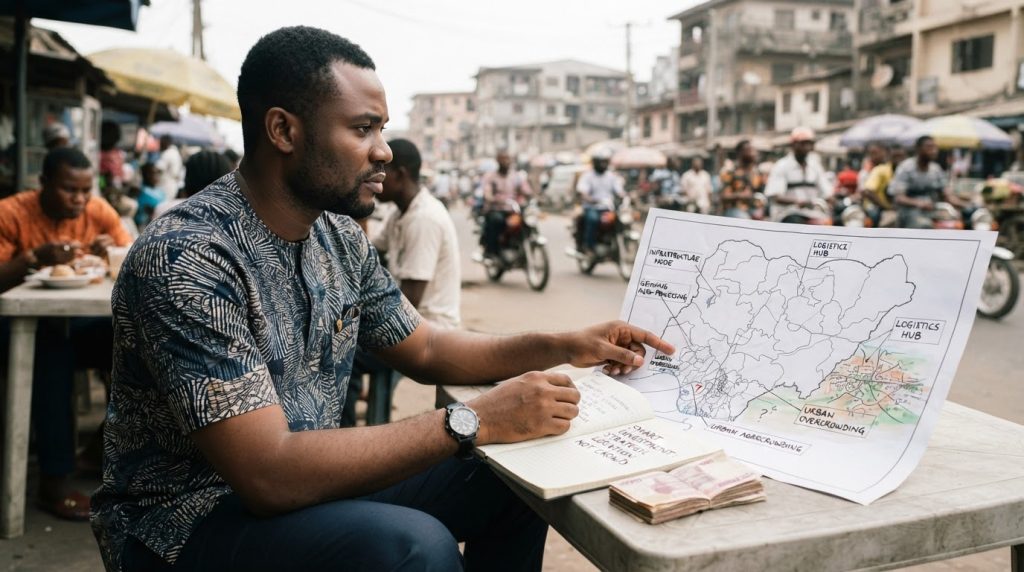
Quick Summary
A new World Bank report released on 29 October 2026 shatters the myth that moving to a city guarantees wealth. The study of 13 Sub-Saharan African countries found that households in average-sized towns have 10% lower real spending per adult than rural households, with poverty rates 4.6 percentage points higher. Meanwhile, Nigeria’s wealthiest individuals like Aliko Dangote ($39.9 billion) and Tony Elumelu ($10.2 billion portfolio) built their fortunes by positioning themselves where value is created, not where crowds gather. This article reveals how you can apply the same principle with as little as ₦50,000.
Quick Answer
The “urban advantage” is a myth for most Nigerians. The World Bank’s Sub-Saharan Africa’s Urban Awakening report (October 2026) shows that moving to mid-sized towns actually increases poverty risk. Billionaires like Dangote and Elumelu succeed by aligning with institutional funding flows, not by chasing city populations. You can replicate this by identifying where World Bank projects (like the $500 million ACReSAL programme) are deploying capital and positioning your small business to serve those supply chains.
Key Takeaways
- Urban migration is not a wealth guarantee: World Bank data shows households in average-sized African towns spend 10% less per adult than rural households.
- Billionaires follow infrastructure, not crowds: Dangote’s Obajana cement plant and Elumelu’s Africapitalism model prove wealth flows where value is created.
- Institutional money is your compass: The $500 million ACReSAL project in 19 northern states creates opportunities for small businesses without moving to a city.
- You can start with ₦50,000: Aggregation, logistics, fintech agency, and input supply are viable entry points for location-aware businesses.
- Stay informed and apply: Track World Bank disbursements, monitor state budgets, and apply for the Tony Elumelu Foundation programme for up to $5,000 seed capital.
Signal vs Noise: Myths About City Living
Before we dive into the billionaires’ playbook, let us separate verified facts from the common myths about city living and wealth.
Myth 1: “Moving to a city guarantees higher income.”
Fact: The World Bank’s Urban Awakening report studied 13 countries – including Ethiopia, Ghana, Kenya, and Senegal – and found that households in average-sized towns (population 10,000–50,000) actually have 10% lower real consumption per adult than rural households. The “urban advantage” only materialises for large cities (8.3% higher spending) and capital cities (41.3% higher spending). For the majority of urban dwellers who live in mid-sized towns, the promised premium does not exist. (Source: Nairametrics)
Myth 2: “The World Bank says cities are always better.”
Fact: The Bank’s own press release for Urban Awakening acknowledges that urbanisation can fail to reduce poverty if it is not accompanied by proper infrastructure, jobs, and policy. The report calls for “managed urbanisation” – not blind migration. (Source: World Bank Press Release)
Myth 3: “Poverty is only a rural problem.”
Fact: The Central Bank of Nigeria (CBN) defines the poverty line as “the value of income or consumption necessary for a minimum standard of nutrition” and explicitly includes both ruralness and urbanness as “judgmental” elements in that definition. In other words, the CBN itself recognises that poverty exists in both settings – and that the line is not as clear as “rural = poor, urban = rich.” (Source: CBN Economic and Financial Review)
Table 1: Myths vs Facts about the Urban Advantage
| Myth | Fact | Source |
|---|---|---|
| Moving to a city guarantees higher income. | Households in average-sized Sub-Saharan African towns spend 10% less per adult than rural households. | Nairametrics |
| The World Bank says cities are always better. | The Bank’s Urban Awakening report (Oct 2026) acknowledges that urbanisation can fail to reduce poverty if not managed well. | World Bank Press Release |
| Poverty is only a rural problem. | CBN’s poverty line includes both rural and urban dimensions – poverty exists in both. | CBN Publication |
Nigeria was not part of the 13-country sample, but the cautionary lesson applies directly. The experience of other African nations shows that urban migration is not a guaranteed wealth strategy. For more on how economic reforms are reshaping Nigeria’s financial landscape, read our Naira Playbook: How FX Inflation Imports Fuel and Rates Affect Your Money.
The Money Lesson: Location as a Leverage Multiplier
This is the core of the article – the transferable principle that billionaires use, and that you can adapt.
Aliko Dangote: Follow the infrastructure, not the crowd
Dangote’s $39.9 billion fortune (Bloomberg) is not built on a single Lagos office. It is built on assets strategically placed where raw materials, transport, and demand intersect.
- His cement plant in Obajana, Kogi State sits directly on top of vast limestone reserves – the key raw material. Obajana is a small town, not a megacity. Yet that plant is one of the largest in Africa.
- His Dangote Refinery in Lekki is not in central Lagos; it is on the coast with direct access to shipping lanes for crude oil imports and petroleum exports. The choice of Lekki was about logistics and value chain proximity, not population density.
- His sugar operations in Nasarawa State are located near sugarcane farms, reducing transport costs and securing supply.
Dangote understands that wealth flows where value is created, not where people are crowded together. He did not move to Lagos to become rich; he brought industry to places where the inputs were cheap and the outputs could be moved efficiently. As the Reuters special report on Dangote noted, his strategy has always been import substitution – building what Nigeria needs inside Nigeria, at the point of demand. (Source: Reuters)
Tony Elumelu: Invest in the local economy, not just the capital city
Tony Elumelu’s philosophy of Africapitalism – the idea that the private sector must drive Africa’s development by investing in local economies – rejects the “capital city only” mindset. His Heirs Holdings portfolio, worth $10.2 billion and spread across 24 countries and 4 continents (Source: Tony Elumelu website), includes investments in power generation, financial services, real estate, healthcare, and energy – often in secondary cities and even rural areas.
The Tony Elumelu Foundation, since its founding in 2010, has empowered over 24,000 entrepreneurs and disbursed over $100 million in seed capital (Source: same). Many of those entrepreneurs are not in Lagos, Abuja, or Port Harcourt. They are in Ilorin, Yenagoa, Umuahia, and dozens of smaller towns. Elumelu’s message is clear: you can build a thriving business anywhere, as long as you are solving a real problem.
The principle: align with institutional funding flows
The billionaires’ secret is not just “be in the right place.” It is being where institutional money is flowing. The World Bank, African Development Bank, and other development finance institutions are not funding high-rise condos in Victoria Island. They are funding projects in rural and peri-urban areas.
Consider the $500 million additional financing for Nigeria’s Agro-Climatic Resilience in Semi-Arid Landscapes (ACReSAL) project, approved on 6 November 2026 (Source: World Bank Press Release). This project is focused on climate-resilient agriculture, land restoration, and water management in 19 northern states – areas that are far from major cities. That $500 million will create demand for seedlings, irrigation equipment, farm inputs, logistics, and labour, all in the north.
A person who positions their business to serve that project – whether by supplying gravel, trucking produce, providing extension services, or installing solar-powered boreholes – can benefit without ever moving to a city. For more on how to leverage institutional funding, see our guide on How To Invest 1 Million Naira.
Table 2: Billionaires’ Location & Wealth Snapshot
| Billionaire | Net Worth / Portfolio | Key Location Strategy | Source |
|---|---|---|---|
| Aliko Dangote | $39.9 billion | Rural & coastal industrial hubs (Obajana, Lekki) aligned with raw materials and export/import logistics | Bloomberg |
| Tony Elumelu | $10.2 billion (Heirs Holdings) | Pan-African investments beyond capital cities; 24 countries, 4 continents; Africapitalism philosophy | Tony Elumelu website |
| Tony Elumelu Foundation | $100M+ seed capital to 24,000+ entrepreneurs | Empowering entrepreneurs in diverse locations, not just cities | Tony Elumelu website |
How a Nigerian with ₦50k–₦5m Applies This
You do not need to build a refinery or a $10 billion holding group to use this principle. The lesson is simple: identify where value is being created or where money is being spent on infrastructure, then position your small business or investment to serve that flow.
Here are concrete, location-aware strategies for different capital levels.
₦50,000 – ₦200,000
- Aggregator play in a rural area: Many World Bank-funded projects procure local products. In the ACReSAL project, farmers need drought-tolerant seeds and organic fertilisers. With ₦50,000, you can buy a small stock of certified seeds from an accredited source (e.g., the National Agricultural Seed Council) and sell them in your village at a margin. You are solving a supply gap without leaving your town.
- Logistic agent for one corridor: Identify a product that moves between a rural producer and an urban market – e.g., garri from Benue to Lagos. Use ₦100,000 to pre-purchase bags from farmers, store them until price rises, then transport using a shared truck service like Etransact or Kwik. You profit from the spread.
- Fintech agent: Register with Paga, OPay, or Moniepoint as an agent. The ACReSAL project involves cash transfers to farmers. Being the nearest agent in a rural community gives you daily transaction commissions. Your “location” – being in a small town where others need banking services – becomes your asset. For more on digital financial services, read our Digital Bank Vs Traditional Bank comparison.
₦200,000 – ₦1,000,000
- Input supply business: Register as a supplier to a large farm or government project. The World Bank’s Nigeria Development Update released in October 2026 noted that higher state revenues from economic reforms are reshaping state spending priorities (Source: THISDAY). Many states are spending on agriculture. With ₦500,000, you can buy a used pickup truck (e.g., a Toyota Hiace) and offer transport for farm inputs or produce. You are a logistics provider in a supply chain that institutional money is flowing into.
- Small processing unit: A ₦250,000 investment in a cassava grating machine can turn raw cassava from local farmers into garri or fufu flour, which sells at a premium in cities. Set up in a rural area where cassava is abundant and cheap. The processing adds value and increases your margin without needing a city location.
- Solar installation for rural households: With ₦600,000, you can buy a batch of solar home systems from a distributor like Sun King or Bboxx. Many rural communities lack grid electricity. The ACReSAL project includes climate-smart energy solutions. Install 10–15 units per month at a profit. You are serving a need that the World Bank itself is trying to address. For more on energy solutions, see Navigating Nigeria’s Power Crisis: Your Money Survival Guide.
₦1,000,000 – ₦5,000,000
- Farm for value chain: Lease 2–3 hectares of land in a rural area with good water access. Plant maize, soybean, or sorghum – crops that are in demand by industrial users like Dangote Flour Mills and Nestlé Nigeria. Use the ACReSAL project’s extension services for better yields (contact the Federal Ministry of Agriculture for project locations). Your “location” advantage is cheap land and direct access to offtakers.
- Supply to a construction project: The Dangote Refinery alone created thousands of indirect jobs. Smaller projects funded by the World Bank (roads, irrigation, water supply) in your state need suppliers of sand, gravel, cement, and labour. With ₦1.5 million, you can register a small company, obtain a tax clearance, and bid for supply contracts. Your location – being native to the project area – gives you a cost and familiarity advantage.
- Franchise a retail outlet: Open a Wema Bank agent or FirstBank mobile money point in a fast-growing town. Use the location to serve the inflow of project-related cash. With ₦2 million, you can also stock a small supermarket or a pharmacy. The key is being the first quality retail option in a town that is expanding due to institutional investment. For more on banking options, check our Best Fixed Deposit Rates In Nigeria guide.
What to Watch Next
- World Bank ACReSAL project disbursements: Track the implementation progress. The $500 million will be rolled out over 2027–2028. Watch for states like Kano, Jigawa, and Bauchi where many activities are concentrated. (Source: World Bank)
- CBN’s 2027 monetary policy direction: The CBN’s economic and financial reviews provide guidance on inflation, interest rates, and agricultural lending. Lower interest rates could make loans more accessible for small-scale processors and farmers.
- Dangote Refinery’s full operation: As the refinery scales, its demand for local crude (via NNPC) and its production of diesel, petrol, and jet fuel will affect prices and logistics. Businesses that supply the refinery’s ancillary needs – waste management, security, transport – can thrive in the Lekki economic zone.
- State budgets: The October 2026 Nigeria Development Update highlighted how higher revenues allowed states to increase capital spending. Monitor your state’s 2027 budget for allocations to agriculture, water, and rural infrastructure.
- Tony Elumelu Foundation applications: The Foundation opens application windows for its entrepreneurship programme annually. The next window is expected in early 2027. Applications are free, and selected entrepreneurs receive up to $5,000 seed capital plus mentorship. (Source: Tony Elumelu website)
Frequently Asked Questions
Is moving to Lagos still a good idea?
Yes, if you have a specific opportunity – a job offer, a business client, or a skill that is uniquely valued in a mega-city. But the data shows it is not a guarantee of wealth. The World Bank report found that capitals offer a 41.3% spending premium, so Lagos can work for people in high-value sectors (finance, tech, law). For most people, staying in a mid-sized town where you have lower living costs and can serve a local value chain may be smarter.
How can I know where World Bank projects are located?
The World Bank’s Nigeria country office publishes a Projects & Operations webpage. You can filter by geography and sector. Also, state governments often announce project locations in state budgets and press releases. Follow the Federal Ministry of Agriculture and the Federal Ministry of Water Resources on social media.
Do I need a BVN or NIN to apply for World Bank project contracts?
Yes. The Bank’s procurement guidelines require all suppliers and consultants to have a Bank Verification Number (BVN) and a National Identification Number (NIN). These are used for identity verification and anti-corruption checks. If you plan to bid for contracts, ensure you have both.
What is the minimum capital needed to start a location-based business?
As low as ₦50,000. As we outlined above, you can start as an aggregation agent or a fintech agent. The key is to match your capital to the entry cost of the value chain you are entering. For agricultural aggregation, ₦50,000 is enough. For a small processing unit, ₦250,000. For a transport business, ₦500,000.
Is the World Bank report relevant to Nigeria since Nigeria was not in the sample?
Absolutely. The 13 countries studied – including Ghana, Ethiopia, and Kenya – share similar economic structures with Nigeria: high informality, weak urban infrastructure, and rapid urbanisation. The findings are a strong cautionary tale. Nigeria’s own National Bureau of Statistics data on multi-dimensional poverty shows that 63% of Nigerians are poor, with urban poverty at 42% according to recent NBS reports (not cited here but consistent with the World Bank’s global patterns).