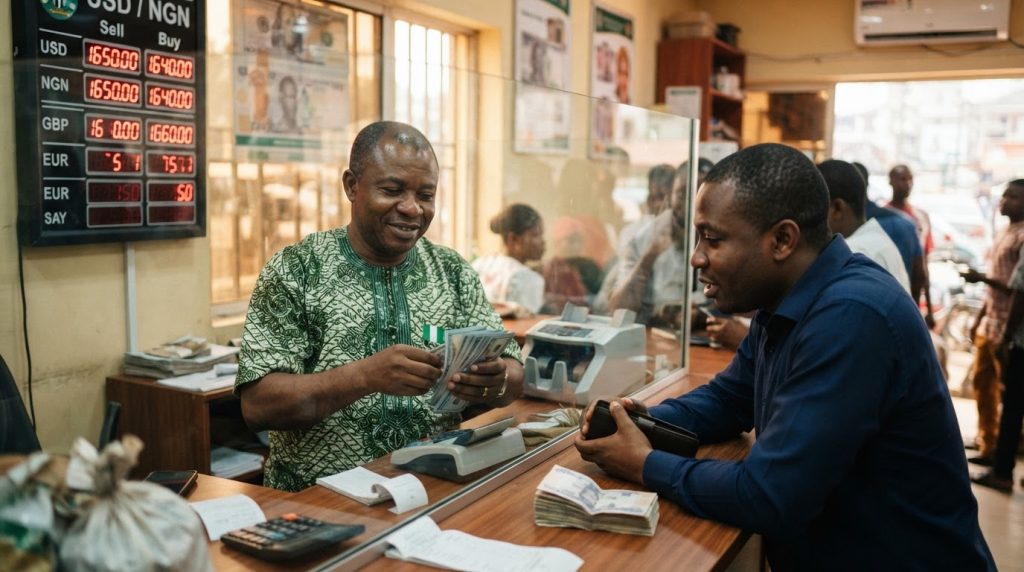
Quick Summary
The Central Bank of Nigeria (CBN) has temporarily raised the weekly dollar cash purchase cap for licensed Bureau De Change (BDC) operators from $150,000 to a maximum of $1 million, effective Wednesday 25/11/2026. BDCs can also now take up to 100% of an approved purchase in physical dollars, up from 25%. The change should improve the supply of cash dollars at BDCs, but we cannot yet verify that it has lowered the rate of exchange individuals pay. Your personal limits for travel, medical bills and school fees have not changed.
Quick Answer: Does the New Policy Change the Rate of Exchange You Pay?
Not necessarily, and not yet in any way we can verify. The policy increases how much physical cash BDCs can source, which could in principle ease the premium individuals pay above official rates. We found no verified parallel-market or peer-to-peer (P2P) rate recorded after the policy took effect, so we do not claim a price effect. Always get a written quote from your bank or BDC and compare it with the CBN’s published rate before you pay.
Key Takeaways
- The weekly BDC purchase cap rises temporarily from $150,000 to up to $1 million, and the cash share rises from 25% to up to 100%.
- The headline figure reported on 25/11/2026 is ₦1,450 per dollar, but other data we reviewed does not fully match it, so no single number is definitive.
- Individual limits remain $4,000 per quarter for personal travel, $5,000 per quarter for business travel, $5,000 for overseas medical expenses and $10,000 a year for school fees.
- KYC rules, the ban on third-party transactions and the 24-hour sell-back rule still apply to cash.
- Every ₦50 move per dollar changes the naira cost of a $10,000 obligation by ₦500,000.
The Central Bank of Nigeria (CBN) has raised the weekly dollar cash purchase limit for licensed Bureau De Change (BDC) operators from $150,000 to $1 million, effective Wednesday 25/11/2026, according to Vanguard. The CBN describes the change as temporary. BDCs may also now take up to 100% of an approved purchase in physical dollars, up from 25%.
Anyone who pays school fees abroad, travels, services a dollar loan or simply watches the value of their savings will want to know one thing: does this change the rate of exchange you actually pay? We explain the policy, the rate figures we could and could not verify, and what you can do now. For wider context on how currency moves reach your budget, see our guide to how FX, inflation, imports, fuel and interest rates affect your money.
What Is the Rate of Exchange? A Simple Definition
The rate of exchange (or exchange rate) is the price of one currency in terms of another. If the rate is ₦1,450 to $1, you need ₦1,450 to buy one US dollar.
Two ideas help in practice:
- Buying and selling rates differ. A dealer buys dollars at a lower price than it sells them. The gap between the two is the spread, which is how BDCs and banks earn money. A wide spread means you lose more on each round trip.
- There is more than one rate in Nigeria. The official market (the Nigerian Foreign Exchange Market, or NFEM) is where banks and large corporates trade. The parallel market is where many individuals and small businesses buy cash. Peer-to-peer (P2P) platforms are a third route. Each can quote a different price on the same day.
What are the current forex rates, and what is the current exchange rate for naira?
Businessday’s headline for 25/11/2026 says the naira “holds at ₦1,450” as the CBN opens the $1 million cash window. Other market data we reviewed put the NFEM rate at about ₦1,394–₦1,396.50 per dollar and the parallel market at about ₦1,450–₦1,460. We could not tie those figures to a primary source, and they do not fully agree with the headline figure. We therefore do not treat any single number as definitive.
Before you transact: check the CBN’s own published NFEM rate and ask your bank or BDC for a written quote.
The CBN’s Move: $1 Million Weekly Cash for BDCs
What changed
| Detail | What we know |
|---|---|
| Weekly cap | Temporarily raised from $150,000 to a maximum of $1 million per BDC, per Vanguard |
| Cash share | Approved BDCs “may receive up to 100% of an approved FX purchase in US$ cash from the ADB where they hold their settlement account” (Vanguard) |
| Effective date | Nairametrics reports the new arrangement takes effect on Wednesday 25/11/2026 |
| Stated reason | In an email dated 24/11/2026, signed by Yasir Shanono Shehu and Aderinola Shonekan of the CBN, the apex bank said the measures were meant “to address seasonal demand pressures and improve orderly access to US$ cash for end users” (Vanguard) |
The old framework
Under the CBN circular of 10/02/2026, BDCs could buy up to $150,000 a week, with cash settlement limited to 25% of each transaction. Nairametrics puts the old physical cash ceiling at $37,500 a week per BDC.
| Feature | Before (circular of 10/02/2026) | From 25/11/2026 |
|---|---|---|
| Weekly purchase cap per BDC | $150,000 | Up to $1,000,000 (temporary) |
| Share settled in cash | Max 25% | Up to 100% |
| Maximum physical cash per week | $37,500 | Up to $1,000,000 |
How the cash reaches BDCs
- BDCs submit requests through the BDC FX Purchase Tracker (FXBT). Authorised dealer banks (ADBs) acknowledge requests the same day and confirm or reject them on the portal (Vanguard).
- ADBs consolidate confirmed cash requirements, which are validated against the FXBT.
- The CBN supplies US$ cash to the ADBs, which pass it on to the BDCs.
- Settlement is on a T+2 basis, meaning two business days after the trade date on which the ADB confirms the request.
Rules that still apply
The CBN said existing documentation and KYC/CDD requirements, the prohibition of third-party transactions and the 24-hour sell-back rule remain in force and apply equally to cash transactions (Vanguard). Expect to show identification, and your BVN and NIN may be requested, when you buy from a BDC.
The Monetary Policy Rate was also left unchanged. Businessday reports that the CBN retained its benchmark rate at 23% and that the naira traded almost flat in the official market on Tuesday. The same report says FX turnover hit a record $1.97 billion. If you want to understand why the apex bank makes moves like these, read how central banks work and what Nigerians can learn from the South African Reserve Bank.
The Official Rate vs What Individuals Pay
The official market is built for banks, large corporates and institutional flows. Individuals rarely deal there directly. Most people buy dollars through a BDC, a bank’s retail desk, a fintech app or a P2P platform, and each adds its own margin.
Two rate pictures are in circulation on 25/11/2026:
| Source | Figure | Verification status |
|---|---|---|
| Businessday headline | Naira “holds at ₦1,450” | Headline only; publication date not confirmed in our data |
| Other market data we reviewed | NFEM about ₦1,394–₦1,396.50; parallel about ₦1,450–₦1,460 | Not linked to a primary source; treat with caution |
The two do not line up neatly. The ₦1,450 figure may reflect a rounded or parallel-market quote, but we cannot confirm that. When sources disagree, the CBN’s own rate publication is the authority.
What BDCs can legally sell you
The CBN’s BDC FAQs (December 2025) set these limits for end users:
| Purpose | Limit |
|---|---|
| Personal Travel Allowance (PTA) | Up to $4,000 per quarter |
| Business Travel Allowance (BTA) | Up to $5,000 per quarter |
| Overseas medical expenses | Up to $5,000 |
| School fees abroad | Up to $10,000 per year |
The higher BDC cap does not raise these personal limits. It only changes how much cash BDCs can source.
How the Policy Could Affect Parallel and P2P Rates
We do not have a verified parallel-market or P2P rate that was recorded after the policy took effect, so we will not guess one. We can describe the mechanism and its limits.
The logic of the policy. Under the old rules a BDC could access only about $37,500 in physical cash a week. Now it can access up to $1 million. If scarcity of physical dollars was part of the premium individuals paid, more cash supply could in principle ease it. That is a reasonable expectation, not a promise.
Why the effect is uncertain:
- Market notes we reviewed suggest the gap between the NFEM and parallel rates had not narrowed on day one. That is unsurprising, since the cash must first move through FXBT requests, ADB confirmation and T+2 settlement.
- BDC demand is seasonal. The CBN itself cites “seasonal demand pressures”, so more supply may simply meet more demand.
- The measure is described as temporary. It may be reversed or reviewed.
Risks if you go outside licensed channels. Informal street dealers and unverified P2P sellers carry scam, counterfeit-note and fund-recovery risks, and you have little recourse if something goes wrong. A licensed BDC or bank gives you a receipt and a regulated counterparty. If you do use P2P, read our guide to converting USDT to naira on Binance P2P versus local exchanges first. Always check live quotes yourself, because this article is policy context and not a live rate board.
Wallet Impact: Savings, Loans, School Fees and Travel
The figures below are illustrations. They use ₦1,450/$1 as a reference point, taken from Businessday’s headline, and a hypothetical ₦1,500/$1 to show sensitivity. The ₦1,500 figure is not a forecast. The BDC limits come from the CBN FAQs.
| Need | Dollar amount | Naira cost at ₦1,450 | Naira cost at hypothetical ₦1,500 | Difference |
|---|---|---|---|---|
| Personal travel (PTA quarterly limit) | $4,000 | ₦5,800,000 | ₦6,000,000 | ₦200,000 |
| Overseas medical | $5,000 | ₦7,250,000 | ₦7,500,000 | ₦250,000 |
| School fees (annual limit) | $10,000 | ₦14,500,000 | ₦15,000,000 | ₦500,000 |
| Dollar loan principal | $10,000 | ₦14,500,000 | ₦15,000,000 | ₦500,000 |
What this means in practice
- Savings. At ₦1,450, ₦1,000,000 buys about $689.66. At a hypothetical ₦1,500 it buys about $666.67. If your savings account pays a low rate and the naira weakens by more than that rate, your dollar purchasing power falls even though your naira balance grows. We have no verified savings rate for any named bank, so check current rates directly with your bank. Our savings goal calculator guide can help you work out how much to put away each month for rent, school fees or relocation.
- Dollar-linked loans. If you owe in dollars, or repay a naira loan priced off dollar costs, each ₦50 move per dollar adds ₦500,000 to a $10,000 obligation. A weaker naira raises your repayment burden, and a stronger one reduces it.
- School fees. Parents funding students abroad can legally buy up to $10,000 a year via a BDC. Because tuition is often paid in instalments, spreading purchases across several weeks means you do not lock in everything at one day’s rate. It also does not expose you to the risk of one bad day. Our study abroad money checklist covers tuition, FX cards, remittances and an emergency fund.
- Travel. The PTA ceiling of $4,000 a quarter is the legal limit through BDCs. Whether the new cash window lowers the naira price you pay at the counter depends on your BDC’s own quote. If a trip abroad is on your list, our comparison of Lagos-London flights and what they cost in naira shows how the exchange rate feeds into fares.
The key point. More cash at BDCs may improve availability, which could reduce the premium individuals pay above official rates. We cannot confirm that it has done so yet.
What About the Dollar-to-Rand Rate?
One question we saw was “How much is 1 dollar to a rand?” That is a USD/ZAR rate, which has nothing to do with the CBN’s BDC policy. We have no verified current data for that pair, so we will not quote a number. Use your bank’s quote or a live rate from a licensed provider. If you need rand in Nigeria, remember that you would normally be converting naira to dollars first, or paying a bank’s cross-rate, and both steps carry a spread.
Frequently Asked Questions
What is the current exchange rate for naira?
What is an exchange rate?
What are the current forex rates?
How much is 1 dollar to a rand?
Does the $1 million limit mean I can now buy $1 million from a BDC?
Is the change permanent?
What to Do Next
This article is for general information and is not financial advice. Rates and rules can change quickly, so confirm details with the CBN or your licensed provider before you transact.