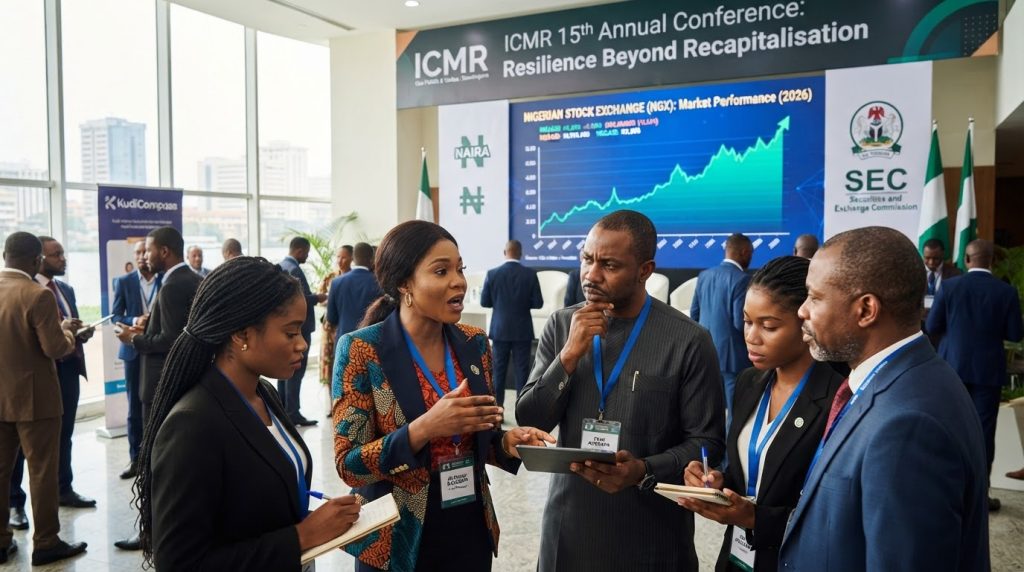
Quick Summary
The Nigerian capital market is undergoing a historic reset in 2026. The Securities and Exchange Commission (SEC) launched the Nigerian Capital Market Master Plan 2.0 on 19 October 2026, targeting a staggering N750 trillion market capitalization by 2036. Just weeks later, the Institute of Capital Market Registrars (ICMR) is holding its 15th Annual Conference on 14 November 2026 under the theme “Beyond Recapitalisation: Building Resilient Institutions and a Sustainable Capital Market.” At the same time, the SEC has enforced new minimum capital requirements for fund managers, forcing Tier 1 operators to hold up to N10 billion in capital. For the average Nigerian investor, this means stronger protection for your savings, pension, and mutual fund investments through better governance and higher institutional standards.
What This Means
For the average Nigerian investor, the phrase “resilience beyond recapitalisation” signals a major shift in regulatory philosophy. The SEC and market operators are moving away from simply bailing out undercapitalized institutions (recapitalisation) and towards building a system that protects your savings, loans, and investment returns through stronger governance, higher capital standards, and institutional durability. Your fund manager now has significant “skin in the game,” with billions of Naira of their own capital at risk alongside your investments.
Key Takeaways
- The SEC Master Plan 2.0 targets a N750 trillion market capitalization by 2036, opening up more investment products for Nigerians.
- Fund managers must now hold between N200 million and N10 billion in minimum capital depending on their tier, drastically reducing the risk of collapse.
- The ICMR conference directly links recapitalisation to governance reforms, meaning more transparency and better risk management for your funds.
- A deeper corporate bond market could mean better returns on fixed-income investments and potentially lower borrowing costs over time.
- Pension funds are safer because the fund managers handling your retirement savings are now required to be financially robust.
Event Deep Dive: What Changed and Who Announced It
The SEC Master Plan 2.0
On 19 October 2026, SEC Director-General Dr Emomotimi Agama hosted the National Capital Market Conference 2026 at the Presidential Villa in Abuja [Source: sec.gov.ng]. The flagship announcement was the Nigerian Capital Market Master Plan 2.0 (NCMMP 2.0), a 10-year roadmap targeting a market capitalization of N750 trillion. This is a massive leap from current figures and signals a deep push to channel more domestic savings into productive capital markets.
The ICMR Conference
Scheduled for 14 November 2026 at the Oriental Hotel, Lagos, the ICMR conference will feature a keynote address by Bismarck Rewane, CEO of Financial Derivatives Company (FDC) [Source: businessday.ng]. Mrs Catherine Nwosu, President and Chairman of Council of ICMR, announced the event [Source: thisdaylive.com].
A key panel titled “Recapitalisation as a Catalyst for Institutional Resilience & Governance Reforms for Sustainable Growth” will feature heavyweights:
- Shehu Shantali, CEO of Central Securities Clearing System (CSCS)
- Dr Kamal Okunola, ICMR First Vice President
- Dr Fiona Ahimie, President of Chartered Institute of Stockbrokers (CIS)
- Jude Chiemeke, CEO of Nigerian Exchange Group (NGX)
New Capital Rules for Fund Managers
In a significant move earlier in 2026, the SEC, through the Fund Managers Association of Nigeria (FMAN), updated the minimum capital requirements for fund managers [Source: FMAN LinkedIn]:
- Tier 1 (Full Scope Level 1): Managers with Assets under Management (AuM) between N40 billion and N250 billion must hold a minimum capital of N5 billion.
- Tier 1 (Full Scope Level 2): Managers with AuM above N250 billion must hold N10 billion.
- Tier 2 (Limited Scope): Managers with AuM of N40 billion or less must hold N2 billion.
- Tier 3 (Private Equity): PE firms need N500 million.
- Tier 3 (Venture Capital): VC firms need N200 million.
Who is Affected
These changes directly impact fund managers, capital market registrars (ICMR members), stockbrokers, and ultimately, every Nigerian investing in mutual funds, pension funds, or the stock market. If you have money with any SEC-licensed fund manager—whether through a pension fund administrator (PFA) like Stanbic IBTC Pension, ARM Pension, or FCMB, or through a mutual fund provider like FBNQuest Meristem or Chapel Hill—these rules affect your risk exposure.
Wallet Impact Breakdown: What This Means for Your Naira
Savings & Investments
The new capital requirements are a game-changer for investor protection. A Tier 1 fund manager managing over N40 billion in assets must now have at least N5 billion of their own capital at risk [Source: FMAN LinkedIn]. This “skin in the game” drastically reduces the risk of your fund collapsing due to undercapitalization or mismanagement.
Practical example: If you have N1 million invested in a mutual fund managed by a Tier 1 operator, you now have the assurance that the manager has N5 billion of its own capital backing its operations. This is a significant layer of protection that did not exist at this scale before 2026.
Loans & Credit
The SEC Master Plan 2.0 aims to deepen the corporate bond market [Source: sec.gov.ng]. A deeper bond market means companies have an alternative to expensive bank loans. For you, this could translate to:
- Better returns on fixed-income investments: Corporate bonds typically offer higher yields than Treasury Bills, giving you more options for income generation.
- Lower borrowing costs over time: As companies access cheaper capital market funding, they may pass on savings to consumers through lower loan rates.
However, a more active bond market also means more competition for your savings, potentially pushing deposit rates higher at commercial banks.
Returns & Governance
The ICMR conference theme explicitly links recapitalisation to governance reforms. For investors, this means the days of opaque fund management are numbered. Stronger governance requirements mean clearer reporting on fund performance, better risk management frameworks, and a focus on long-term sustainable growth rather than short-term speculative gains. Your returns should become more predictable and less prone to systemic shocks.
Pension Funds
Pension Fund Administrators (PFAs) often invest in funds managed by SEC-licensed fund managers. The new capital requirements ensure that the managers handling your retirement savings are financially robust. This adds a critical layer of security to your pension contributions, complementing the oversight of the National Pension Commission (PenCom). For those exploring options beyond traditional PFAs, understanding the landscape of pension fund administrators and their capital backing is now more important than ever.
What a N750 Trillion Market Means for You
A market capitalization of N750 trillion by 2036 means a wider array of investment products. Instead of just Treasury Bills and a handful of mutual funds, you could see more corporate bonds, infrastructure funds, and real estate investment trusts (REITs) available to retail investors. This diversification is key to building a resilient personal portfolio. It also opens the door for more initial public offerings (IPOs) from major Nigerian companies, giving retail investors a chance to own equity in the country’s biggest brands.
Comparison Table: New Fund Manager Capital Requirements (2026)
The table below summarizes the new minimum capital requirements for fund managers as announced by the SEC via FMAN in 2026 [Source: FMAN LinkedIn].
| Tier | Scope / AuM Range | New Minimum Capital Requirement (₦) |
|---|---|---|
| Tier 1 (Level 1) | Full Scope (AuM: N40B – N250B) | N5,000,000,000 |
| Tier 1 (Level 2) | Full Scope (AuM: Above N250B) | N10,000,000,000 |
| Tier 2 | Limited Scope (AuM: ≤ N40B) | N2,000,000,000 |
| Tier 3 (PE) | Private Equity | N500,000,000 |
| Tier 3 (VC) | Venture Capital | N200,000,000 |
What this table tells you: The SEC has created a tiered structure where capital requirements scale with the risk and size of assets being managed. This is a direct mechanism to protect investors. If your fund manager falls into Tier 1, they must have significant financial resources committed to their operations.
The Bigger Picture: Why This Matters for the Nigerian Capital Market
Moving from Bailouts to Resilience
Historically, the Nigerian capital market has seen instances of market operators failing, leading to investor losses and a crisis of confidence. The “beyond recapitalisation” theme signals a proactive approach. Instead of waiting for a firm to fail and then injecting capital (recapitalisation), the SEC and ICMR are building a system where failure is less likely because the institutions are inherently resilient.
Attracting Foreign Investment
A robust, well-capitalized market with strong governance is a prerequisite for attracting foreign portfolio investors. The N750 trillion target under the NCMMP 2.0 cannot be achieved with domestic capital alone. These reforms signal to international investors that Nigeria is a safe and regulated market for their funds. This push for macroeconomic stability and institutional strength is designed to build a virtuous cycle of investment and growth.
Trust in the System
For the average Nigerian, trust in financial institutions is paramount. The combination of the SEC Master Plan, the ICMR focus on governance, and the FMAN capital requirements creates a tripod of investor protection. This is designed to restore and build trust in the Nigerian capital market as a vehicle for wealth creation.
The Role of Infrastructure Providers
The Central Securities Clearing System (CSCS), led by CEO Shehu Shantali who is a panelist at the ICMR conference, is the backbone of the Nigerian capital market infrastructure. Its role in ensuring seamless settlement and custody of assets is critical for the “resilience” being discussed. For the investor, a resilient CSCS means your stock trades settle on time (T+3) and your assets are safe from counterparty default. The conference panel featuring CSCS directly links the operational resilience of the market infrastructure to the financial resilience of fund managers.
The N750 Trillion Target: To put this in perspective, Nigeria’s current stock market capitalization is a fraction of this ambitious target. Achieving it will require a massive influx of both domestic and foreign capital, a thriving corporate bond market, and a significant increase in the number of publicly listed companies. For investors, this means a future with far more choices for where to put your money.
Frequently Asked Questions (FAQ)
What is the Institute of Capital Market Registrars (ICMR)?
The ICMR is the professional body for Capital Market Registrars in Nigeria. Its members are responsible for maintaining the register of shareholders and unit holders for public companies and mutual funds. Their role is critical for the integrity of the capital market [Source: ICMR Official Website].
Who is Mrs Catherine Nwosu?
Mrs Catherine Nwosu is the current President and Chairman of the Council of the Institute of Capital Market Registrars (ICMR). She is a key figure in the Nigerian capital market and signed the statement announcing the 15th Annual Conference [Source: thisdaylive.com].
What is the Nigerian Capital Market Master Plan 2.0?
It is a 10-year strategic plan launched by the SEC on 19 October 2026, aiming to grow the Nigerian capital market to a capitalization of N750 trillion by 2036 [Source: sec.gov.ng].
How do the new fund manager capital requirements protect my investments?
They ensure that your fund manager has significant financial resources of their own at risk. This aligns their interests with yours and provides a buffer against operational losses or market downturns, reducing the chance that your investment capital is lost due to the manager’s insolvency [Source: FMAN LinkedIn].
Who is Bismarck Rewane and why is his keynote important?
Bismarck Rewane is the CEO of Financial Derivatives Company (FDC), one of Nigeria’s most respected economic analysts. His keynote at the ICMR conference is important because he will likely provide a macroeconomic perspective on how institutional resilience can drive long-term market growth [Source: businessday.ng].
What is the difference between recapitalisation and resilience?
Recapitalisation is a reactive measure—injecting capital into a failing institution to keep it afloat. Resilience, as discussed at the ICMR conference, is a proactive strategy—building institutions with strong capital bases, robust governance, and sound risk management so they do not fail in the first place.
How does the ICMR conference directly affect my mutual fund investments?
The ICMR represents Capital Market Registrars, who are crucial for maintaining the integrity of share and unit registers. The conference’s focus on governance and resilience means your fund manager is under pressure to work with registrars that have strong operational and financial capacity, reducing the risk of administrative failures that can freeze your investments.
What is the role of the CSCS in this?
The Central Securities Clearing System (CSCS) provides clearing, settlement, and custody services for the Nigerian capital market. Its CEO, Shehu Shantali, is a panelist at the ICMR conference. A resilient CSCS means your stock trades settle on time and your assets are safe from counterparty default.
What to Do Next: 3 Concrete Steps
This article was published on 4 November 2026. All rates, fees, and regulatory details reflect the current market environment as of this date. For the most recent updates, consult the SEC Nigeria website and your licensed fund manager.