
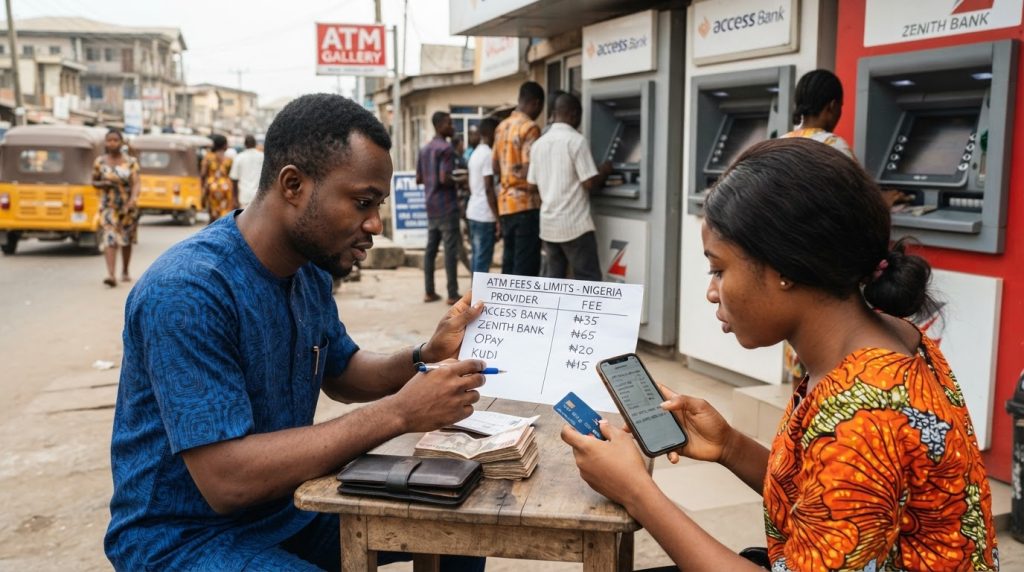
Quick Summary
This guide explains the key costs, trade-offs, and practical steps Nigerian readers should know.
CBN Cash Withdrawal Limit in 2026: ATM Fees, Daily Thresholds & How to Avoid Charges
Why Every Nigerian Must Understand the New Rules
If you’ve used an ATM lately, you’ve probably felt the sting — ₦100 here, ₦600 there — and wondered, “When did cash become this expensive?” The answer goes back to 1 March 2025, when the Central Bank of Nigeria (CBN) overhauled ATM transaction fees, eliminating the three free monthly withdrawals many had relied on. Then came the draft Guide to Charges 2026 in April 2026, proposing even more changes that may still reshape what we pay.
This guide will give you the exact costs you face today:
- ATM fee per transaction: Own bank = ₦0. Another bank on-site = ₦100. Another bank off-site = ₦100 + up to ₦500 surcharge.
- Daily withdrawal threshold (Cash‑less Policy): ₦500,000 for individuals, ₦3,000,000 for corporates — above that, cash handling charges kick in.
- Per‑transaction ATM limit: Banks must allow up to ₦20,000 per withdrawal.
We’ll walk you through the numbers step by step, show you how to compare methods, and give you a practical plan to save money starting today.
Section 1: CBN’s New ATM Fee Structure – What You Actually Pay
The CBN circular FPR/DIR/GEN/CIR/001/002, issued on 10 February 2025 and effective 1 March 2025, set the rules that still apply today. Let’s break down each fee type.
On‑Us (Same Bank) Withdrawals – Still Free
If you use an ATM belonging to your own bank, you pay exactly ₦0. The circular states: “On-Us (same bank) withdrawals are free” CBN Circular.
Example: If you have a First Bank account and use a First Bank ATM, you can withdraw ₦20,000 at no cost — repeat as many times as you need (within any daily limits your bank sets).
Not‑On‑Us On‑Site – ₦100 per ₦20,000
Using another bank’s ATM located inside a bank branch costs you a flat ₦100 for every ₦20,000 withdrawn. This charge applies even if you take out less than ₦20,000 — it’s a base fee per transaction. The CBN Reforms page confirms the ₦100 charge for on-site ATMs CBN Reforms.
Example: You withdraw ₦10,000 from a UBA on‑site ATM — you still pay ₦100. You withdraw ₦40,000 — you pay ₦200 (two ₦20,000 blocks).
Not‑On‑Us Off‑Site – ₦100 + Surcharge Up to ₦500
Off‑site ATMs (those in malls, petrol stations, standalone kiosks) carry an additional cost. You pay the ₦100 base fee plus a surcharge that can go up to ₦500 per ₦20,000. That brings the total to as much as ₦600 per ₦20,000 withdrawal.
The critical rule: the surcharge must be disclosed at the point of withdrawal — either on screen or on a sticker. If you don’t see it, walk away CBN Circular.
Example: You need ₦20,000 from a GTBank off‑site ATM at a shopping mall. The machine shows a surcharge of ₦300. You will be debited: ₦20,000 + ₦100 + ₦300 = ₦20,400.
The Three Free Monthly Withdrawals Are Gone
Before March 2025, customers enjoyed three free Not‑On‑Us ATM withdrawals per month. That policy is eliminated as of 1 March 2025. Every Not‑On‑Us transaction now costs you CBN Circular.
Tiered Fee – More Than ₦20,000 = More Charges
The ₦100 fee is not a one‑time charge for amounts above ₦20,000. The CBN FAQs clarify: for each additional ₦20,000 (or part of it), you pay another ₦100 CBN FAQs.
| Amount Withdrawn | Fees Breakdown (Not‑On‑Us On‑Site) | Total Fee |
|---|---|---|
| ₦20,000 | 1 × ₦100 | ₦100 |
| ₦40,000 | 2 × ₦100 | ₦200 |
| ₦60,000 | 3 × ₦100 | ₦300 |
| ₦80,000 | 4 × ₦100 | ₦400 |
| ₦100,000 | 5 × ₦100 | ₦500 |
International ATM Withdrawals – Cost Recovery
If you use your Nigerian card abroad, the ATM fee is not fixed. The CBN circular states: international withdrawals are charged on a cost‑recovery basis — the exact charge from the international acquirer is passed on to you CBN Circular. That can be much higher than local fees.
Draft Guide to Charges 2026 – What Might Change
In April 2026, the CBN published a draft “Guide to Charges by Banks and Other Financial Institutions, 2026” for public comment (comments closed 8 May 2026). Among the proposals are:
- Electronic transfer caps: ₦5,001–₦50,000 → ₦10; above ₦50,000 → ₦50; below ₦5,000 → free Nairametrics.
- Merchant service charge cap: 0.5% per transaction, max ₦10,000 Nairametrics.
- Standardisation of ATM charges — but as of today (17 October 2026), this draft is not yet in force. The 2025 circular remains the active policy.
Section 2: Cash‑Less Nigeria – Daily Withdrawal Thresholds and Charges
Beyond ATM fees, the CBN’s Cash‑less Nigeria policy imposes a different kind of “limit” — one that triggers cash handling charges when you exceed certain daily withdrawal amounts.
The Thresholds
According to the official Cash‑less Nigeria page, cash handling charges apply when daily cash withdrawals exceed:
- ₦500,000 for individuals
- ₦3,000,000 for corporates
What Happens When You Exceed the Threshold?
The policy says “cash handling charges shall apply.” However, the specific charge rate (e.g., 3% or 5%) is not stated in the primary sources available in our evidence ledger. Earlier versions of the policy in 2023–2024 used different percentages, but the current applicable rate cannot be confirmed from the sources we have. We recommend checking with your bank or the CBN directly.
Important: This Is Not an ATM Limit
The ₦500,000/₦3,000,000 threshold applies to total cash withdrawals across all channels (teller counter, ATM, Point of Sale cash‑out) in a single day. ATM withdrawals are part of this total. So if you take ₦200,000 from an ATM and later request ₦350,000 over the counter, your daily total is ₦550,000 — exceeding the individual limit by ₦50,000, which may attract a handling charge.
How to Avoid the Charge
- Keep daily withdrawals below ₦500,000 (individual) or ₦3,000,000 (corporate).
- For larger cash needs, spread withdrawals over multiple days.
- Use electronic transfers or cheques for amounts above the threshold.
Section 3: Decision Framework – How to Choose the Cheapest Cash Access Method
Now that you know the costs, here’s a quick comparison table to help you decide:
| Method | Cost per ₦20,000 | Best for |
|---|---|---|
| Own bank ATM (On‑Us) | ₦0 | Any amount, any time (free) |
| Another bank ATM on‑site | ₦100 | When you can visit a bank branch near you |
| Another bank ATM off‑site | ₦100 + surcharge up to ₦500 (must be disclosed) | Only if truly urgent; check surcharge first |
| Over‑the‑counter (teller) | No direct CBN fee, but cash handling charge may apply if daily total > ₦500k (individual) or ₦3M (corporate) | Large sums; plan to split across days |
| PoS terminal at a merchant | Varies (usually ₦50–₦100 cash‑out fee, plus any merchant charge) | Small urgent amounts; compare with ATM costs |
Decision Rules
- Always prefer your own bank’s ATM – free and no hassle. Download your bank’s app to locate the nearest own‑brand ATM.
- If you must use another bank, choose on‑site over off‑site – the difference can be up to ₦500 per ₦20,000.
- Check the surcharge before you confirm – off‑site ATMs must show it. If it’s not displayed, cancel and find another ATM.
- For cash above ₦100,000, consider using your own bank ATM multiple times – free per transaction, but watch your cumulative daily total if you approach ₦500,000.
- For very large amounts (₦500k+), split across days – avoid potential cash handling charges.
- Compare with bank transfers – if you need to send money to someone else, a transfer may be cheaper than withdrawing cash and handing it over. The draft Guide to Charges 2026 proposes free transfers for under ₦5,000 and low fees for larger amounts, though not yet in effect.
Risk Note
Off‑site ATMs sometimes have a sticker with tiny print. Take a moment to read it. If the surcharge seems excessive (approaching ₦500), consider walking to the nearest bank branch to use an on‑site ATM instead.
Section 4: Step‑by‑Step Guide to Smarter Cash Access
Follow these five steps to minimise fees every time you need cash.
Step 1 – Identify Your Bank’s Own ATMs
Every Nigerian bank has a free ATM locator service. For example:
- First Bank: Dial *894# or use the First Mobile app.
- UBA: Use the UBA App’s “ATM Locator”.
- Access Bank: Use the Access More app.
- GTBank: Use the GTWorld app.
Withdraw from these machines for free — regardless of amount up to your daily limit (usually ₦100,000–₦200,000 per day across multiple transactions, depending on your bank).
Step 2 – If You Must Use Another Bank, Check the Location Type
When you approach a non‑your‑bank ATM, ask yourself:
- Is it inside a bank branch? Yes → on‑site. Cost = ₦100 per ₦20,000.
- Is it standalone (mall, petrol station, outside a bank)? Likely off‑site. Cost = ₦100 + surcharge.
Look for a disclosure sticker or screen message. If none, assume it’s off‑site and might carry a surcharge. Walk away if you can’t confirm — you have the right to cancel.
Step 3 – Understand How the Fee Multiplies
You now know: fee = (number of ₦20,000 blocks) × ₦100 (for on‑site) or ₦100 + surcharge (for off‑site).
Example: You withdraw ₦50,000 from an off‑site ATM with a ₦200 surcharge.
- Blocks: ₦50,000 = 2 full blocks + ₦10,000 (partial block) → 3 blocks.
- Base fee: 3 × ₦100 = ₦300.
- Surcharge: 3 × ₦200 = ₦600.
- Total fee: ₦900.
You would have been better off withdrawing ₦20,000 three times from your own bank ATM (free) or visiting a bank branch to use an on‑site ATM (₦300 total).
Step 4 – Plan Large Cash Needs
If you need ₦100,000 or more for a business payment, school fees, or property rent:
- Use your own bank ATM repeatedly – withdraw ₦20,000 five times from your bank’s machine = ₦0 fee. But check your bank’s daily withdrawal limit (typically ₦100,000–₦200,000). Five transactions may be possible, but you might hit a daily cap.
- Visit a bank branch – request over‑the‑counter withdrawal. No CBN fee, but remember the Cash‑less threshold: if your total withdrawals today (including ATM earlier) exceed ₦500,000, you may attract a handling charge.
- If the amount is above ₦500,000, split across two days – e.g., withdraw ₦300,000 on Day 1 and ₦200,000 on Day 2.
Timeline: This guidance is based on the CBN circular effective March 2025 and the Cash‑less policy active today. Always verify via your bank’s app or the CBN website.
Step 5 – Keep Every Receipt
Save ATM receipts and teller slips. If you are charged incorrectly (e.g., a surcharge not disclosed, or double‑charged), report to your bank immediately. The CBN consumer protection helpline: 0800‑226‑5226 (available during business hours).
Example scenario: Tunde, a small business owner, needs ₦350,000 cash for supplier payment. He has a UBA account. He uses the UBA app to find three UBA ATMs near his shop, withdraws ₦20,000 from each (free), but realises he needs more. He visits a UBA branch, withdraws ₦290,000 over the counter — total daily withdrawals = (₦20,000 ×3) + ₦290,000 = ₦350,000. Under ₦500,000, so no cash handling charge. Total fee paid: ₦0.
Had he used an off‑site ATM, he would have paid up to ₦600 per ₦20,000 — on ₦350,000 that could be ₦10,500 in fees alone.
Frequently Asked Questions (Based on What Nigerians Ask)
1. Can I withdraw more than ₦20,000 from an ATM per transaction? Yes, but it depends on your bank. The CBN FAQs state that banks must allow customers to withdraw up to ₦20,000 per transaction. However, some banks may set a lower limit (though doing so would be a regulatory contravention). If your bank caps you below ₦20,000, you can complain to the CBN via its portal or call the consumer helpline Nairametrics.
2. What is the daily limit on ATM withdrawals? The CBN does not set a specific daily ATM limit across all banks. Each bank sets its own daily transaction limit (commonly ₦100,000–₦200,000 per card). However, the Cash‑less policy triggers handling charges if your total daily cash withdrawals from all sources exceed ₦500,000 for individuals.
3. Are ATM fees refundable? Not by default. If you use a different bank’s ATM, the fee is expected. However, if you are charged without proper disclosure (e.g., surcharge not shown), you may request a refund from your bank, citing the CBN circular that mandates disclosure.
4. Do OPay, Moniepoint, and other fintechs have different withdrawal limits? No. All financial institutions operating in Nigeria — including OPay, Moniepoint, First Bank, UBA — are bound by the same CBN circulars. However, fintech ATMs are rare; most users access cash via PoS agents. OPay and Moniepoint PoS agents charge a separate fee that varies (usualy ₦50–₦100 for cash‑out, but can be higher). This is not regulated by the CBN ATM fee schedule.
5. Will the draft Guide to Charges 2026 lower fees? If adopted, it would cap electronic transfer fees and merchant charges, but it does not propose changing the current ATM fee structure (₦100 + surcharge). The draft was open for comment until May 8, 2026, but as of October 2026, it has not been announced as final. Monitor CBN’s website for updates.
6. What is the NIN/BVN requirement for withdrawing large amounts? The Cash‑less policy does not require NIN or BVN specifically for cash withdrawals under ₦500,000. However, for withdrawals above ₦5,000,000, banks may request BVN verification under anti‑money laundering guidelines. Always carry your BVN and NIN details when making large transactions.
What to Do Next
- Know your bank’s ATM locations – open your mobile app now and save the nearest five own‑bank ATMs. Commit to using only those for regular withdrawals.
- If you don’t have a bank account with widespread ATMs, consider opening one. First Bank, GTBank, UBA, and Access Bank all have large ATM networks. A second account costs little but can save you hundreds every month.
- Track your daily cash withdrawals – a simple note on your phone: “₦X today from ATM, ₦Y from teller” keeps you under the ₦500,000 threshold.
- Report any hidden surcharge – if an off‑site ATM does not clearly show the fee, contact your bank and forward the receipt. The CBN requires disclosure.
- Stay informed about the 2026 draft guide – if it becomes final, transfer costs may drop, making electronic payments even cheaper than cash. Subscribe to CBN’s press release page.
The cost of cash has risen, but with knowledge and a little planning, you can keep your money where it belongs — in your pocket.
Last updated: 17 October 2026. All fees and policies are based on official CBN sources and media reports cited within. This article does not constitute financial advice. For specific questions about your account, please contact your bank directly.