
Quick Summary
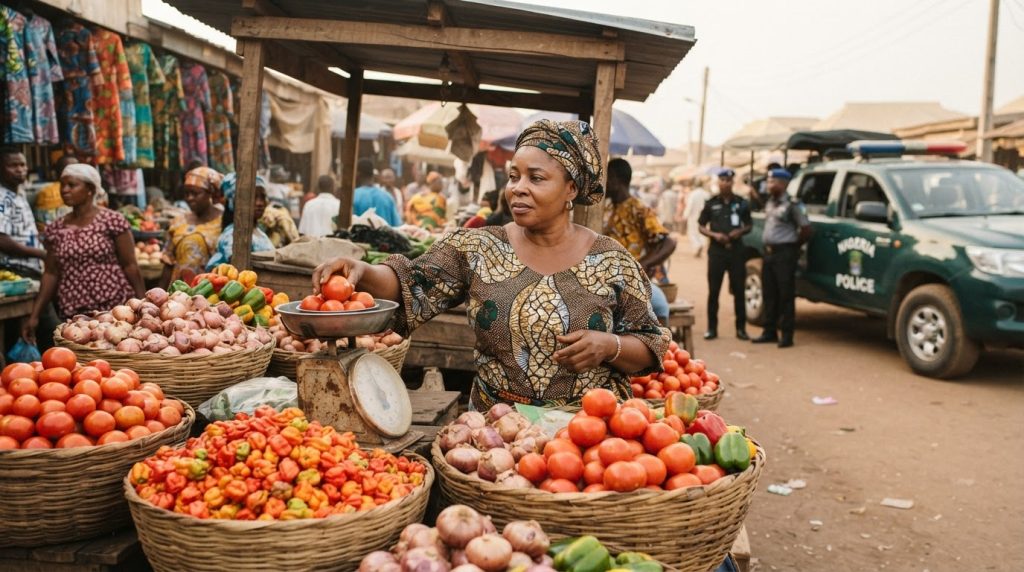
Every trip to the market feels heavier. A paint-rubber of garri, a measure of rice, a bunch of vegetables — the total at the counter keeps climbing week after week. The National Bureau of Statistics (NBS) and the Central Bank of Nigeria (CBN) have confirmed what your wallet already knows: food inflation stood at 19.57% year-on-year in August 2026, according to official CBN inflation data. But this is not just an economics story. It is a security story.
On 25/09/2026, Dr. Michael Sunbola, Founder/Executive Director of the Lagos Food Bank Initiative, said it plainly in a Punch interview: “When they attack farmers, they are not just afraid to go to the farm; production drops, and demand rises. So, it’s a major driver, and I believe one of the things I feel I think is high time the government implement is the state police.”
The question this article answers: does insecurity really inflate your grocery bill, and can state police bring prices down? The short answer is yes — and yes, with important caveats you need to understand before the policy reaches your state assembly.
Quick Answer
Yes, insecurity directly inflates food prices by reducing farm output. When farmers are attacked, they plant less and harvest less, driving supply down while demand stays constant. The result is higher prices at the market. State police, if properly implemented, could protect farmers and stabilise supply, potentially easing food inflation. However, the constitutional bill passed on 11/06/2026 still requires ratification by at least two-thirds of state assemblies before it becomes law.
The Insecurity–Food Price Link: What the Experts Say
The mechanism is brutally simple. Banditry, kidnapping, and farmer-herder clashes in Nigeria’s food-producing belts do not just make headlines — they change farmer behaviour. When a farmer fears for his life, he plants less, harvests less, or abandons his land altogether. Supply drops. Demand stays the same, or grows with a rising population. The result is higher prices at the market.
“When they attack farmers, they are not just afraid to go to the farm; production drops, and demand rises,” Sunbola told Punch on 25/09/2026. “So, it’s a major driver.”
The scale of the problem is measurable in the work of his organisation. The Lagos Food Bank Initiative, which Sunbola leads, has reached over 3.5 million beneficiaries since 2016, as reported in the same Punch interview. A food bank that has served millions is not a sign of abundance — it is a sign that a large share of households cannot reliably feed themselves without support.
The national data backs the logic. In August 2026, food and non-alcoholic beverages contributed 6.16 percentage points to headline inflation — the single largest contributor, ahead of restaurants/accommodation (1.99%) and transport (1.64%), according to the NBS August 2026 CPI report as covered by Premium Times. When food alone accounts for more than a third of the inflation you feel, anything that disrupts farming — from insecurity to fuel costs to weather — hits your household budget directly.
Key Insight: The connection between insecurity and food prices is not theoretical. Every attack on a farm reduces the national food supply, and that reduction shows up in the monthly inflation numbers. For a deeper look at how broader economic trends affect your wallet, read our analysis on Government Revenue Drops: What it Means for Your Wallet and Nigeria’s Economy.
Current Food Inflation Picture: August 2026 Data
The latest official numbers show a mixed picture: improvement on the margins, but persistent pain at the centre.
- Headline inflation (year-on-year): 15.39% in August 2026, down from 15.43% in July 2026, per the NBS report covered by Premium Times.
- Month-on-month headline inflation: 0.71% in August 2026, down sharply from 1.57% in July 2026 — the same Premium Times report notes this is a notable slowdown in the pace of price increases.
- Food inflation (year-on-year): 19.57% in August 2026, down from 20.31% in July 2026, according to CBN inflation data. Nairametrics described this as the first drop in food inflation in six months.
What Contributed Most to Inflation in August 2026
| Item | Contribution to headline inflation |
|---|---|
| Food & non-alcoholic beverages | 6.16 percentage points |
| Restaurants & accommodation | 1.99 percentage points |
| Transport | 1.64 percentage points |
So yes — headline inflation is easing, and food inflation has finally turned downward. But a 19.57% annual food inflation rate means the average food item that cost ₦10,000 this time last year now costs roughly ₦11,957. That gap is the difference between a family eating three meals a day and skipping one. The BusinessDay analysis called it “food inflation eases for first time in 2026” — a technically accurate headline that should not be mistaken for relief at the till.
Important: While food inflation has eased, it remains above 19%. For context on how to adjust your spending in this environment, see our guide on How to Negotiate Salary in Nigeria Using Inflation Data and Benefits.
State Police: The Proposed Solution
The reform at the heart of this debate is no longer hypothetical. On 11/06/2026, Nigeria’s parliament passed a constitutional bill allowing each of the 36 states to establish and run its own police force alongside the federal Nigeria Police Force, as Reuters reported. The stated aim: tackle worsening insecurity.
Sunbola argues this is exactly what is needed. “State police will help protect farmers’ lives and property across borders,” he said in the Punch interview. His logic runs like this: a farmer in Benue whose farm straddles a state boundary cannot rely on a police force based hundreds of kilometres away in Abuja to respond to an attack at 3am. A local force with local knowledge and local accountability can.
How State Police Could Reduce Food Prices
- Faster response to farm attacks. A local command can deploy within minutes, not hours — reducing the window in which bandits destroy crops, steal livestock, or burn harvests.
- Better intelligence. Local officers know the terrain, the communities, and the warning signs of conflict before it erupts.
- Protection across borders. Farmers who farm near state boundaries currently fall between jurisdictions. State police forces with clear mandates can close that gap.
- Deterrence. When attackers know a permanent, local security presence exists, the cost of attacking a farm rises — and farm output becomes more predictable.
More predictable farming means more consistent supply, and more consistent supply is what pushes prices down from the supply side — the same side the CBN cannot reach with interest rate policy alone.
Related Reading: For a broader view of how policy changes affect your finances, explore our analysis of Nigeria’s Economy in 2026: Navigating AI, Food Security, and CBN Policy.
Decision Framework: What the Trends Tell Us
| Month (2026) | Food inflation, year-on-year | Direction |
|---|---|---|
| June | 17.52% | — |
| July | 20.31% | ↑ Up |
| August | 19.57% | ↓ Down |
Source: CBN Inflation Data
Observation 1: Food inflation peaked in July 2026, then eased in August. Nairametrics noted this was the first decline in six months. Early harvest season and the slower month-on-month headline pace (0.71% versus 1.57%) both likely contributed.
Observation 2: The decline is real but fragile. A single major security incident in a food-producing state — a renewed wave of attacks on farmers in the North Central or North West — can reverse it within one reporting cycle. This is precisely the sensitivity that makes Sunbola’s call for state police a food-price issue, not just a security talking point.
Decision framework for you as a reader: If the state police bill is ratified by at least two-thirds of state assemblies and insecurity eases, expect further downward pressure on food inflation in 2027. If ratification stalls — the Reuters report confirms the bill still requires state-level ratification — prices could remain elevated or climb again. Watch two things: the ratification votes in your state assembly, and the monthly NBS data on the NBS official website.
Risks and Challenges of State Police
A balanced view requires naming the risks. The state police proposal is not a magic wand, and critics raise legitimate concerns:
Potential Benefits
- Faster response to farm attacks
- Better local intelligence on security threats
- Protection for farmers near state borders
- Deterrence against banditry
Risks and Challenges
- Abuse by state governors. Nigeria’s history is littered with examples of state security apparatuses used against political opponents or ethnic groups. A governor-controlled police force could become a tool of political repression.
- Funding burden. State budgets are already stretched. A fully equipped state police force — salaries, vehicles, weapons, training, accommodation — would compete with education and health spending.
- Coordination problems. Two police forces operating in the same territory creates genuine risks: conflicting orders, overlapping jurisdictions, and the possibility that neither force responds because each assumes the other will.
These risks are real, and the constitutional amendment process itself is a form of protection: as Reuters noted on 11/06/2026, the bill must still be ratified by at least two-thirds of the 36 state assemblies before it becomes law — a process that gives citizens time to debate the safeguards.
Sunbola’s position is that the benefits for food security outweigh the risks. Given that food contributed 6.16 percentage points to headline inflation in August 2026 (NBS via Premium Times), the stakes could hardly be higher for household budgets.
Policy Context: The CBN’s monetary policy tools — interest rates, open market operations — cannot solve supply-side food inflation caused by insecurity. This is why structural reforms like state police matter. For more on how monetary policy interacts with food prices, see our guide on Naira’s Two-Year High: Is This Stability, or a Temporary Reprieve?
Actionable Next Steps for Your Household
While the political process plays out, here are concrete steps that can cushion your budget today and help you track the food price story:
-
Follow the ratification process in your state
The bill passed by the National Assembly on 11/06/2026 requires ratification by at least two-thirds of state assemblies (Reuters). Find out who represents you in your state House of Assembly and ask where they stand on state police. Their vote could determine whether farmers get protection — and whether food prices ease — in your region.
-
Monitor official price data yourself
The NBS website publishes monthly CPI reports and food price watch data. The CBN inflation page is the primary source for the official rate. Checking one page once a month gives you verified numbers — not market gossip — for your family discussions and spending decisions.
-
Practical household adjustments
- Join or start a community buying group (ajo/esusu). Bulk-purchasing rice, beans, garri, and palm oil collectively often secures wholesale prices that individual buyers cannot access.
- Substitute expensive proteins. Beans, soya, and eggs are typically cheaper per gram of protein than beef or chicken. Rotating proteins across the week reduces the bite of meat price spikes.
- Start a small vegetable garden. Even a few plastic buckets of ugwu, spinach, or okro on a balcony or compound can cut weekly market trips — and insulate you from the price of transport-driven vegetables.
- Buy staples in the harvest season. In many parts of Nigeria, prices dip in the early harvest months (September–November). Buying a bag of grain then, if your storage allows, is a time-honoured hedge against the lean season.
Smart Budgeting: For more strategies on managing your money during inflation, read our guide on How to Price Products in Nigeria During Inflation, FX Volatility, and Fuel Cost Swings.
Frequently Asked Questions
What is the current food inflation rate in Nigeria?
Food inflation stood at 19.57% year-on-year in August 2026, down from 20.31% in July 2026, according to CBN official data.
How does insecurity affect food prices in Nigeria?
Insecurity — banditry, kidnapping, and farmer-herder clashes — reduces the number of farmers willing to plant and harvest. Lower supply with steady or growing demand pushes prices up. As Dr. Michael Sunbola put it, “production drops, and demand rises” (Punch, 25/09/2026).
Has the state police bill been passed in Nigeria?
The National Assembly passed the constitutional bill on 11/06/2026, but it still requires ratification by at least two-thirds of state assemblies before becoming law (Reuters).
How will state police reduce food prices?
By protecting farmers and farmland, state police are expected to increase farming confidence, boost supply, and reduce the supply-side pressure that drives food inflation. Sunbola argues state police “will help protect farmers’ lives and property across borders” (Punch).
What is the biggest driver of inflation in Nigeria right now?
Food and non-alcoholic beverages are the largest contributor, accounting for 6.16 percentage points of headline inflation in August 2026 (NBS via Premium Times).