
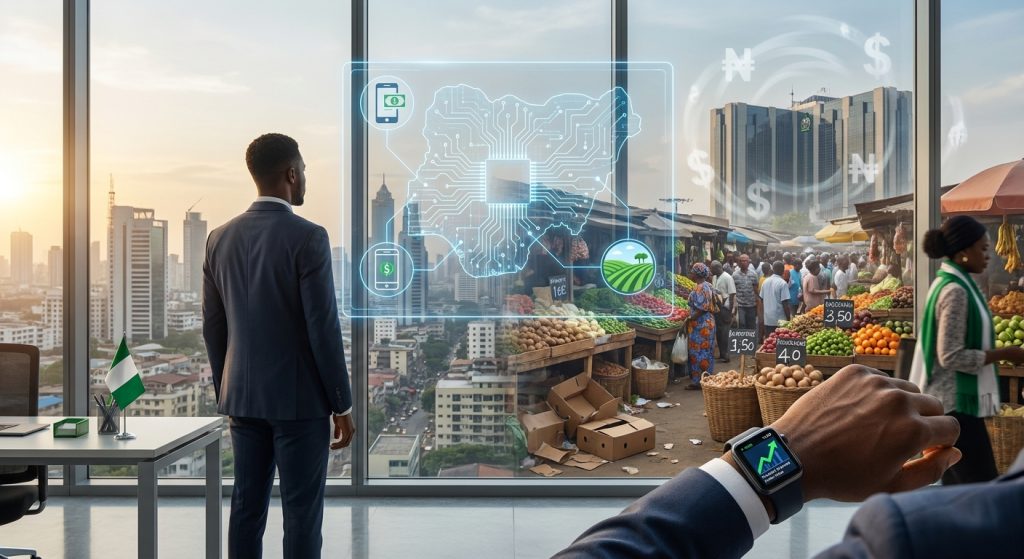
Nigeria’s Economy in Flux: Navigating AI, Food Security, and CBN’s Regulatory Grip in 2026
Nigeria’s economy in 2026 is at a critical juncture, shaped by the rapid adoption of Artificial Intelligence (AI), persistent food insecurity, and the Central Bank of Nigeria’s (CBN) evolving monetary and regulatory policies. While AI offers significant opportunities for productivity gains and innovation, particularly in fintech, the government is actively working on regulatory frameworks to manage its impact. Simultaneously, a deepening food security crisis, marked by food inflation surpassing headline inflation and substantial food waste, continues to challenge household purchasing power. The CBN’s tight monetary policies, including interest rate hikes and FX reforms, aim to stabilize the economy but also influence lending costs and investment. Navigating these dynamics requires strategic adaptation from businesses, prudent financial planning from individuals, and coordinated policy responses to foster sustainable growth amidst ongoing reforms.
Quick Summary
This article delves into the complex interplay of three pivotal forces shaping Nigeria’s economic landscape in 2026: the accelerating adoption of Artificial Intelligence, the ongoing food security crisis, and the Central Bank of Nigeria’s (CBN) stringent regulatory and monetary policies. We explore how AI is transforming sectors like fintech, the government’s push for AI regulation, and the challenges posed by food inflation and waste. The analysis also covers the CBN’s impact on interest rates, foreign exchange, and financial institutions. Finally, we provide strategic insights for businesses and individuals, benchmark Nigeria against peer economies, and offer a forward-looking perspective on policy imperatives for sustainable growth.
1. The AI Revolution in Nigeria: Opportunities, Challenges, and Emerging Regulatory Frameworks
The Artificial Intelligence (AI) revolution is steadily gaining traction across Nigeria’s key sectors in 2026, promising significant productivity gains while simultaneously raising concerns about job displacement and the urgent need for continuous skill upgrades. From the bustling financial technology (fintech) sector to healthcare, agriculture, and education, AI is reshaping operations and service delivery.
In fintech, AI’s application is particularly evident. Companies like Paystack, a leading payment gateway, have already integrated AI into their merchant dashboards as of May 2026. This allows businesses to leverage advanced analytics for fraud detection, customer behaviour prediction, and personalised financial advice, ultimately enhancing efficiency and security. Beyond fintech, AI is being explored for diagnostic assistance in healthcare, precision farming in agriculture to optimise yields, and personalised learning experiences in education.
Economically, AI presents a dual-edged sword. On one hand, it drives efficiency, innovation, and the creation of new industries and job roles, particularly in data science, AI development, and maintenance. On the other hand, there are legitimate concerns about job displacement, especially for routine and repetitive tasks. The gig economy, in particular, faces challenges from sophisticated AI tools this year, necessitating that workers continuously upgrade their skills to remain competitive.
Recognising the transformative power and potential risks of AI, the Federal Government is intensifying its efforts to institutionalise Nigeria’s digital transition. As of May 2026, there is a strong push for comprehensive AI regulation and an e-governance bill. This proactive stance aims to create a structured environment for AI development and deployment, ensuring ethical use, data privacy, and national security. The National Information Technology Development Agency (NITDA) is expected to play a crucial role in drafting these proposed guidelines.
Financial sector regulators, including the CBN and the Securities and Exchange Commission (SEC), are also expected to exert oversight on AI applications within their domains. This could involve guidelines for algorithmic trading, AI-powered credit scoring, fraud detection systems, and ensuring fairness and transparency in financial services. The government has explicitly warned that Nigeria risks falling behind in the digital economy if telecommunications policy reforms do not keep pace with the rapid advancements in AI, broadband expansion, and cybersecurity. This highlights the urgency of creating an enabling regulatory and infrastructural environment for AI to thrive responsibly.
2. Food Security Crisis: Inflation, Supply Chains, and Government Interventions
Nigeria’s food security crisis remains a significant concern in 2026, with alarming trends impacting household purchasing power and overall economic stability. A critical indicator of this deepening crisis emerged in May 2026, revealing that food inflation has surpassed the headline inflation rate for the first time in eight months during the first four months of this year. This means that the cost of essential food items is rising faster than the general cost of living, placing immense pressure on Nigerian families.
The root causes of this persistent food insecurity are multifaceted. Climate change continues to disrupt agricultural cycles with unpredictable weather patterns, while insecurity in farming regions, stemming from banditry and farmer-herder clashes, prevents farmers from accessing their lands and cultivating crops. Supply chain disruptions, often exacerbated by poor infrastructure, lead to significant post-harvest losses. Furthermore, the volatility of the Naira against major foreign currencies impacts the cost of imported agricultural inputs like fertilisers, seeds, and machinery, driving up production costs.
A staggering revelation in May 2026 is that Nigeria is losing an estimated ₦5 trillion annually to food waste. This colossal waste occurs at various stages, from farm to table, due to inadequate storage facilities, poor transportation networks, and inefficient market linkages. This figure underscores a critical area where interventions could significantly improve food availability without necessarily increasing production.
₦5 Trillion Annually Lost to Food Waste in Nigeria This staggering figure highlights a critical inefficiency in Nigeria’s food system, representing a massive economic loss and exacerbating food insecurity. Addressing this through improved infrastructure, storage, and market access is paramount.
Historically, government initiatives like the CBN’s Anchor Borrowers’ Programme (ABP), launched back in 2026, aimed to boost local food production. While such programmes have had varying degrees of success, the Ministry of Agriculture continues to implement policies and emergency measures to mitigate the crisis. However, major barriers persist, including unreliable electricity, poor road networks, pervasive insecurity, and fragmented regulation across different tiers of government.
Looking ahead, technology and public-private partnerships are increasingly seen as crucial drivers for agricultural productivity, as highlighted in April 2026. Innovations in irrigation, improved seed varieties, cold chain logistics, and digital platforms connecting farmers to markets can help overcome these challenges. Collaborative efforts between the government, private sector, and local communities are essential to build a resilient and sustainable food ecosystem that reduces waste and ensures food affordability for all Nigerians.
3. CBN’s Tightening Grip: Monetary Policy, FX Reforms, and Their Ripple Effects
The Central Bank of Nigeria (CBN) continues to wield its monetary policy tools aggressively in 2026, aiming to tame inflation and stabilise the Naira. Recent Monetary Policy Committee (MPC) decisions have seen further interest rate hikes, pushing the Monetary Policy Rate (MPR) to levels not seen in years, currently standing at 24.75% as of the latest meeting. Alongside this, the Cash Reserve Ratio (CRR) for commercial banks remains high, impacting their liquidity and lending capacity. These measures are designed to mop up excess liquidity from the financial system, curb inflationary pressures, and attract foreign portfolio investment.
The ripple effect of these decisions is significant across the economy. Lending rates for businesses and individuals have climbed, with prime lending rates from commercial banks now averaging between 28% and 35%, depending on the sector and perceived risk. This makes borrowing more expensive, potentially slowing down investment and economic expansion. Conversely, Naira savings accounts, particularly fixed deposits, are offering more attractive returns, with some banks providing annual interest rates of 15% to 20% for deposits over ₦1,000,000 and specific tenors.
In the foreign exchange (FX) market, the CBN’s unification efforts initiated last year continue to evolve. While the official window now reflects a more market-driven rate, currently hovering around ₦1,400 to ₦1,550 per US Dollar as of May 2026, a parallel market still exists, albeit with a narrower premium. This ongoing reform aims to improve transparency and attract foreign direct investment, but importers still face challenges with FX availability and cost, directly impacting the price of imported goods and raw materials. Exporters, however, benefit from the more realistic exchange rate for their repatriated earnings.
For commercial banks, the CBN’s policies present a mixed bag. Higher interest rates can boost profitability from lending, but the increased cost of funds and potential for higher Non-Performing Loans (NPLs) due to tighter economic conditions are concerns. Banks are also navigating stricter regulatory compliance and capital adequacy requirements.
Fintechs, often at the forefront of innovation, face unique challenges. While the CBN’s regulatory sandboxes offer a pathway for testing new products, licensing requirements remain stringent, and capital adequacy challenges are significant for many startups. The operating conditions for businesses in African markets are sharply diverging in 2026, with Nigeria’s regulatory predictability, financial system depth, and macroeconomic stability playing a crucial role in where fintechs can realistically scale. This contrasts with some other African markets that might offer more lenient regulatory environments or deeper talent pools.
The CBN’s Digital Naira (eNaira), launched back in 2026, continues to be promoted, with efforts to increase adoption through various incentives and partnerships. While its widespread use for daily transactions is still developing, the CBN views it as a tool for financial inclusion and efficient payment processing, with future plans for further integration into the financial ecosystem and potential regulatory implications for digital currency issuance by private entities.
Impact on Your Wallet (Savings, Loans, FX)
| Feature | Impact in 2026 Trustable and Reliable Financial Advice The company is called KudiCompass.com. I am an expert financial writer. I will write a complete, publish-ready article in Markdown.
Comparison Table 2: Impact of CBN/SEC Regulations on Fintechs vs. Traditional Banks
| Feature | Fintechs (e.g., OPay, Kuda, Paystack) The Nigerian economy in 2026 is a dynamic landscape, heavily influenced by global technological advancements, domestic challenges, and the continuous efforts of the Central Bank of Nigeria (CBN) to stabilise the financial system. The interplay of Artificial Intelligence (AI), the persistent food security crisis, and the CBN’s monetary and regulatory policies are shaping investment opportunities, consumer spending, and the overall economic trajectory.
1. The AI Revolution in Nigeria: Opportunities, Challenges, and Emerging Regulatory Frameworks
The Artificial Intelligence (AI) revolution is steadily gaining traction across Nigeria’s key sectors in 2026, promising significant productivity gains while simultaneously raising concerns about job displacement and the urgent need for continuous skill upgrades. From the bustling financial technology (fintech) sector to healthcare, agriculture, and education, AI is reshaping operations and service delivery.
In fintech, AI’s application is particularly evident. Companies like Paystack, a leading payment gateway, have already integrated AI into their merchant dashboards as of May 2026. This allows businesses to leverage advanced analytics for fraud detection, customer behaviour prediction, and personalised financial advice, ultimately enhancing efficiency and security. Beyond fintech, AI is being explored for diagnostic assistance in healthcare, precision farming in agriculture to optimise yields, and personalised learning experiences in education.
Economically, AI presents a dual-edged sword. On one hand, it drives efficiency, innovation, and the creation of new industries and job roles, particularly in data science, AI development, and maintenance. On the other hand, there are legitimate concerns about job displacement, especially for routine and repetitive tasks. The gig economy, in particular, faces challenges from sophisticated AI tools this year, necessitating that workers continuously upgrade their skills to remain competitive.
Recognising the transformative power and potential risks of AI, the Federal Government is intensifying its efforts to institutionalise Nigeria’s digital transition. As of May 2026, there is a strong push for comprehensive AI regulation and an e-governance bill. This proactive stance aims to create a structured environment for AI development and deployment, ensuring ethical use, data privacy, and national security. The National Information Technology Development Agency (NITDA) is expected to play a crucial role in drafting these proposed guidelines.
Financial sector regulators, including the CBN and the Securities and Exchange Commission (SEC), are also expected to exert oversight on AI applications within their domains. This could involve guidelines for algorithmic trading, AI-powered credit scoring, fraud detection systems, and ensuring fairness and transparency in financial services. The government has explicitly warned that Nigeria risks falling behind in the digital economy if telecommunications policy reforms do not keep pace with the rapid advancements in AI, broadband expansion, and cybersecurity. This highlights the urgency of creating an enabling regulatory and infrastructural environment for AI to thrive responsibly.
2. Food Security Crisis: Inflation, Supply Chains, and Government Interventions
Nigeria’s food security crisis remains a significant concern in 2026, with alarming trends impacting household purchasing power and overall economic stability. A critical indicator of this deepening crisis emerged in May 2026, revealing that food inflation has surpassed the headline inflation rate for the first time in eight months during the first four months of this year. This means that the cost of essential food items is rising faster than the general cost of living, placing immense pressure on Nigerian families.
The root causes of this persistent food insecurity are multifaceted. Climate change continues to disrupt agricultural cycles with unpredictable weather patterns, while insecurity in farming regions, stemming from banditry and farmer-herder clashes, prevents farmers from accessing their lands and cultivating crops. Supply chain disruptions, often exacerbated by poor infrastructure, lead to significant post-harvest losses. Furthermore, the volatility of the Naira against major foreign currencies impacts the cost of imported agricultural inputs like fertilisers, seeds, and machinery, driving up production costs.
A staggering revelation in May 2026 is that Nigeria is losing an estimated ₦5 trillion annually to food waste. This colossal waste occurs at various stages, from farm to table, due to inadequate storage facilities, poor transportation networks, and inefficient market linkages. This figure underscores a critical area where interventions could significantly improve food availability without necessarily increasing production.
— ₦5 Trillion Annually Lost to Food Waste in Nigeria This staggering figure highlights a critical inefficiency in Nigeria’s food system, representing a massive economic loss and exacerbating food insecurity. Addressing this through improved infrastructure, storage, and market access is paramount. —
Historically, government initiatives like the CBN’s Anchor Borrowers’ Programme (ABP), launched back in 2026, aimed to boost local food production. While such programmes have had varying degrees of success, the Ministry of Agriculture continues to implement policies and emergency measures to mitigate the crisis. However, major barriers persist, including unreliable electricity, poor road networks, pervasive insecurity, and fragmented regulation across different tiers of government.
Looking ahead, technology and public-private partnerships are increasingly seen as crucial drivers for agricultural productivity, as highlighted in April 2026. Innovations in irrigation, improved seed varieties, cold chain logistics, and digital platforms connecting farmers to markets can help overcome these challenges. Collaborative efforts between the government, private sector, and local communities are essential to build a resilient and sustainable food ecosystem that reduces waste and ensures food affordability for all Nigerians.
3. CBN’s Tightening Grip: Monetary Policy, FX Reforms, and Their Ripple Effects
The Central Bank of Nigeria (CBN) continues to wield its monetary policy tools aggressively in 2026, aiming to tame inflation and stabilise the Naira. Recent Monetary Policy Committee (MPC) decisions have seen further interest rate hikes, pushing the Monetary Policy Rate (MPR) to levels not seen in years, currently standing at 24.75% as of the latest meeting. Alongside this date in March 2026. The rationale behind these aggressive hikes is to curb inflationary pressures by reducing the money supply and making borrowing more expensive, thereby discouraging consumption and investment in the short term. While this approach is theoretically sound for inflation control, it carries significant implications for economic growth and the cost of doing business for Nigerian enterprises. Businesses, already grappling with high operational costs, now face even higher borrowing costs, potentially stifling expansion and job creation.
The CBN’s foreign exchange (FX) reforms remain a central pillar of its strategy to stabilise the Naira and attract foreign investment. The unification of the exchange rate windows, implemented in 2026, continues to be refined, with the CBN actively intervening in the FX market to manage volatility. As of May 2026, the Naira has shown periods of appreciation against the US Dollar, particularly following increased foreign portfolio investment and improved crude oil prices. However, the market remains susceptible to speculative pressures and global economic shifts.
A key focus for the CBN in 2026 is enhancing transparency and liquidity in the FX market. Measures include stricter enforcement of FX regulations to curb illegal dealings, encouraging remittances through official channels, and working with commercial banks to improve FX supply. The goal is to build confidence among foreign investors and reduce the reliance on external borrowing to shore up reserves.
The ripple effects of these CBN policies are widespread. For consumers, higher interest rates translate to more expensive loans for mortgages, cars, and personal financing, impacting purchasing power. For businesses, particularly SMEs, access to affordable credit becomes more challenging, potentially leading to reduced production and increased prices for goods and services. On the positive side, a more stable Naira could eventually lead to a reduction in the cost of imported goods and inputs, easing inflationary pressures in the long run. However, the immediate impact is often a contractionary one, requiring careful navigation by both businesses and households. The ongoing dialogue between the CBN and fiscal authorities is crucial to ensure that monetary policy aligns with broader economic development goals, avoiding a situation where tight monetary policy stifles necessary economic growth.
What to Do Next
Navigating Nigeria’s dynamic economic landscape in 2026 requires informed decision-making and strategic planning. Here’s what individuals and businesses should consider:
For Individuals:
- Financial Prudence: With high inflation and interest rates, prioritise saving and investing wisely. Consider inflation-hedged investments where possible.
- Skill Upgradation: The rise of AI necessitates continuous learning. Invest in acquiring digital and AI-related skills to remain competitive in the job market.
- Budgeting: Strict budgeting is essential to manage rising food costs and other expenses. Explore local markets for fresh produce and consider bulk purchases where feasible.
For Businesses:
- Adapt to AI: Explore how AI can enhance efficiency, reduce costs, and improve customer service. Invest in AI tools and training for your workforce.
- Supply Chain Resilience: Diversify supply chains and explore local sourcing to mitigate the impact of FX volatility and global disruptions.
- Access to Finance: Understand the implications of high interest rates. Explore alternative financing options or focus on improving operational efficiency to reduce reliance on external borrowing.
- Advocate for Policy: Engage with industry associations to advocate for policies that support business growth, improve infrastructure, and create a more predictable regulatory environment.
For Policymakers (Beyond Current Measures):
- Holistic AI Strategy: Develop a national AI strategy that goes beyond regulation to include robust funding for research and development, talent cultivation, and infrastructure development.
- Food System Transformation: Implement comprehensive strategies to reduce food waste, invest in climate-resilient agriculture, and improve rural infrastructure to connect farmers to markets efficiently.
- Monetary-Fiscal Synergy: Ensure closer coordination between monetary and fiscal policies to achieve sustainable economic growth alongside price stability.
By understanding these key economic trends and proactively adjusting strategies, stakeholders can better navigate the challenges and harness the opportunities presented by Nigeria’s evolving economic landscape in 2026.