
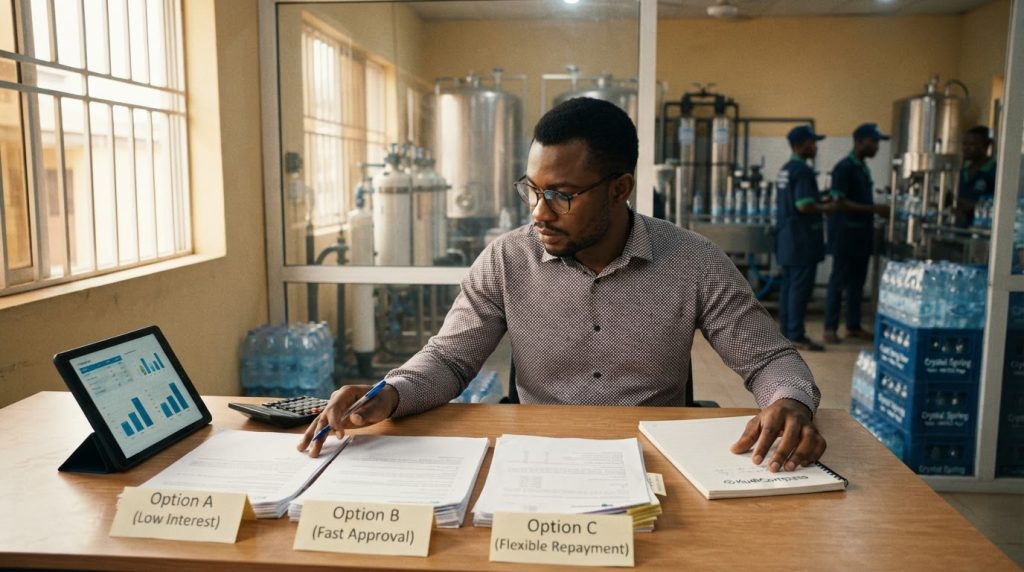
Quick Summary
This guide explains the key costs, trade-offs, and practical steps Nigerian readers should know.
Funding Your Water Factory: Best SME Loans for Nigerian Entrepreneurs in 2026
The dream is easy. The capital wall is not.
Every sachet water business in Nigeria starts with the same picture: a good borehole, a treatment plant, a sealing machine, a NAFDAC-compliant facility, and a market that drinks everything you can produce before noon. Then reality arrives. A production line, a borehole, treatment equipment, packaging machinery, a generator and a facility that passes inspection add up quickly — and rather than throw an invented number at you, this guide sticks strictly to the figures we could verify against primary sources.
If you landed here after typing “loan apps in Nigeria” into Google, we need to be blunt with you: you are looking at the wrong tool. Loan apps are built for small, short-tenor, personal-cash needs — a rent gap, a school fee, a phone. A water factory is a capital-intensive manufacturing business. It needs equipment finance, a moratorium while you build, and a repayment schedule measured in years, not weeks.
The real path runs through structured SME lending from Nigeria’s development finance institutions and commercial banks. Bank of Industry (BOI) primarily finances projects involved in manufacturing, production and agro-processing — which puts a water factory squarely inside its mandate. This guide walks through every product we verified, what each one costs, who it fits, and who should walk away. All rates and product terms below were verified on 15/10/2026.
Quick Answer: the shortlist
| Option | Interest | Maximum amount | Tenor | Moratorium | Best fit |
|---|---|---|---|---|---|
| BOI Food & Agro Commodity Processing | 9% p.a. + 1% processing fee | ₦200m (Limited Liability Company) / ₦10m (cooperative or enterprise) | 3–5 years | Up to 12 months from disbursement | Registered water factory scaling production |
| FGN/BOI MSME Intervention Fund | 9% p.a. all-inclusive | ₦1m per business | 3 years | Repayment starts 3 months after disbursement | Micro sachet/table water start-up |
| DBN funding via a PFI | Set by the PFI — we could not verify current PFI on-lending pricing | Set by the PFI | Up to 10 years | Up to 18 months | Long-payback asset finance |
| Zenith Z-Woman Business Package | 16% p.a. | ₦10m | 12–24 months | Not stated on the product page | Female-owned businesses (50%+ or majority woman shareholding) |
| Zenith MSME loan | 27% p.a. | ₦2m | 12 months | Not stated | Very short working capital only |
Top pick: BOI’s Food & Agro Commodity Processing product. At 9% per annum with a 1% processing fee, it is the cheapest verified naira facility on this list, and the 3–5 year tenor with up to 12 months moratorium matches the reality of building a facility before you sell a single bag.
One caution before you read further: these are structured loans. They need documentation, not just a phone number and a BVN. We break down the paperwork in Section 3.1.
Detailed Analysis: what each lender actually offers
3.1 Bank of Industry (BOI) — the natural first stop
BOI is the obvious starting point for a water business because its lending mandate is manufacturing, production and agro-processing — the exact category a sachet or bottled water operation falls into. Its SME offer is also structurally different from a commercial bank’s: BOI states its SME loans carry longer tenors of 3–5 years than are generally available, are offered at below-market rates, and include a moratorium period of 3–12 months.
The flagship product for this sector is Food & Agro Commodity Processing:
- Interest rate: 9% per annum
- Processing fee: 1%
- Maximum for a Limited Liability Company: ₦200 million
- Maximum for cooperatives and enterprises: ₦10 million
- Term loan tenor: 3–5 years
- Moratorium: up to 12 months from the date of loan disbursement
The documentation reality check. This is where most applications die. BOI’s MSME check-off list requires, among other items:
- Regulatory approvals and licences applicable to the sector of operation — for example NAFDAC and SON
- A completed BOI Environmental, Social and Governance (ESG) Evaluation Form
- A feasibility study report including the company profile and a write-up on the technology/manufacturing process
- Quotations or proforma invoices for the supply of machinery and equipment
- Sources and quotations for raw materials expressed in quantity and amount
In plain English: if you do not yet have a water factory plan detailed enough to list your treatment equipment by model, your PET preform supplier by name, and your NAFDAC registration, you are not ready to apply. BOI also runs a facility assessment step as part of the process.
3.2 FGN/BOI MSME Intervention Fund — for the smallest operators
If you are producing sachet water from a single sealing machine and a rented shop, the ₦200 million product is not for you. The FGN/BOI MSME Intervention Fund is the better fit. It is a ₦75 billion pool structured for micro and small businesses, with:
- A maximum loan amount of ₦1 million per business
- 9% per annum, all-inclusive
- Repayment over a three-year period
- Repayment beginning three months after disbursement
Honest verdict: ₦1 million buys a used sealing machine, a small UV unit and some packaging film. It does not buy a borehole, a treatment plant or a bottling line. Treat this as a starter facility for a micro-producer, not a factory build.
3.3 Development Bank of Nigeria (DBN) — long tenors, accessed indirectly
This is the single most misunderstood lender in Nigerian SME finance. DBN does not lend directly to businesses. Applications are channelled through Participating Financial Institutions (PFIs) — commercial banks and microfinance banks — which take the credit risk and price the loan themselves.
What DBN’s wholesale line does is give PFIs the room to offer terms you will not find on a standard commercial ticket:
- Tenors of up to 10 years to repay
- Up to 18 months moratorium on principal repayment for working capital and investment projects
For credibility, DBN’s own homepage reports it had disbursed over ₦1.4 trillion in wholesale funding as of December 2025 — a useful indicator that the window is genuinely active, though the on-lending rate you are quoted will be determined by the PFI, not by DBN.
Practical note: because you apply through a PFI, you face two layers of assessment — the bank’s own credit review on top of DBN’s wholesale terms. We could not retrieve current published product pricing for individual PFIs such as GTB or First Bank within our verification window; both appear in DBN’s PFI network, but we will not quote a rate we could not confirm against a primary source. Ask the branch directly.
3.4 Zenith Bank — the commercial bank alternative
If you need speed, a long banking relationship, or you simply do not qualify for a development finance product, Zenith’s published corporate lending terms are the clearest commercial option we could verify.
Z-Woman Business Package — for female-owned businesses with 50% or any majority shareholding owned by a woman:
- Rate: 16% p.a.
- Maximum loan amount: ₦10 million
- Tenor: 12 to 24 months
Zenith MSME loan:
- Rate: 27% p.a.
- Loan range: ₦500,000 to ₦2,000,000
- Tenor: 12 months
Zenith Sub-KD/Sub-Dealer Finance — listed on the same page at 19% p.a., maximum ₦5 million. This is a distributor product, not a manufacturer product. It is relevant to you only if you are moving other people’s water, not making your own.
Notice the spread: 16% versus 27% on the same bank’s own page. Commercial pricing in Nigeria is heavily risk- and segment-based, and the CBN’s monetary policy stance sits underneath all of it. We could not verify the current policy rate against a primary source at the time of writing, so treat any commercial bank quote as a moving target and confirm it in writing before you commit.
The full comparison, side by side
| Feature | BOI Food & Agro | FGN/BOI MSME Fund | DBN via PFI | Zenith Z-Woman | Zenith MSME |
|---|---|---|---|---|---|
| Interest | 9% p.a. | 9% p.a. all-in | PFI-determined | 16% p.a. | 27% p.a. |
| Processing fee | 1% | Not stated | PFI-determined | Not stated | Not stated |
| Ceiling | ₦200m (LLC) / ₦10m (co-op) | ₦1m | PFI-determined | ₦10m | ₦2m |
| Tenor | 3–5 years | 3 years | Up to 10 years | 12–24 months | 12 months |
| Moratorium | Up to 12 months | 3 months to first repayment | Up to 18 months | Not stated | Not stated |
| Apply through | BOI directly | BOI directly | A PFI | Zenith | Zenith |
| Documentation load | Heavy | Lighter | Heavy | Moderate | Moderate |
Why loan apps in Nigeria cannot fund a water factory
This is the part the search results will not tell you. Loan apps and structured SME loans are different financial instruments solving different problems.
| Typical loan app | Structured SME loan |
|---|---|
| Ticket size | Small personal-cash amounts |
| Tenor | Weeks to a few months |
| Underwriting basis | Phone data, BVN, credit bureau records |
| Documentation | Minimal |
| Designed for | Personal emergencies, cash-flow smoothing |
| Fit for a water factory | Poor |
Two compliance call-outs before you download anything:
First, Nigerian digital lenders operate under a registration framework supervised by the Federal Competition and Consumer Protection Commission (FCCPC). We were unable to verify the current register of approved digital lenders against a primary source at the time of writing, so treat any app’s marketing claim of being “CBN licensed” or “FCCPC approved” as unverified until you check the regulator’s own published list. Do not take a screenshot of an app store page as proof.
Second, a loan app’s speed is not free. Short-tenor credit priced over a few weeks can carry an effective annual cost far higher than the 9%–27% range on this page. If your plan is to borrow ₦2 million for 30 days, roll it, and buy a sealing machine, you are financing a five-year asset with 30-day money. That is how water businesses die.
What a water factory lender actually looks at
Based on BOI’s published checklist, your application lives or dies on four things:
- Regulatory standing. NAFDAC and SON approvals applicable to your sector. No NAFDAC number, no water business, no loan.
- A real technical plan. The feasibility study must include a write-up on your technology and manufacturing process — that means treatment stages, capacity per hour, and how you handle quality control.
- Priced equipment. Quotations or proforma invoices for your machinery. Lenders fund invoices, not intentions.
- Raw material visibility. Sources and quotations for raw materials, expressed in quantity and amount — film, preforms, chemicals, and your supply chain for each.
You will also complete an ESG Evaluation Form and go through a facility assessment. Expect a KYC process that includes your BVN, NIN and corporate documents — as with any regulated lender in Nigeria, identity verification is non-negotiable at account opening and at drawdown.
Illustrative repayment maths (and why the moratorium matters)
Take ₦10 million drawn under the BOI Food & Agro product at the published 9% per annum over three years, using simple interest purely as an illustration:
- Annual interest: ₦900,000
- Total interest over three years: ₦2,700,000
- Total repayment: ₦12,700,000
- Roughly ₦352,778 per month across 36 months
Now compare the same ₦10 million on Zenith’s MSME product at 27% p.a. — except you cannot, because the ceiling is ₦2 million on a 12-month tenor. That is the whole point of the comparison. Cheaper money is not just cheaper; it is the difference between a facility that can be repaid from production and a facility that cannot be accessed at all.
These are illustrative arithmetic figures, not lender quotes. Actual amortisation schedules, interest treatment during moratorium, and fees vary by product and will be detailed in your offer letter. Read that letter line by line before signing.
Who should NOT use these products
Being straight with you matters more than filling this page with enthusiasm.
- You have no NAFDAC registration and no plan to get one. BOI’s checklist asks for sector regulatory approvals including NAFDAC. Fix compliance first.
- You need money in 48 hours. Structured lending does not work at app speed. If the need is urgent and small, this is not your instrument — but neither is rolling short-term debt into a factory.
- You are a distributor, not a manufacturer. BOI’s mandate covers manufacturing, production and agro-processing. If you buy and resell finished water, look at dealer finance structures such as Zenith’s Sub-KD/Sub-Dealer Finance at 19% p.a., maximum ₦5 million instead.
- You want ₦500,000 for personal spending. The Zenith MSME product’s ₦500,000 floor exists, but using business credit for personal consumption is how small businesses acquire bad debt.
- You cannot service a monthly instalment from projected sales. If your unit economics do not cover roughly ₦352,778 a month on a ₦10 million draw, the loan will bury you.
- You have not priced your raw materials. The checklist requires raw material sourcing in quantity and amount for a reason. If you cannot state your cost per bag, you cannot state your margin.
This is not a recommendation to borrow. Debt is a tool with a repayment obligation attached, and every facility above must be repaid whether your factory sells or not.
What to Do Next
- Pick your lane before you pick a lender. Under ₦1 million: the FGN/BOI MSME Intervention Fund. ₦1 million to ₦200 million with a manufacturing plan: BOI Food & Agro Commodity Processing. Female-majority ownership: Zenith Z-Woman.
- Start the compliance file today. NAFDAC and SON approvals, CAC documents, BVN and NIN for directors. Nothing else moves until this exists.
- Build the documentation pack against BOI’s published checklist — download it and work through it item by item. Get real equipment quotations and raw material quotes in writing.
- If you want the longest tenor, walk into a DBN PFI branch and ask specifically about DBN wholesale-funded facilities. Remember DBN does not lend directly — but it does underwrite tenors of up to 10 years with up to 18 months moratorium through its partners.
- Compare the all-in cost, not the headline rate. Add processing fees, insurance, legal fees and any moratorium interest treatment before you compare two offers.
- Complete the BOI facility assessment honestly. Inflated projections get caught, and a declined application stays in the system.
FAQ
Can I use a loan app in Nigeria to fund a water factory? No, not sensibly. Loan apps are built for small, short-tenor personal needs. A water factory needs equipment finance over 3–10 years, which is what BOI and DBN-backed PFI lending exist to provide.
Which lender offers the cheapest SME loan for a water business? On verified published terms, BOI’s Food & Agro Commodity Processing product at 9% per annum plus a 1% processing fee. The FGN/BOI MSME Intervention Fund is also 9% per annum all-inclusive, but capped at ₦1 million.
Do I need NAFDAC registration to get a loan for a water factory? BOI’s MSME checklist requires regulatory approvals and licences applicable to your sector, including NAFDAC and SON. Without them you cannot complete the application.
How long does a BOI SME loan take to process? We could not verify a current published turnaround time from a primary source, so we will not guess. What is verifiable is the document burden — feasibility study, machinery quotations, ESG form and raw material sourcing — which means preparation time, not approval time, is usually the bottleneck.
Can a cooperative or an enterprise apply, or only a Limited Liability Company? Both. The Food & Agro Commodity Processing product allows up to ₦200 million for a Limited Liability Company and ₦10 million for cooperatives or enterprises.
I am a woman-owned water business. Is there a specific product? Yes. Zenith’s Z-Woman Business Package is available to businesses with 50% or any majority shareholding owned by a woman, at 16% per annum, up to ₦10 million, over 12–24 months.
What collateral do these lenders require? We could not verify current collateral requirements for these specific products from primary sources, so we will not state a figure. Ask each lender directly and get the security requirement in writing before you pay any application fee.
Do GTB and First Bank offer DBN-backed loans? Both are confirmed participants in DBN’s PFI network, and DBN channels all its lending through PFIs. However, we could not retrieve current published product pricing for either bank, so we are not quoting rates for them. Ask at the branch.
Sources
- Bank of Industry — SMEs
- Bank of Industry — Food & Agro Commodity Processing
- BOI MSME Document Check-off List
- BOI Facility Assessment
- FGN/BOI MSME Intervention Portal — FAQs
- Development Bank of Nigeria — FAQs
- Development Bank of Nigeria — Homepage
- Zenith Bank — Corporate Banking Loans & Investment
All product terms verified 15/10/2026. Lending rates, ceilings and eligibility criteria change; confirm current terms directly with the lender before making any decision.