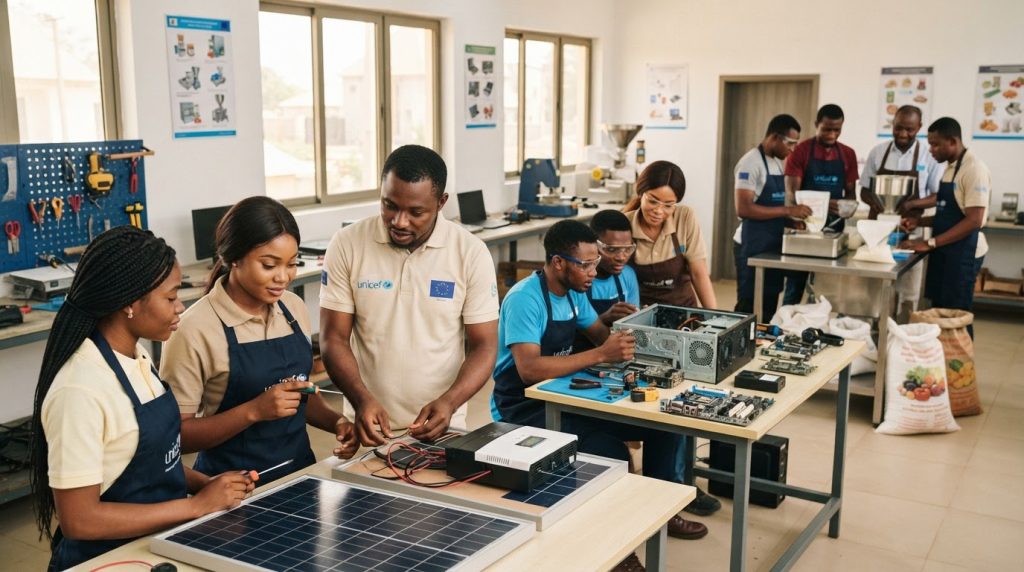
Quick Summary
The European Union, in partnership with UNICEF and YABATECH, launched the Youth Employability and Skills Project (YESP) on 2 November 2026. This free initiative targets 3,400 young people across Kano, Jigawa, and Sokoto states, offering training in nine high-demand skill areas like solar installation, climate-smart agriculture, and computer repair. Beneficiaries receive NSQ Level 2 certification and access to Community Entrepreneurship Hubs for post-training support.
Quick Answer: What Is the YESP Project and How Can You Apply?
The Youth Employability and Skills Project (YESP) is a free training program funded by the European Union and UNICEF. It provides 3,400 young Nigerians in Kano, Jigawa, and Sokoto with practical skills, nationally recognized certification, and business support. To apply, you must engage with your local government area (LGA) secretariat, as there is no public online application portal. Priority is given to young women and vulnerable youths.
Key Takeaways
- Free Training: YESP is fully funded by the EU and UNICEF, costing participants nothing.
- 9 Practical Skills: Choose from solar PV, climate-smart agriculture, computer repair, and more.
- Nationally Recognized Certification: Earn an NSQ Level 2 qualification and a YABATECH certificate.
- Post-Training Support: Access mentorship and enterprise support via Community Entrepreneurship Hubs.
- No Online Portal: Applications are managed through local government areas (LGAs).
Introduction: A New Opportunity for Northern Nigerian Youth
When most Nigerians hear “European Union,” they think of Schengen visas, study abroad opportunities, or European products. But the European Union’s presence in Nigeria goes far beyond travel documents. Through partnerships with UNICEF and Nigerian institutions, the EU is actively funding life-changing projects that directly impact young Nigerians—especially those in the North.
One of the most significant opportunities available right now is the Youth Employability and Skills Project (YESP) —a completely free training initiative targeting 3,400 young people across Kano, Jigawa, and Sokoto states. Launched on 2 November 2026 at Niimah Guest Palace in Kano, this project offers market-relevant skills training, nationally recognized certification, and post-training support—all at zero cost to participants.
If you’re a young Nigerian in Northern Nigeria wondering how to gain practical skills without paying expensive tuition fees, this guide is for you. We’ll cover who qualifies, what skills you can learn, how to apply, what certification you receive, and the challenges you should be aware of.
In 2026, with youth unemployment remaining stubbornly high across Nigeria, projects like YESP offer a direct pathway to self-employment and formal certification. Let’s break down everything you need to know.
What Is the Youth Employability and Skills Project (YESP)?
The Youth Employability and Skills Project is a partnership between UNICEF and the European Union, implemented by Yaba College of Technology (YABATECH) in collaboration with the Industrial Training Fund (ITF). According to The Nation Newspaper, the project was officially launched on 2 November 2026.
Key Facts at a Glance
| Total beneficiaries | 3,400 young people |
| States covered | Kano (1,200 slots), Jigawa (1,100), Sokoto (1,100) |
| Local government areas | 30 (10 per state) |
| Gender balance | 1,700 female, 1,700 male |
| Implementing partners | YABATECH and ITF |
| Funders | UNICEF and European Union |
| Launch date | 2 November 2026 |
| Launch location | Niimah Guest Palace, Kano |
As reported by Punch Newspapers, the project gives particular attention to young women and vulnerable youths to ensure inclusive access. This means if you’re a young woman or come from a disadvantaged background, you have a higher chance of being selected.
The project operates under the broader EU-supported Education and Youth Empowerment Programme in Northern Nigeria (EYEPINN), which has been running for several years. YESP represents a focused skills-development component of this larger initiative.
Nine Skill Areas You Can Train In for Free
One of the most attractive features of YESP is the variety of practical skills on offer. According to The Nation Newspaper, the project covers nine distinct skill areas, each chosen for its relevance to the Northern Nigerian economy and its potential for self-employment.
The Nine Training Areas
- Solar PV Installation and Maintenance – Learn to install, maintain, and repair solar photovoltaic systems. With Nigeria’s growing solar energy market, this skill is in high demand across residential, commercial, and rural electrification projects.
- Climate-Smart Poultry and Micro-Livestock Production – Modern poultry farming techniques that account for climate change. Includes disease management, feed optimization, and sustainable practices.
- Agro-Processing and Solar Drying – Transform raw agricultural produce into value-added products using solar drying technology. Think dried fruits, vegetables, and herbs that can be stored longer and sold at higher prices.
- Economic Tree Production – Cultivation of trees with commercial value, such as shea, moringa, and fruit trees. This combines environmental benefits with income generation.
- Briquette and Clean-Energy Production – Turn agricultural waste (sawdust, rice husks, groundnut shells) into clean-burning briquettes. A growing market as Nigerians seek alternatives to firewood and charcoal.
- Waste Recycling and Upcycling – Convert waste materials into useful products. From plastic recycling to fabric upcycling, this sector offers both environmental and economic benefits.
- Climate-Smart Irrigation – Water-efficient farming techniques that help farmers cope with changing rainfall patterns. Includes drip irrigation, rainwater harvesting, and solar-powered pumping.
- Compost Production – Turn organic waste into high-quality fertilizer. Essential for sustainable agriculture and increasingly demanded by farmers moving away from chemical fertilizers.
- Computer Hardware Maintenance and GSM Repair – Diagnose and repair computers, laptops, and mobile phones. With digital penetration rising across Nigeria, this skill guarantees steady demand.
Which Skill Is Best for You?
| If you’re interested in… | Choose this skill |
|---|---|
| Renewable energy and technology | Solar PV Installation |
| Agriculture and food production | Climate-Smart Poultry, Agro-Processing, Economic Tree Production, Climate-Smart Irrigation, Compost Production |
| Environmental sustainability | Briquette Production, Waste Recycling |
| Digital economy and repairs | Computer Hardware Maintenance and GSM Repair |
These skills were deliberately chosen because they align with climate-smart agriculture, renewable energy, and the digital economy—sectors with proven demand in Northern Nigeria. Whether you want to start your own business or find formal employment, these skills give you a competitive edge.
Who Can Apply? Eligibility and Selection Process
This is the question we get most often, so let’s be clear about what we know—and what we don’t.
Eligibility Criteria
Based on available information from Punch Newspapers:
- Target group: Young people in Kano, Jigawa, and Sokoto states
- Priority: Young women and vulnerable youths
- Age range: Not explicitly stated in sources, but implied as youth/unemployed individuals
- Residency: You must be resident in one of the 30 participating LGAs
How the Selection Process Works
According to The Nation Newspaper, as of the launch date on 2 November 2026, no public online application portal has been announced. Instead, beneficiary selection is conducted through:
- The 30 participating local government areas (10 per state)
- Community-level stakeholder engagement
This means the application process is not something you can complete online from your phone. You need to engage with your local government council.
Actionable Steps You Can Take Right Now
- Identify your LGA – Find out if your local government is one of the 10 participating LGAs in your state. The specific LGAs were not listed in the sources, so you’ll need to contact your LGA council directly.
- Visit your LGA secretariat – Go to the local government council office in your area and ask about the Youth Employability and Skills Project. Inquire about community engagement sessions and how to be nominated.
- Connect with community leaders – The project uses community-level stakeholder engagement, so traditional rulers, ward heads, and youth leaders may have information about selection processes.
- Prepare your documents – While not explicitly required, having your BVN and NIN ready is always wise for any government or donor-funded program in Nigeria.
- Be patient but persistent – With only 3,400 slots across three states, competition will be high. Follow up regularly with your LGA office.
What You Get – Certification and Post-Training Support
The value of YESP goes beyond the training itself. Successful participants receive formal certification and ongoing support that can transform their career prospects.
Certification You’ll Earn
According to Voice of Nigeria, beneficiaries who pass competency-based assessments will receive:
- National Skills Qualification (NSQ) Level 2 certification – This is a nationally recognized qualification under the Nigerian skills qualification framework. It’s the equivalent of a trade certificate and is recognized by employers and government agencies across Nigeria.
- YABATECH completion certificate – Issued by Yaba College of Technology, one of Nigeria’s most respected polytechnics. This adds institutional credibility to your training.
Why This Matters
- NSQ Level 2 can open doors to formal employment in both public and private sectors
- The certification can help you access micro-loans from banks and development finance institutions
- It provides a foundation for further skills development and higher-level NSQ certifications
- YABATECH’s reputation adds weight to your CV
Post-Training Support
According to The Nation Newspaper, Community Entrepreneurship Hubs will be established in all three states. These hubs provide:
- Post-training mentorship – Guidance from experienced entrepreneurs and industry professionals
- Enterprise support – Help with business registration, market access, and networking
- Continued learning – Opportunities to upgrade your skills and stay current in your field
This ongoing support is crucial because many skills training programs end after the classroom sessions, leaving graduates to figure out the next steps on their own. YESP’s hub model addresses this gap. Graduates can also learn how to protect their new business ventures with proper insurance coverage.
Risks and Challenges to Be Aware Of
We believe in giving you the full picture—not just the good parts. Here are the challenges and risks you should consider before pursuing this opportunity.
Key Challenges
- Limited Slots: Only 3,400 beneficiaries across three states means competition will be intense. With millions of young people in Kano, Jigawa, and Sokoto combined, the acceptance rate will be very low. Don’t put all your hopes on this single program.
- No Online Application Portal: As confirmed by The Nation Newspaper, there is no public online application portal. This creates access barriers, transparency concerns, and information asymmetry.
- Geographic Limitation: The project is strictly limited to 30 LGAs across three states. If you live outside these areas—even in neighboring states like Katsina, Zamfara, or Kaduna—you are not eligible.
- Unclear Timeline: As of 18 November 2026, the exact training schedule, duration, and start dates have not been publicly announced. This makes it difficult to plan around the program.
What You Can Do About These Challenges
- Apply to multiple programs – Don’t rely solely on YESP. Look for other skills training opportunities from government agencies (like NDE, ITF, or SMEDAN), NGOs, and private sector initiatives. Check out state-specific business grants that may be available in your area.
- Build local connections – Attend community meetings, introduce yourself to LGA officials, and network with youth leaders in your area.
- Prepare alternative plans – Consider self-learning through online platforms (Coursera, Udemy, YouTube) while waiting for YESP updates.
Frequently Asked Questions
Is the YESP training really free?
Yes. The Youth Employability and Skills Project is fully funded by the European Union and UNICEF. Beneficiaries pay nothing for training, materials, or certification. According to Punch Newspapers, the project targets young people specifically to remove financial barriers to skills acquisition.
Do I need a BVN or NIN to apply?
The sources do not explicitly list BVN or NIN as requirements for YESP. However, for any government or donor-funded program in Nigeria in 2026, having your National Identification Number (NIN) and Bank Verification Number (BVN) is strongly recommended. These are increasingly required for identity verification and potential stipend or grant disbursements.
Can I apply if I live outside Kano, Jigawa, or Sokoto?
No. The project is specifically designed for young people in these three states, covering 30 local government areas (10 per state). If you live in other Northern states like Kaduna, Katsina, Zamfara, or Bauchi, you are not eligible for this particular program.
How long is the training?
The exact duration of training has not been publicly announced as of 18 November 2026. Based on similar UNICEF/EU skills projects, training typically runs between 3 to 6 months, including both classroom instruction and practical sessions. We recommend contacting your LGA for specific timelines.
What if I don’t pass the competency assessment?
The sources indicate that certification is awarded to beneficiaries who pass competency-based assessments. If you don’t pass, you may still receive a certificate of participation, but you won’t earn the NSQ Level 2 or YABATECH completion certificate. The project likely includes support to help you prepare for assessments.
Will I get a job after completing the training?
YESP does not guarantee employment. However, the project provides market-relevant skills that increase your employability, NSQ Level 2 certification recognized by employers, and Community Entrepreneurship Hubs for post-training mentorship and enterprise support. Your success depends on how you leverage these resources.
Is there an age limit?
The sources do not specify an exact age range. The project targets “young people” and “youths,” which in Nigerian government contexts typically refers to individuals aged 18 to 35. Contact your LGA for clarification.
Can I choose more than one skill area?
The available information does not specify whether beneficiaries can train in multiple skill areas. Given the limited slots (3,400 for nine skill areas), it’s likely that each participant will focus on one skill. You may need to indicate your preference during the selection process.