
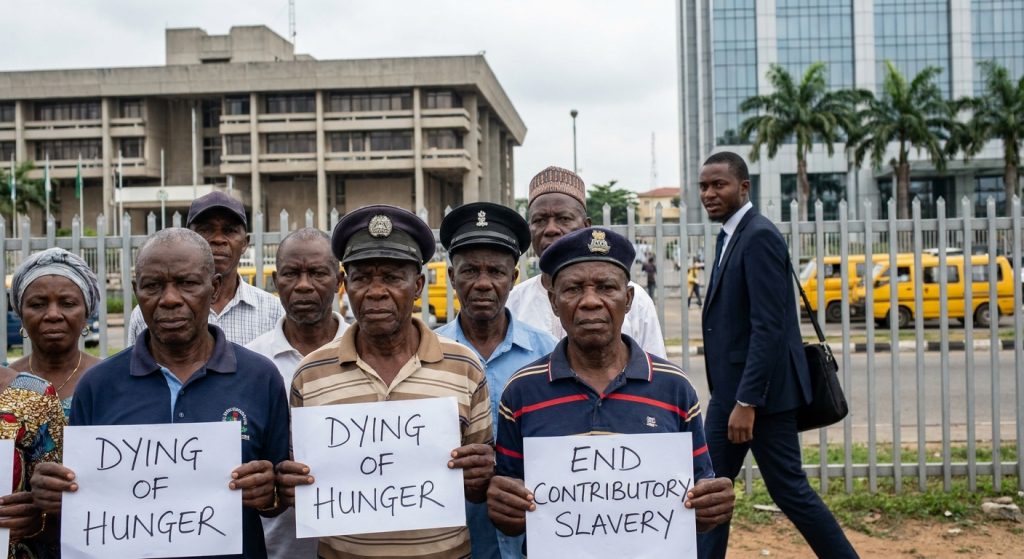
Nigerian police retirees are protesting nationwide, demanding exit from the Contributory Pension Scheme (CPS) due to perceived inadequate benefits and delays. They want President Tinubu to sign a bill passed by the National Assembly that would move them to a Police Pension Board, similar to the military. This ongoing struggle highlights significant financial hardship for veterans and could impact Nigeria’s pension system, government finances, and the broader economy, affecting your savings and investments.
Breaking News: Police Retirees Stage Nationwide Pension Protest – The Full Story
On 20/04/2026, hundreds of retired police officers blocked the entrance to Nigeria’s Presidential Villa in Abuja, carrying placards with messages like "Dying of hunger" and "End Contributory Slavery." The protest, organized by the Police Retired Officers Forum of Nigeria (PROF), marks the latest escalation in a decade-long battle over pension rights.
Key demands of the protesting police retirees include:
- Immediate presidential assent to the Police Pension Board Bill passed by the National Assembly on 04/12/2025.
- Migration from the Contributory Pension Scheme (CPS) to a Defined Benefit Scheme under a dedicated Police Pension Board.
- Payment of outstanding accrued benefits, estimated at ₦500 billion.
- Pension harmonization with military counterparts.
"The CPS has left us as beggars in retirement," said retired AIG Emmanuel Ojukwu, PROF’s spokesperson. "While soldiers receive ₦150,000 monthly minimum, police retirees get as low as ₦35,000 under this fraudulent scheme."
Understanding the Grievance: Why Are Police Retirees Protesting Now?
The Pension Scheme Timeline:
- Pre-2004: Police enjoyed Defined Benefits (government-funded pensions).
- 2004: Obasanjo administration introduced CPS for all civil servants.
- 2014: Military was exempted from CPS, creating disparity.
- 2025: National Assembly passed police exemption bill.
How CPS Works for Police:
- 7.5% salary deduction + 7.5% employer contribution.
- Managed by Pension Fund Administrators (PFAs) like ARM Pension, Stanbic IBTC, and Premium Pension.
- Average monthly pension: ₦35,000-₦80,000 after 35 years service.
Core Complaints:
- Inadequate Payments: ₦35,000 can’t cover basic needs amid 28% inflation.
- Delayed Access: Retirees wait 6-18 months for first payment.
- Lump Sum Disparity: Maximum 25% withdrawal vs military’s 300% gratuity.
- Investment Risks: Pension funds exposed to market fluctuations.
What is the Contributory Pension Scheme (CPS)?
The Contributory Pension Scheme (CPS) is a system in Nigeria where workers and their employers contribute a percentage of their salaries to individual retirement savings accounts (RSAs). These accounts are managed by licensed Pension Fund Administrators (PFAs), with the goal of providing retirement benefits. It was designed to reduce government pension liabilities but has been criticized for low payouts and delays.
Key Players and Their Stance
| Institution | Position | Concerns |
|---|---|---|
| PENCOM | Opposes exemption | Fears mass exit could destabilize ₦15 trillion pension assets |
| Police HQ | Supports retirees | Argues policing is "high-risk" like military |
| Presidency | Undecided | Weighing fiscal impact (₦2.1 trillion estimated cost) |
| National Assembly | Pro-exit | Passed bill with bipartisan support |
Notably, the Nigeria Labour Congress (NLC) warns that police exemption could trigger similar demands from civil servants, potentially collapsing the CPS system entirely.
Impact on the Nigerian Economy and Financial Market
Potential Ripple Effects:
- Pension System Stability
- Police contributions make up 18% of CPS funds.
- Mass withdrawal could force PFAs to liquidate assets quickly.
- Government Finances
- Transition costs could consume 3% of 2026 budget.
- May require new borrowing, increasing debt-to-GDP ratio.
- Investor Confidence
- Rating agencies watching for policy reversals.
- Foreign portfolio investors hold 40% of pension bond assets.
- Inflation Risk
- Large pension payouts could spike money supply.
- CBN may respond with higher interest rates.
Comparison: Police vs Military Pensions
| Feature | Police (CPS) | Military (DBS) |
|---|---|---|
| Monthly Pension | ₦35k-₦80k | ₦150k-₦450k |
| Gratuity | 25% balance | 300% annual salary |
| Payment Delay | 6-18 months | 3 months max |
| Adjustment | No inflation indexing | Annual increases |
What This Means for Working Nigerians
For Current Police Officers:
- Immediate 7.5% salary deduction continues.
- Uncertainty about future benefits.
- Required documents: BVN, NIN, PENCOM registration.
For Private Sector Workers:
- CPS likely to remain mandatory.
- Watch for possible PFA fee increases to cover losses.
- Consider voluntary contributions (up to ₦300k/year tax-free).
For Investors:
- FGN bonds may see sell-off if government borrows more.
- Equity market volatility as PFAs rebalance portfolios.
- Real estate demand may rise from lump sum payments.
What to Do Next: Actionable Steps
Top 5 PFAs by Returns (2025):
| PFA | 5-Year Avg Return | Contact |
|---|---|---|
| ARM Pension | 9.2% | 0700ARM-PENS |
| Stanbic IBTC | 8.7% | *565*6# |
| Premium Pension | 8.5% | 0700PENSION |
| Fidelity Pension | 8.3% | 08003900000 |
| NLPC Pension | 8.1% | 0800NLPC-NOW |
FAQ: People Also Ask
Q: How much pension do police retirees currently get?
A: Police retirees in Nigeria currently receive between ₦35,000 and ₦80,000 monthly, with the exact amount depending on their rank and years of service under the Contributory Pension Scheme (CPS).
Q: What’s the fastest way to check my police pension balance?
A: The fastest way to check your Retirement Savings Account (RSA) balance for police pension is to dial *565*8# or visit the official PENCOM website at pencom.gov.ng.
Q: Can police officers opt out of CPS individually?
A: No, individual police officers cannot opt out of the Contributory Pension Scheme (CPS). Any exemption from the scheme requires a legislative change, as stipulated by Section 5(1) of the Pension Reform Act (PRA) 2014.
Q: Will this affect my private sector pension?
A: While the police retirees’ protest and potential exemption from CPS would not directly affect your private sector pension, widespread instability in the overall pension system could indirectly lead to higher Pension Fund Administrator (PFA) fees or other systemic changes.
Q: How many police retirees are affected?
A: Approximately 150,000 living police retirees are directly affected by the current pension scheme, with an additional 300,000 active personnel also having their future benefits tied to the outcome of this protest.
Bottom Line: These protests highlight systemic flaws in Nigeria’s pension architecture. While police retirees deserve dignified retirement, their demands pose complex trade-offs for national finances. All Nigerians should monitor developments, as the outcome could redefine retirement security for generations.