
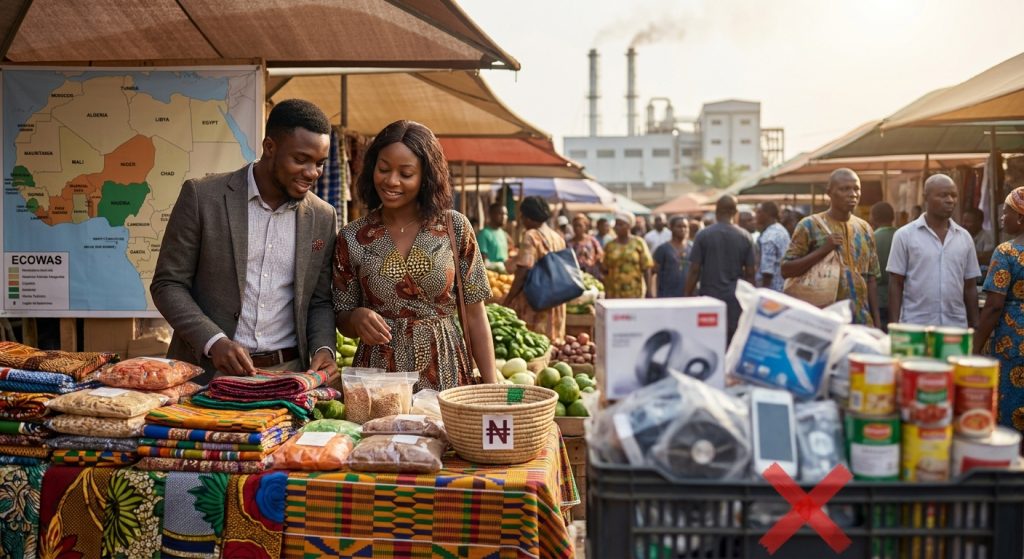
Nigeria has banned 17 categories of imports from non-ECOWAS countries, effective April 1, 2026, to boost local production, conserve forex, and strengthen the Naira. This will likely increase prices for affected goods like cement, poultry, and pharmaceuticals, impacting consumer budgets and business operations. While aiming for long-term economic self-reliance, the policy poses risks of inflation and supply chain disruptions. Nigerians should prepare for higher costs, explore local alternatives, and businesses must adapt supply chains.
Key Takeaways from Nigeria’s Import Ban
- Effective Date: The ban on 17 import categories from non-ECOWAS countries takes effect on April 1, 2026.
- Affected Goods: Includes poultry, cement, pharmaceuticals, agricultural commodities, and detergents.
- Policy Goals: Aims to conserve foreign exchange, strengthen the Naira, and stimulate local production.
- Consumer Impact: Expect significant price increases (40-50% for cement, 50% for frozen chicken) and higher household budgets.
- Business Impact: Local manufacturers and ECOWAS exporters stand to gain, while import-dependent businesses face challenges.
- Economic Outlook: Potential for ₦2.8 trillion annual forex savings and 500,000 new jobs, but risks short-term inflation and smuggling.
- Actionable Advice: Consumers should budget, explore local alternatives; businesses must adapt supply chains and leverage government incentives.
BREAKING: Nigeria’s Sweeping Import Ban Beyond ECOWAS – The Immediate Impact
The Federal Government has announced a major policy shift banning 17 categories of imported goods from non-ECOWAS countries, effective April 1, 2026. This directive, aimed at bolstering local production and conserving foreign exchange, was outlined in a circular signed by Finance Minister Wale Edun. The targeted items include critical sectors such as:
- Poultry foods (frozen chicken/turkey)
- Bagged cement
- Pharmaceutical products
- Agricultural commodities
- Sugar drinks
- Detergents and soaps
- Fertilizers
The Nigerian Customs Service is tasked with enforcing this ban, while the Central Bank of Nigeria (CBN) will closely monitor its implications on the nation’s foreign exchange market. Early market reactions have already indicated significant shifts:
- Price hikes of 15-20% for frozen poultry have been observed in major Lagos markets.
- Leading cement manufacturers like Dangote and BUA are anticipating potential supply gaps as they ramp up local production.
- Pharmaceutical distributors have issued warnings about possible drug shortages, particularly for specialized imported medications.
What is Nigeria’s import ban? Nigeria’s import ban, effective April 1, 2026, prohibits 17 categories of goods from non-ECOWAS countries, including frozen poultry, cement, and pharmaceuticals, to boost local production and conserve foreign exchange.
"The policy is necessary to redirect demand to local producers and foster economic self-reliance," stated Minister Edun during the announcement. However, the Manufacturers Association of Nigeria (MAN) has expressed concerns regarding the accessibility of essential raw materials for local industries, highlighting a potential challenge in the transition phase.
Why Now? Unpacking the CBN’s Rationale and Government’s Strategy
This bold policy move comes at a critical juncture for Nigeria, grappling with persistent economic challenges. The government’s strategy is multifaceted, primarily driven by the need to address:
- Forex Conservation: Nigeria currently spends over ₦5 trillion annually on non-essential imports, according to CBN data from 2025. This significant outflow of foreign exchange has put immense pressure on the nation’s reserves.
- Naira Defense: The Nigerian Naira has experienced substantial depreciation, losing approximately 45% of its value against the US dollar since 2020. Reducing import demand is a key strategy to stabilize and strengthen the local currency.
- Inflation Control: Food inflation reached a staggering 35.4% in March 2026, as reported by the National Bureau of Statistics (NBS). By promoting local production, the government aims to reduce reliance on imported goods, which often contribute to inflationary pressures due to exchange rate fluctuations.
Why is Nigeria banning imports from non-ECOWAS countries? Nigeria is banning imports from non-ECOWAS countries to conserve over ₦5 trillion in annual foreign exchange spending, defend the Naira which has lost 45% of its value since 2020, and control inflation, which saw food prices rise by 35.4% in March 2026.
The policy aligns with several key government initiatives:
- ✅ The Presidential 8-point agenda, which prioritizes economic stabilization and growth.
- ✅ ECOWAS trade promotion targets, aiming to strengthen regional economic integration and intra-African trade.
- ✅ Nigeria’s Industrial Revolution Plan, designed to diversify the economy and boost manufacturing capabilities.
Historically, similar import restrictions in Nigeria have yielded mixed results:
- The 2015 restrictions on rice imports successfully boosted local production by an estimated 60% over five years.
- Conversely, a 2020 ban on cement imports initially led to a 40% price increase before local production capacity could stabilize the market.
The Direct Impact on Nigerian Consumers: What You’ll Pay More For
Nigerian consumers are likely to bear the immediate brunt of this import ban through increased prices for a range of essential goods. The policy, while designed for long-term benefits, will necessitate significant adjustments to household budgets.
Comparison Table: Price Projections for Key Goods Post-Ban
| Product | Current Price (₦) | Post-Ban Estimate (₦) | Increase |
|---|---|---|---|
| 50kg Cement (Dangote) | 8,000-10,000 | 12,000-15,000 | 40-50% |
| 1kg Frozen Chicken | 3,000-4,500 | 4,500-6,000 | 50% |
| Antibiotics (Imported) | Varies | 20-40% higher | – |
| Detergent (5kg) | 6,500 | 8,200 | 26% |
What will be the impact of Nigeria’s import ban on consumer prices? Nigerian consumers can expect significant price increases for banned goods, with 50kg cement potentially rising by 40-50% (to ₦12,000-₦15,000), 1kg frozen chicken by 50% (to ₦4,500-₦6,000), and imported antibiotics by 20-40%.
Household Budget Impact:
- An average Nigerian family of four could see an increase of approximately ₦15,000 monthly on purchases of affected items.
- Low-income earners will disproportionately feel the financial strain, necessitating careful budgeting and exploration of cheaper alternatives.
- Local alternatives, such as fresh local chicken (currently around ₦4,000/kg), may become more attractive compared to the rising cost of frozen imported poultry.
KudiCompass Tip: Adjust Your Budget Now
"Consumers should start adjusting budgets now, well before the April 2026 implementation date," advises KudiCompass financial analyst Adeola Johnson. "Prioritize essential medications and consider bulk buying of non-perishable items before the full impact of the ban is felt. Exploring local alternatives for food items can also help mitigate rising costs."
Nigerian Businesses Under Pressure: Winners and Losers
The import ban will create a dynamic shift in the Nigerian business landscape, presenting both significant opportunities and considerable challenges across various sectors.
Winners:
- Local Manufacturers: Companies like Dangote Foods, Flour Mills Nigeria, and local pharmaceutical producers are poised to benefit from reduced competition and increased domestic demand.
- ECOWAS Exporters: Businesses in neighboring ECOWAS countries, such as Ghanaian poultry suppliers or Benin cement manufacturers, will find new market opportunities in Nigeria.
- Agricultural Startups: Innovative agricultural tech companies like Farmcrowdy and Thrive Agric, focused on local food production, are expected to see increased investment and demand.
Losers:
- Import-Dependent Retailers: Businesses heavily reliant on importing goods, particularly in electronics (though not directly banned, supply chain costs may rise), and specialized pharmaceuticals, will face significant operational hurdles.
- Quick-Service Restaurants: Many QSRs that depend on imported frozen poultry for consistency and cost-efficiency will need to rapidly re-evaluate their supply chains.
- SMEs Using Imported Raw Materials: Small and Medium Enterprises (SMEs) that rely on specific imported raw materials not readily available locally or from ECOWAS partners may struggle with increased input costs and supply disruptions.
Adaptation Strategies for Businesses:
To navigate this new trade environment, Nigerian businesses must proactively implement strategic changes:
- Source from ECOWAS Partners: Explore and establish new supply chains with countries like Ivory Coast, Senegal, and Ghana, leveraging regional trade agreements.
- Partner with Local Producers: Collaborate with Nigerian manufacturers and farmers. The government offers a 10% tax incentive for businesses that significantly increase their local sourcing.
- Apply for CBN’s RT200 Forex Rebate Scheme: This initiative provides rebates to exporters, which can indirectly support businesses looking to earn foreign exchange to import essential, non-banned raw materials.
Financial Support for Transition
Leading Nigerian banks, including UBA, Zenith Bank, and Access Bank, have announced special loan packages with interest rates around 18% for businesses transitioning to local sourcing or expanding their production capacities to meet domestic demand. Businesses should explore these financing options to facilitate their adaptation.
The Long-Term Economic Outlook: Potential Benefits and Risks
The import ban is a high-stakes gamble with the potential for significant long-term economic restructuring. While the government projects substantial benefits, critical risks must be effectively managed for the policy to succeed.
Potential Benefits:
- ₦2.8 Trillion Annual Forex Savings: The Federal Ministry of Budget and National Planning (FMBNP) estimates that the ban could lead to annual foreign exchange savings of up to ₦2.8 trillion, significantly bolstering Nigeria’s external reserves.
- 500,000 New Manufacturing Jobs by 2028: Increased local production is projected to create a substantial number of jobs across various manufacturing sectors, contributing to employment generation and poverty reduction.
- Stronger Regional Trade Ties: The policy is expected to foster stronger economic integration within ECOWAS, potentially growing intra-regional trade by 25% as Nigeria shifts its import focus.
Critical Risks:
- Short-Term Inflation Spike: Economists project an initial increase of at least 5% on the food index due to supply shortages and higher costs of local production before stabilization.
- Smuggling Resurgence: The ban could inadvertently fuel a resurgence in smuggling activities, particularly across porous borders with Benin and Niger, undermining the policy’s effectiveness and revenue generation.
- Quality Concerns with Local Substitutes: Consumers may initially face challenges with the quality and consistency of some local substitutes compared to previously imported goods, requiring robust regulatory oversight from agencies like NAFDAC and SON.
What are the long-term economic impacts of Nigeria’s import ban? The long-term economic impacts of Nigeria’s import ban include potential annual forex savings of ₦2.8 trillion, the creation of 500,000 new manufacturing jobs by 2028, and a 25% growth in ECOWAS trade. However, risks include a short-term inflation spike (+5% on food index), a resurgence in smuggling, and initial quality concerns with local substitutes.
The ultimate success of this policy hinges on several critical factors:
- Stable Electricity for Manufacturers: Consistent power supply is paramount for local industries to scale up production efficiently and competitively.
- Farm Input Subsidies: Government support for agricultural inputs (fertilizers, improved seeds) is essential to boost local food production and keep prices competitive.
- Strict Border Controls: Effective enforcement by the Nigerian Customs Service and other security agencies is crucial to prevent the influx of banned goods through illegal channels.
What Nigerians Should Do Now: Practical Steps
As the April 1, 2026, deadline approaches, both consumers and businesses in Nigeria need to take proactive steps to mitigate potential negative impacts and capitalize on new opportunities.
For Consumers:
-
Stockpile Essential Medications
If you rely on specific imported medications that might be affected, consider purchasing a 3-month supply before the ban takes full effect, subject to expiry dates and storage conditions. Consult your doctor or pharmacist.
-
Open High-Yield Savings Accounts
To offset the impact of potential inflation, consider saving in high-yield accounts. Platforms like Piggyvest offer competitive annual interest rates, currently around 12% p.a., which can help preserve your purchasing power.
-
Explore Local Alternatives
Begin experimenting with locally produced goods, especially for food items and household products. Always check for NAFDAC registration numbers to ensure product safety and quality.
For Businesses:
-
Register with ECOWAS Trade Network (ETN) Portal
This portal facilitates trade within the ECOWAS region. Registering can help identify new suppliers and markets for your products or raw materials.
-
Apply for CBN’s Production and Productivity (P&P) Credit Facility
This facility is designed to support local production. Businesses looking to expand or pivot to local sourcing should explore eligibility and application processes.
-
Re-negotiate Supplier Contracts
Review and re-negotiate existing contracts with international suppliers, especially those outside ECOWAS, before the December 2025 deadline to avoid penalties and ensure a smooth transition.
Government Promised Interventions:
The Federal Government has outlined several support measures to ease the transition:
- ₦500 Billion SME Support Fund: A dedicated fund to assist Small and Medium Enterprises in adapting to the new policy environment.
- 24-Hour Port Clearance for ECOWAS Goods: Streamlined customs procedures to facilitate faster movement of goods from ECOWAS member states.
- Special Waivers for Pharmaceutical Raw Materials: Targeted exemptions or subsidies for essential raw materials used in local pharmaceutical production to prevent drug shortages.
FAQ: Nigeria’s Non-ECOWAS Import Ban
Q: Can I still buy iPhones and laptops?
A: Yes! The import ban does not cover electronics such as iPhones, laptops, or other tech gadgets. It is specifically targeted at the 17 categories of goods outlined by the government, which primarily focus on food items, construction materials, and certain consumer goods.
Q: How will this affect dollar rates?
A: The Central Bank of Nigeria (CBN) predicts that if the demand for foreign exchange drops by 30% due to the ban, the Naira could stabilize at approximately ₦1,050/$ by Q3 2026. The policy’s primary goal is to reduce forex demand and strengthen the Naira.
Q: Are there exemptions to the import ban?
A: Yes, certain critical items are exempted from the ban. These include essential medical equipment, educational materials, and machinery specifically used for local production. The government aims to support key sectors while restricting non-essential imports.
Q: What happens if I travel with banned items?
A: If you travel into Nigeria with undeclared banned goods worth over ₦50,000, the Nigerian Customs Service will confiscate them. It is crucial to declare all items you bring into the country to avoid penalties and ensure compliance with the new regulations.
What To Do Next: Your Action Plan
While challenging, this policy could mark Nigeria’s turning point towards greater economic self-sufficiency. Strategic adaptation will be key to minimizing the pain while maximizing the long-term gains for both businesses and households.