
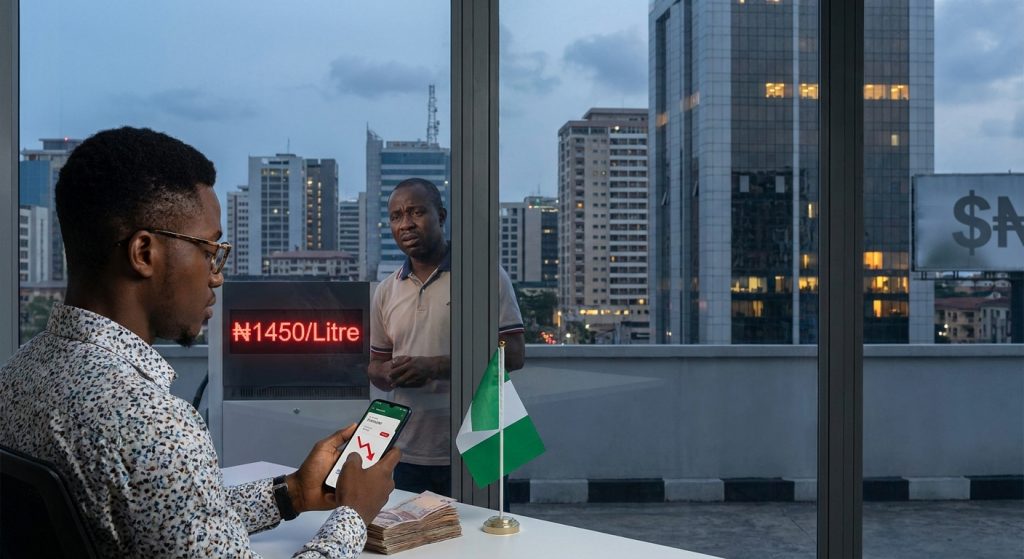
Nigeria’s economy in 2026 faces a severe “economic squeeze” driven by surging fuel costs (now around ₦1,400-₦1,500/litre), persistent power instability, and a volatile Naira. The government’s firm stance against fuel subsidies and price controls has led to market-determined fuel prices, significantly increasing operating costs for businesses and daily expenses for households. This interconnected crisis is fueling inflation, eroding purchasing power, and prompting businesses to raise selling prices. While the IMF projects a growth downgrade, potential oil revenue windfalls offer a glimmer of hope. Nigerians must adapt through strategic budgeting, income diversification, and informed financial planning to navigate these challenging economic headwinds.
Nigeria’s economic squeeze in 2026 is primarily characterized by three interconnected challenges: escalating fuel costs, a persistent power crisis, and the Naira’s volatility. Following the removal of fuel subsidies, petrol prices have surged to approximately ₦1,400-₦1,500 per litre in May 2026. This, combined with unreliable electricity supply and rising tariffs, forces businesses and households to rely on expensive alternative power sources. The Naira’s depreciation further exacerbates the situation by making imports more costly, contributing to high inflation and eroding purchasing power. The government maintains its no-subsidy stance, placing the burden of market-determined prices on consumers and businesses, leading to increased operating costs and a significant strain on the average Nigerian’s finances.
Executive Summary: The Triple Threat – Fuel, Power, and Naira Devaluation 2026
Nigeria’s economic landscape in 2026 is dominated by a severe “economic squeeze,” a confluence of high fuel costs, chronic power instability, and persistent Naira depreciation. These three challenges are deeply interconnected, with the government’s decisive removal of fuel subsidies back in mid-2026 acting as a major catalyst. This policy shift has directly impacted inflation, driven up power generation costs for businesses and households, and contributed to the Naira’s volatile trajectory.
The immediate repercussions are evident across the nation: household budgets are stretched thin, business profitability is under immense pressure, and the overall investment climate faces significant headwinds. As of May 2026, petrol prices have soared to between ₦1,400 and ₦1,500 per litre in many parts of the country, reflecting the government’s firm non-interventionist stance on fuel pricing. Key players like the Central Bank of Nigeria (CBN) continue to navigate monetary policy in a challenging environment, while the federal government remains steadfast in its fiscal policy of no subsidies. This situation has led the International Monetary Fund (IMF) to downgrade Nigeria’s growth projections for 2026 and 2027, underscoring the severity of the economic shock and the further strain on households and businesses.
The Fuel Subsidy Removal Fallout: Unpacking the ₦1,400+/Litre Reality 2026
The journey to the current fuel price reality began back in mid-2026 with the landmark decision to remove the long-standing fuel subsidy. This move, aimed at freeing up government revenue and promoting market efficiency, has profoundly reshaped Nigeria’s economic fabric. While initially met with mixed reactions, its full impact is now starkly evident in May 2026.
Today, the average pump price for Premium Motor Spirit (PMS) across major Nigerian cities hovers between ₦1,400 and ₦1,500 per litre. This is a dramatic increase from the pre-subsidy era. The government, through the Minister of Finance, Taiwo Oyedele, has repeatedly affirmed its commitment to not reintroducing subsidies or price controls, a stance reiterated as recently as May 6, 2026. This policy has empowered marketers like Dangote and others to determine fuel costs based on market dynamics, albeit with some price moderation observed briefly in April 2026 by Dangote when crude prices dipped.
The ripple effect on transportation and logistics has been immediate and severe. Commercial bus fares, taxi rates, and freight charges for goods have skyrocketed, directly increasing the cost of living and doing business. This surge in transport costs inevitably translates into broader inflationary pressure. The latest reports from April 2026 indicate that firms increased their selling prices to the highest level in 16 months, a direct consequence of soaring operational costs driven by expensive fuel. This inflationary spiral erodes the purchasing power of the average Nigerian, making everyday essentials more expensive.
Here’s a snapshot of how fuel prices have evolved:
Table 1: Average Fuel Prices (PMS) Across Key Nigerian Cities (₦/Litre)
| City | Pre-Subsidy (Early 2026) | March 2026 | April 2026 (Dangote) | May 2026 (Current) |
|---|---|---|---|---|
| Lagos | ₦195 | ₦870 – ₦1,100 | ₦1,200 | ₦1,400 – ₦1,450 |
| Abuja | ₦195 | ₦1,000 – ₦1,200 | ₦1,200 | ₦1,450 – ₦1,500 |
| Port Harcourt | ₦195 | ₦950 – ₦1,150 | ₦1,200 | ₦1,400 – ₦1,480 |
| Kano | ₦195 | ₦1,050 – ₦1,300 | ₦1,200 | ₦1,480 – ₦1,500+ |
| Enugu | ₦195 | ₦980 – ₦1,250 | ₦1,200 | ₦1,420 – ₦1,490 |
Note: Prices are indicative and can vary slightly between filling stations and locations.
Nigeria’s Power Crisis: Blackouts, Tariffs, and the Quest for Stability 2026
The persistent power crisis remains a formidable obstacle to Nigeria’s economic stability, exacerbating the challenges posed by high fuel costs. Nigeria’s electricity generation capacity has historically struggled to meet demand, leading to widespread blackouts and an over-reliance on alternative power sources.
Recent years, including 2026, have seen continuous adjustments to electricity tariffs. The current tariff structure segments consumers into different bands (Band A, B, C, D, E) based on the guaranteed hours of electricity supply. Notably, Band A customers, who are promised 20+ hours of supply daily, face significantly higher tariffs. While these hikes are intended to attract investment and improve infrastructure, they place an immense burden on both businesses and households.
The impact of unreliable power and high tariffs is crippling. Manufacturing industries face exorbitant operational costs, with many Small and Medium-sized Enterprises (SMEs) struggling to remain viable. For households, the constant blackouts disrupt daily life, forcing reliance on generators. However, with petrol now costing ₦1,400-₦1,500 per litre and diesel prices similarly elevated, powering generators has become an unsustainable luxury for many. This situation is described as “crippling power supply difficulties,” with “most businesses and households relying on diesel-fueled generators,” making generator use a “luxury” that few can afford.
The government has initiated various interventions over the years, such as the Siemens deal aimed at upgrading transmission infrastructure, metering programs to ensure fair billing, and the promotion of mini-grids for rural electrification. While these efforts continue, the desired stability and affordability in the power sector remain elusive in 2026.
Table 2: Electricity Tariff Bands & Rates (₦/kWh) for Residential & Commercial Users (Post-Hike)
| Band | Supply Hours (per day) | Residential Rate (₦/kWh) | Commercial Rate (₦/kWh) |
|---|---|---|---|
| A | 20+ | ₦225 | ₦270 |
| B | 16-20 | ₦180 | ₦215 |
| C | 12-16 | ₦145 | ₦175 |
| D | 8-12 | ₦90 | ₦110 |
| E | 0-8 | ₦65 | ₦80 |
Note: Tariffs are subject to change by DISCOs and NERC. Rates are indicative as of May 2026.
The Naira’s Volatility: CBN’s Battle Against Depreciation and FX Scarcity 2026
The Nigerian Naira’s volatility remains a central theme in the 2026 economic narrative, directly impacting inflation and the cost of imports. The Central Bank of Nigeria (CBN) has been actively implementing various policies to stabilize the currency and address the persistent foreign exchange (FX) scarcity.
As of May 2026, the Naira trades at approximately ₦1,450 to ₦1,550 against the US Dollar in the parallel market, while the official Nigerian Autonomous Foreign Exchange Market (NAFEM) hovers around ₦1,350 to ₦1,400. This significant disparity, though narrower than back in 2026, continues to fuel arbitrage and uncertainty. The CBN’s efforts to unify exchange rates and boost liquidity, including interventions and policy adjustments, are ongoing. For instance, the CBN has maintained high Monetary Policy Rates (MPR), currently at 26.25% as of April 2026, to attract foreign portfolio investment and curb inflation.
The impact of a depreciating Naira is far-reaching. Imported goods, from raw materials for manufacturing to essential consumer items, become significantly more expensive. This directly contributes to the high inflation rate, which was a major concern throughout 2026 and continues into 2026. Businesses struggle with planning and budgeting due to unpredictable import costs, while consumers face higher prices for almost everything.
To manage FX demand, the CBN continues to prioritize critical imports such as manufacturing inputs, essential medicines, and petroleum products. However, the scarcity persists for other sectors, leading to delays and increased costs. The requirement for BVN and NIN for various FX transactions, including international transfers and domiciliary account operations, remains in force, aimed at enhancing transparency and curbing illicit flows.
Table 3: Naira Exchange Rates (₦ to 1 USD) – Official vs. Parallel Market (May 2026)
| Market Channel | Exchange Rate (₦/USD) | Key Features |
|---|---|---|
| NAFEM (Official) | ₦1,350 – ₦1,400 | Regulated by CBN, used for official transactions, limited access for some, requires documentation (e.g., Form A, Form M, Letters of Credit). |
| Parallel Market | ₦1,450 – ₦1,550 | Unregulated, higher rates, readily accessible, preferred by many for speed and less documentation, but carries higher risk. |
| International Transfer (Banks) | ₦1,380 – ₦1,420 | Rates for transfers via commercial banks (e.g., GTBank, Access Bank, Zenith Bank), subject to bank charges and CBN limits. |
| Fintech Apps (e.g., Payoneer, Wise) | ₦1,400 – ₦1,480 | Rates for receiving international payments, often competitive, but transaction limits and fees apply. |
Note: Rates are indicative and fluctuate daily. Always check current rates with your bank or provider.
Inflationary Pressures: Eroding Purchasing Power and Business Profitability 2026
The combined forces of high fuel costs and Naira depreciation have created a potent inflationary cocktail, significantly eroding the purchasing power of Nigerians and squeezing business profitability in 2026. The economic shock described in April 2026, driven by high fuel prices, increasing food costs, and broader inflationary pressures, continues to reverberate.
The latest reports indicate that firms increased their selling prices to the highest level in 16 months in April 2026. This is a direct response to soaring input costs, primarily fuel and imported raw materials. Businesses, especially SMEs, are caught between rising operational expenses and consumers with diminished purchasing power. Many are struggling to absorb these costs, leading to reduced profit margins, business contraction, and, in some cases, outright closure.
For the average Nigerian household, the impact is severe. Food inflation, particularly for staples like rice, garri, and yam, has remained stubbornly high. The cost of transportation, healthcare, and education has also surged. This means that salaries and wages, which have not kept pace with inflation, are worth significantly less than they were a year or two ago. The median inflation projection for sub-Saharan Africa, including Nigeria, is expected to rise to 5% in 2026, up from 3.4% in 2026, although specific Nigerian inflation figures are likely higher given local dynamics.
The CBN, in its bid to tame inflation, has consistently raised the Monetary Policy Rate (MPR). The recent hike to 26.25% in April 2026 is aimed at tightening liquidity and discouraging borrowing, thereby reducing money supply and inflationary pressures. However, this also increases borrowing costs for businesses, potentially stifling investment and expansion.
Government Response and Economic Outlook 2026
The Nigerian government’s economic strategy in 2026 is largely defined by its commitment to market-driven policies, particularly the non-reintroduction of fuel subsidies and price controls. This stance, articulated by Minister of Finance Taiwo Oyedele, signifies a departure from past interventions, placing the onus of price determination on market forces.
While the government acknowledges the hardship, its focus remains on fiscal discipline and attracting foreign investment. Initiatives like improving tax collection, streamlining government expenditure, and promoting local production are central to its long-term vision. However, the immediate impact of these policies has been a significant economic squeeze.
The International Monetary Fund (IMF) has taken note, downgrading Nigeria’s growth projections by 0.4 percentage points cumulatively for 2026 and 2027. This revision is directly attributed to higher energy costs and the broader economic challenges. Despite this, there’s a glimmer of hope from potential oil revenue windfalls. If global crude oil prices remain elevated, Nigeria could see increased foreign exchange earnings, which could help stabilize the Naira and fund critical infrastructure projects. However, this remains contingent on global market dynamics and Nigeria’s ability to boost oil production.
The CBN, under its mandate, continues to manage monetary policy, using interest rate hikes to combat inflation and stabilize the Naira. The effectiveness of these measures in the face of structural challenges like power instability and high fuel costs is a continuous test. The overall outlook for 2026 suggests continued vigilance and adaptation will be crucial for both policymakers and citizens.
Impact on Your Wallet: Savings, Loans, FX, and Returns 2026
The economic squeeze has profound implications for every Nigerian’s personal finances. Understanding these impacts is crucial for making informed financial decisions in 2026.
Savings
- Erosion by Inflation: With inflation persistently high, the real value of your savings in traditional bank accounts or even fixed deposits is being eroded. A ₦1,000,000 saved today will buy significantly less in a year’s time.
- High-Yield Options: To counter this, consider high-yield savings accounts or money market funds offered by institutions like Stanbic IBTC, Access Bank, or fintechs like Cowrywise and PiggyVest. These typically offer annual interest rates ranging from 15% to 22% in 2026, though still often below the current inflation rate.
- Diversification: Diversifying savings into dollar-denominated investments or real assets (if feasible) could offer better protection against Naira depreciation.
Loans
- Higher Interest Rates: The CBN’s aggressive MPR hikes have translated into higher lending rates across the board. Personal loans, business loans, and mortgages from commercial banks (e.g., Zenith Bank, GTBank) now carry annual interest rates ranging from 28% to 35% or even higher, depending on the borrower’s risk profile and collateral.
- Increased Cost of Borrowing: This makes borrowing more expensive, impacting businesses’ expansion plans and individuals’ ability to finance major purchases. Fintech lenders (e.g., Carbon, Renmoney) also reflect these higher rates, often with shorter tenors.
- Repayment Burden: For existing loans, the economic squeeze means a higher portion of income goes towards servicing debt, especially if income growth hasn’t kept pace with inflation.
Foreign Exchange (FX)
- Increased Cost of Imports: If you rely on imported goods or services, expect to pay more due to the Naira’s depreciation. This affects everything from online subscriptions paid in USD to imported spare parts for your car.
- International Transfers: Sending money abroad or receiving remittances will be impacted by the fluctuating exchange rates. While official channels offer stability, the parallel market might offer better rates for receiving, albeit with higher risks. Ensure you use CBN-approved channels for legitimate transactions, requiring BVN/NIN.
- Dollar-Denominated Investments: For those with access, investing in dollar-denominated assets or mutual funds (e.g., through Stanbic IBTC Dollar Fund or other asset managers) can provide a hedge against Naira depreciation.
Investment Returns
- Equities: The Nigerian stock market (NGX) can be volatile. While some sectors might benefit from inflation (e.g., consumer goods companies that can pass on costs), others will suffer from reduced consumer spending and high operating costs. Careful stock selection is paramount.
- Fixed Income: High-yield fixed-income instruments like Treasury Bills and FGN Bonds offer competitive returns (e.g., 20-25% for short-term T-bills in 2026) but may still yield negative real returns after inflation.
- Real Estate: While often seen as an inflation hedge, the real estate market is also affected by high construction costs and reduced purchasing power. Investment requires long-term perspective and careful due diligence.
- Alternative Investments: Consider diversifying into alternative investments like agricultural ventures, tech startups (through regulated platforms), or even commodities, but these carry higher risks and require expertise.
What to Do Next: 3 Concrete Steps for Nigerians 2026
Navigating Nigeria’s economic squeeze requires proactive and strategic financial planning. Here are three concrete steps you can take:
-
Aggressively Review and Adjust Your Budget:
- Track Everything: Use budgeting apps (e.g., Wallet.ng, Kuda) or a simple spreadsheet to track every Naira spent for at least a month. Identify non-essential expenses that can be cut or reduced.
- Prioritize Needs: With high inflation, focus on essential needs: food, housing, transportation, and healthcare. Look for cheaper alternatives for recurring expenses. For example, consider ride-sharing for commuting if fuel costs make personal car use prohibitive, or explore local alternatives to imported goods.
- Energy Efficiency: Invest in energy-efficient appliances, switch off lights when not in use, and explore solar solutions if feasible, to reduce your reliance on expensive grid power and generators. Even small changes can add up.
-
Diversify Income Streams and Upskill:
- Side Hustles: Explore opportunities for additional income. This could be freelancing online (e.g., writing, graphic design, virtual assistance), selling handmade goods, offering consulting services, or leveraging skills for weekend gigs. Platforms like Upwork or Fiverr can connect you to global opportunities.
- Skill Acquisition: Invest in acquiring new, in-demand skills, especially in technology (e.g., coding, digital marketing, data analysis). Many online courses (e.g., Coursera, Udemy) offer affordable learning opportunities that can boost your earning potential and open doors to remote work, providing a hedge against local economic instability.
- Entrepreneurship: If you have a viable business idea, start small. Focus on local sourcing to mitigate FX risk and target a niche market. Leverage social media for marketing to reduce overheads.
-
Strategically Manage Your Savings and Investments:
- High-Yield Savings: Move idle funds from traditional savings accounts to high-yield savings accounts or money market funds offered by reputable banks (e.g., Stanbic IBTC, FCMB) or fintech platforms (e.g., PiggyVest, Cowrywise). Aim for rates that offer the best possible return, currently around 15-22% annually.
- Consider Dollar-Denominated Assets: If you have spare funds and a medium-to-long-term investment horizon, explore dollar-denominated mutual funds or Eurobonds available through Nigerian asset managers. This provides a hedge against Naira depreciation. However, understand the risks associated with foreign investments.
- Review Investment Portfolio: Regularly review your investment portfolio with a financial advisor. Rebalance if necessary, ensuring your assets align with your risk tolerance and financial goals in the current economic climate. Avoid speculative investments based on hype.
Frequently Asked Questions (FAQ)
Q1: Why are fuel prices so high in Nigeria in 2026?
A1: Fuel prices are high in 2026 primarily due to the complete removal of fuel subsidies back in mid-2026. The government no longer controls pump prices, allowing marketers to determine costs based on global crude oil prices, refining costs, and distribution expenses. This has led to prices ranging from ₦1,400 to ₦1,500 per litre in May 2026.
Q2: How does the power crisis affect my daily expenses?
A2: The power crisis significantly increases daily expenses. Unreliable grid power forces households and businesses to rely on generators, which are expensive to run given petrol and diesel prices (₦1,400-₦1,500/litre). Additionally, recent electricity tariff hikes mean that even when power is available, it costs more, especially for those in higher supply bands.
Q3: What is the current exchange rate of Naira to Dollar in 2026?
A3: As of May 2026, the official NAFEM rate for the Naira to US Dollar is approximately ₦1,350 – ₦1,400, while the parallel market rate hovers around ₦1,450 – ₦1,550. These rates are subject to daily fluctuations based on market demand and CBN interventions.
Q4: How can I protect my savings from inflation in Nigeria?
A4: To protect your savings from inflation, consider moving funds from traditional savings accounts to high-yield savings accounts or money market funds offered by banks and fintechs, which currently offer 15-22% interest. For those with higher risk tolerance, exploring dollar-denominated investments or real assets can also provide a hedge against Naira depreciation.
Q5: Are there any government interventions to ease the economic squeeze in 2026?
A5: The government’s primary intervention is its commitment to market-driven policies, including no reintroduction of fuel subsidies. The CBN is actively using monetary policy tools, such as interest rate hikes (MPR at 26.25% in April 2026), to combat inflation and stabilize the Naira. There are also ongoing efforts to improve power infrastructure and diversify the economy, though their impact is long-term.
Q6: What are the best investment options in Nigeria given the current economic climate?
A6: Given the current climate, consider a diversified approach. High-yield fixed-income instruments like Treasury Bills and FGN Bonds offer competitive returns (20-25%). Dollar-denominated mutual funds can hedge against currency depreciation. For equities, focus on resilient companies in essential sectors. Consulting a financial advisor for personalized advice is recommended.
Q7: Will the Naira appreciate significantly in 2026?
A7: While the CBN is working to stabilize the Naira, a significant and sustained appreciation in 2026 faces challenges from high import demand, persistent FX scarcity, and global economic factors. Any appreciation is likely to be gradual and dependent on increased foreign investment inflows and robust oil revenues.
Q8: What are the requirements for international transfers in Nigeria in 2026?
A8: For international transfers through official channels (banks, licensed IMTOs), you will typically need your Bank Verification Number (BVN) and National Identification Number (NIN), along with valid identification and supporting documents for the purpose of the transfer. Limits and fees vary by provider.
Q9: How is the power crisis affecting small businesses in Nigeria?
A9: The power crisis severely impacts small businesses by increasing operating costs due to reliance on expensive generators. This leads to higher production costs, reduced profit margins, and sometimes forces businesses to increase selling prices, which can deter customers already struggling with reduced purchasing power. Many small businesses are struggling to survive.
Q10: What is the Monetary Policy Rate (MPR) in Nigeria in 2026 and how does it affect me?
A10: As of April 2026, Nigeria’s Monetary Policy Rate (MPR) is 26.25%. This high rate is intended to combat inflation by making borrowing more expensive, thus reducing money supply. For you, it means higher interest rates on loans (personal, business, mortgage) and potentially slightly better returns on savings accounts and fixed deposits, though often still below the inflation rate.