
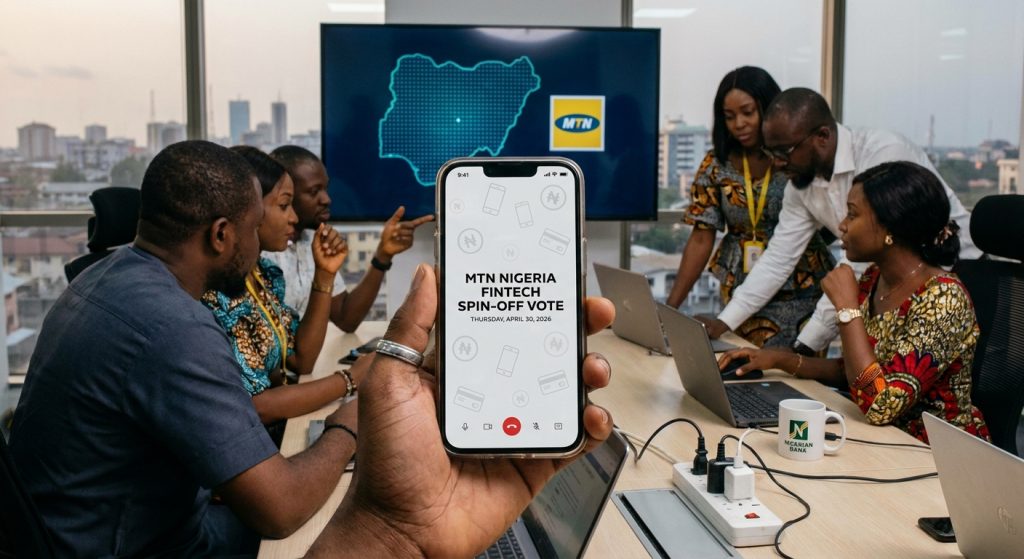
MTN Nigeria shareholders are set to vote on **Thursday, April 30, 2026**, on a proposal to spin off its fintech operations, including MoMo PSB, into a separate, independent entity. This strategic move aims to unlock valuation, enhance regulatory compliance, and attract new investments, potentially creating Nigeria’s largest independent fintech by customer base. Shareholders could receive new shares in the spun-off entity, while consumers can expect enhanced mobile money services and increased competition in the financial sector, though new fee structures and temporary service adjustments are possible. The decision, requiring 75% shareholder approval, will significantly reshape Nigeria’s digital financial landscape.
MTN Nigeria Shareholders to Vote on Fintech Spin-Off: What You Need to Know Before Thursday
Lagos, Nigeria – April 29, 2026
MTN Nigeria shareholders will decide tomorrow whether to spin off the company’s lucrative fintech division into a separate entity – a move that could profoundly reshape Nigeria’s digital financial landscape. This comprehensive guide breaks down everything from the intricate shareholder implications to how this pivotal decision might affect your everyday mobile money transactions and financial interactions. We delve into the strategic rationale, potential financial impacts, regulatory considerations, and what this means for millions of Nigerians who rely on MTN’s extensive network for their financial needs.
Key Takeaways
- MTN Nigeria shareholders will vote on April 30, 2026, on spinning off its fintech operations (MoMo PSB, mobile money, agency banking) into an independent company.
- The spin-off aims to unlock higher valuations for the fintech business, improve regulatory compliance, and attract strategic investors.
- If approved, shareholders will receive new shares in the spun-off fintech entity proportional to their existing MTN Nigeria holdings.
- Consumers can expect enhanced mobile money services, potential new fee structures, and increased competition in the fintech sector.
- The move requires 75% shareholder approval and is expected to create Nigeria’s largest independent fintech by customer base.
- Regulatory bodies like the CBN, SEC, and NDIC play crucial roles in approving and overseeing the transition, ensuring consumer protection and market stability.
Breaking News: The Thursday Vote That Could Reshape Nigerian Fintech
On Thursday, April 30, 2026, MTN Nigeria (NGX: MTNN) shareholders will convene virtually for an Extraordinary General Meeting (EGM) to cast their votes on a momentous proposal: the spin-off of its extensive fintech operations into an independent, standalone company. This strategic unbundling encompasses a significant portion of MTN’s digital financial services, including:
- MTN’s Payment Service Bank (MoMo PSB), which has rapidly expanded its reach across Nigeria.
- All mobile money services, which facilitate millions of transactions daily for individuals and businesses.
- The vast agency banking network, a critical component for financial inclusion in remote and underserved areas.
- A growing portfolio of emerging credit and insurance products, designed to meet the evolving financial needs of its customer base.
What is the MTN Nigeria fintech spin-off?
The MTN Nigeria fintech spin-off is a proposal for shareholders to vote on separating MTN’s financial technology operations, including MoMo PSB, mobile money services, and agency banking, into a new, independent company. This move aims to unlock value and allow the fintech business to operate with greater autonomy and focus.
Why this matters: This isn’t just a corporate restructuring; it’s a potential game-changer for Nigeria’s financial technology sector. If approved, the spin-off would instantly create Nigeria’s largest independent fintech by customer base. With over 40 million active mobile money users, MTN’s fintech arm processed an astounding ₦12.8 trillion in transactions last year alone, according to the CBN’s Q4 2025 report. This scale positions the new entity to become a dominant force, driving innovation and competition in the digital payments space.
The implications extend beyond MTN itself, touching every aspect of the Nigerian financial ecosystem. From traditional banks to emerging startups, the landscape will undoubtedly shift as a new, formidable player emerges with a clear focus solely on fintech. This could lead to accelerated product development, more competitive pricing, and a broader array of financial services accessible to the average Nigerian.
Key Players and Their Stakes in the MTN Fintech Spin-Off
| Entity | Role | Stakes |
|---|---|---|
| MTN Nigeria | Parent company proposing spin-off | Currently owns 100% of fintech operations; seeks to unlock value and strategic flexibility. |
| Central Bank of Nigeria (CBN) | Must approve new PSB license and oversee regulatory compliance | Recently capped PSB transfers at ₦50,000/day to manage risk and promote financial stability. |
| Securities and Exchange Commission (SEC) | Oversees shareholder protections and market integrity | Requires a 75% approval vote from shareholders for such a significant corporate action. |
| Nigeria Deposit Insurance Corporation (NDIC) | Insures deposits up to ₦500,000 | Critical for maintaining consumer trust and safeguarding funds within the new PSB entity. |
Why MTN Wants to Spin Off Its Cash Cow
The decision to spin off a highly profitable division like fintech is not taken lightly. MTN’s strategic rationale is multi-faceted, driven by a desire to unlock greater value, enhance operational efficiency, and position the fintech business for accelerated growth in a rapidly evolving market. This move reflects a global trend where large conglomerates are unbundling their diverse operations to allow specialized units to thrive independently.
Understanding the Strategic Imperative
MTN’s move is a calculated strategic maneuver to capitalize on the distinct growth trajectories and valuation metrics of the telecommunications and financial technology sectors. By separating these entities, MTN aims to create two highly focused companies, each better positioned to attract specific investor profiles and pursue tailored growth strategies.
Strategic reasons behind the move:
- Valuation unlock: One of the primary drivers is the significant disparity in market valuations between traditional telecommunications companies and high-growth fintech firms. Fintechs typically trade at much higher multiples, often 15-20 times EBITDA, compared to telcos, which might trade at 5-7 times EBITDA. A spin-off allows the market to assign a more appropriate, higher valuation to the fintech business, reflecting its growth potential and asset-light model.
- Regulatory focus and agility: Operating a Payment Service Bank (PSB) and other financial services within a large telco structure can present regulatory complexities. A separate entity can better comply with the Central Bank of Nigeria’s (CBN) specific PSB rules and financial regulations, allowing for more agile responses to policy changes and a clearer regulatory oversight framework. This separation can also streamline licensing processes and reduce potential conflicts of interest.
- Investment flexibility and strategic partnerships: As an independent entity, the fintech company will have greater flexibility to attract strategic partners and investors. This could include global payment giants like Visa or Mastercard, or leading African fintech innovators such as Flutterwave or Paystack. Such partnerships could bring in capital, technology, and expertise, accelerating product development and market expansion. A standalone entity is often more appealing to investors looking for pure-play fintech exposure.
- Talent retention and specialized culture: The fintech industry demands a unique talent pool with specialized skills in software development, data science, and financial product innovation. Within a large telco, fintech staff might be constrained by broader corporate pay structures and cultural norms. A separate fintech company can foster a distinct, agile culture, offer competitive compensation packages, and implement incentive schemes tailored to attract and retain top-tier fintech talent, crucial for sustained innovation.
Financial impact: The financial performance of MTN’s fintech segment underscores its ‘cash cow’ status. In 2025, the segment’s revenue grew by an impressive 62% year-over-year, reaching ₦428 billion. This now contributes a substantial 18% of the MTN Group’s total earnings, highlighting its growing importance. As a standalone entity, the projections are even more compelling:
- Projected 2027 valuation: Analysts estimate the spun-off fintech company could achieve a valuation between ₦1.2 trillion and ₦1.8 trillion within two years of its independence. This significant valuation uplift is a key driver for the spin-off.
- Potential IPO within 3 years: An independent fintech entity would be a prime candidate for an Initial Public Offering (IPO) on the Nigerian Exchange (NGX) or even an international exchange within three years, offering further liquidity and investment opportunities.
- Faster product rollout: With dedicated focus and resources, the new company can accelerate the development and deployment of innovative financial products, including micro-loans, savings accounts, investment platforms, and cross-border payment solutions, catering to the evolving needs of the Nigerian market.
Precedent for Success: Airtel Africa’s Fintech Journey
MTN’s strategy is not without precedent. Airtel Africa’s similar move to spin off its mobile money business, Airtel Money, resulted in a remarkable **300% jump** in its fintech valuation post-spin-off. This success story provides a compelling blueprint and validates the potential for significant value creation through such a corporate action.
What Shareholders Stand to Gain (or Lose)
For existing MTN Nigeria shareholders, the upcoming vote represents a critical juncture that could significantly impact their investment portfolio. The spin-off, if approved, will not just be a change in corporate structure but a re-distribution of assets and a re-evaluation of investment prospects. Understanding the mechanics and potential outcomes is paramount for informed decision-making.
What happens to MTN Nigeria shares if the fintech spin-off is approved?
If the fintech spin-off is approved, existing MTN Nigeria shareholders will retain their current MTN shares and will also receive new shares in the newly formed independent fintech company. The allocation will be proportional, for example, 1 MTN Nigeria share might entitle you to 0.15 shares in the new fintech entity.
If approved, here’s what happens:
- Share allocation: A key aspect of the spin-off will be the distribution of shares in the new fintech entity to existing MTN Nigeria shareholders. A common model is a pro-rata distribution, where for every share held in MTN Nigeria, shareholders will receive a specified fraction of a share in the ‘NewFintechCo’. For instance, a proposed ratio might be 1 MTNN share = 0.15 shares in NewFintechCo. This ensures that existing shareholders continue to participate in the growth of both businesses.
- Dividend policy: The dividend policy of the new fintech entity is likely to differ from that of MTN Nigeria. Given its high-growth potential, the NewFintechCo may initially adopt a policy of retaining a larger portion of its earnings to reinvest in growth, product development, and market expansion. This could mean lower or no dividends in the short term, prioritizing capital appreciation over immediate income. MTN Nigeria, as the more mature entity, might maintain its existing dividend policy or adjust it based on its revised financial structure.
- Tax implications: A significant consideration for shareholders is the tax treatment of the spin-off. Fortunately, a recent Securities and Exchange Commission (SEC) ruling (2024-17) indicates that there will be no immediate capital gains tax implications on the receipt of the new fintech shares. This is a crucial relief, as it prevents shareholders from incurring a tax liability simply for receiving shares in the new entity. However, capital gains tax would apply when these new shares are eventually sold. Shareholders are advised to consult with tax professionals for personalized advice.
Comparison of Key Valuation Metrics: MTN Nigeria vs. Projected Fintech Co
| Metric | MTN Nigeria (Current) | Projected Fintech Co |
|---|---|---|
| P/E Ratio (Price-to-Earnings) | 8.2x | 18.5x (Reflecting higher growth potential) |
| Revenue Growth (YoY) | 12% | 35% (Driven by digital adoption and new products) |
| Profit Margin | 22% | 28% (Leveraging asset-light model and scale) |
| Return on Equity (ROE) | 19% | 25% (Indicating efficient use of shareholder capital) |
| Market Capitalization (Est.) | ₦5.5 Trillion | ₦1.2 – 1.8 Trillion |
| EBITDA Multiple | 6.5x | 18x |
Potential Gains for Shareholders
- Increased overall portfolio value: The higher valuation multiple for the fintech business could lead to an increase in the combined market capitalization of your holdings (MTN Nigeria + NewFintechCo).
- Exposure to high-growth sector: Direct ownership in a pure-play fintech company offers exposure to a rapidly expanding and innovative sector with significant upside potential.
- Improved transparency: Separate financial reporting for each entity provides clearer insights into the performance and profitability of both the telco and fintech businesses.
- Enhanced M&A prospects: The independent fintech entity could become an attractive acquisition target for global financial institutions or tech giants, potentially leading to a premium for shareholders.
Risks to Consider for Shareholders
- Initial liquidity crunch: The new fintech company might have a smaller free float initially, potentially leading to lower trading volumes and price volatility in the short term.
- Execution risk in separation: The process of legally and operationally separating two large entities is complex and carries execution risks, which could impact initial performance.
- Potential regulatory hurdles from CBN: While the CBN is generally supportive of financial inclusion, any unforeseen regulatory changes or delays in approvals could impact the new entity’s operations.
- Dividend uncertainty: As mentioned, the new fintech entity may prioritize growth over immediate dividends, which might not suit income-focused investors.
- Increased administrative burden: Shareholders will now manage two separate stock holdings, which might require additional administrative effort.
How This Affects Everyday Nigerians
Beyond the boardrooms and stock market, the proposed MTN fintech spin-off holds significant implications for millions of everyday Nigerians who rely on mobile money and other digital financial services. This move is not just about corporate strategy; it’s about the future of financial inclusion, convenience, and competition in the Nigerian market.
How will the MTN fintech spin-off affect mobile money users in Nigeria?
Mobile money users in Nigeria will likely experience no immediate disruption to their services. In the long term, they can expect enhanced services, potentially faster loan approvals, higher savings rates, and a broader range of financial products due to increased focus and investment in the independent fintech entity. There might be new fee structures or branding changes over time.
Consumer impacts:
- Mobile Money Users (40M+ Nigerians):
- No immediate changes to MoMo accounts: Crucially, users should not expect any immediate disruption to their existing MoMo accounts, balances, or transaction capabilities. The transition will be managed to ensure continuity of service.
- Possible new fee structures post-transition: As an independent entity, the new fintech company will have the autonomy to set its own pricing strategies. While this could lead to more competitive fees in some areas, it’s also possible that certain services might see adjusted charges to reflect the new operational costs and value proposition.
- Enhanced services: With a dedicated focus on fintech, the new company is expected to accelerate innovation. This could translate into faster loan approvals, more attractive savings rates, a wider array of micro-insurance products, and more sophisticated investment options directly accessible via mobile. The goal is to deepen financial inclusion and offer more value to users.
- Improved user experience: Dedicated resources for fintech development could lead to more intuitive apps, better customer support, and seamless integration of new features.
- Agent Network (1.2M agents):
- Separate settlement terms: The vast network of MTN agents, critical for cash-in and cash-out services, may operate under new contractual agreements and settlement terms with the independent fintech entity. This could involve changes in commission structures or payment cycles.
- New branding requirements: Over time, agents might be required to adopt new branding elements for the spun-off fintech company, distinguishing it from the core MTN telecommunications brand.
- Potential incentive programs: To ensure loyalty and drive adoption of new services, the independent fintech company may introduce enhanced incentive programs for its agent network, recognizing their vital role in reaching customers.
- Training and support: Agents will likely receive extensive training on new products, services, and operational procedures to ensure a smooth transition and continued high-quality service delivery.
- Banking Customers:
- Increased competition may force lower transfer fees: The emergence of a powerful, independent fintech player will intensify competition within the broader financial services sector. This could pressure traditional banks and other fintechs to reduce transfer fees, offer more attractive interest rates, and innovate faster to retain customers.
- More seamless bank-to-wallet integrations: The new fintech entity will likely prioritize seamless interoperability with traditional banks, making it easier for customers to move funds between their bank accounts and mobile wallets, fostering a more integrated financial ecosystem.
- Broader access to financial products: As the fintech company expands its offerings, banking customers may find new, convenient ways to access credit, savings, and investment products that complement their traditional banking relationships.
Regulatory Safeguards for Consumers
The Central Bank of Nigeria (CBN), Securities and Exchange Commission (SEC), and Nigeria Deposit Insurance Corporation (NDIC) will play crucial roles in overseeing this transition to protect consumers:
- NDIC insurance remains intact: Funds held in MoMo PSB accounts will continue to be insured by the NDIC up to ₦500,000 per depositor, providing a critical safety net for users.
- CBN monitoring for service disruptions: The CBN will closely monitor the transition to ensure there are no significant service disruptions and that consumer interests are protected throughout the process.
- SEC oversight on consumer protections: The SEC will ensure that all disclosures to shareholders and the public are transparent and that consumer protection mechanisms are robust, especially concerning new financial products.
Step-by-Step: What Happens After the Vote
The outcome of Thursday’s EGM will set in motion a series of carefully planned steps, whether the spin-off is approved or rejected. Understanding this timeline is crucial for all stakeholders, from shareholders to everyday users and agents.
What are the next steps if MTN Nigeria shareholders approve the fintech spin-off?
If approved, the next steps involve regulatory filings with the CBN and SEC (Day 1-30), operational separation of the fintech business (Month 2-3), a new brand launch for the independent entity (Month 4-6), and potentially a strategic investment round within the first year.
Approval Scenario (75%+ votes):
If shareholders vote overwhelmingly in favor of the spin-off, a detailed roadmap will be activated:
-
Day 1-30: Regulatory Filings and Approvals
Immediately following the EGM, MTN Nigeria will commence the formal regulatory process. This involves submitting comprehensive documentation to the Central Bank of Nigeria (CBN) for the final approval of the new PSB license and to the Securities and Exchange Commission (SEC) for the listing of the new fintech entity’s shares and other corporate actions. This period is critical for ensuring compliance with all financial and capital market regulations.
-
Month 2-3: Operational Separation Begins
Once initial regulatory nods are secured, the complex process of operational separation will begin. This includes disentangling IT systems, customer databases, human resources, and financial reporting structures. Dedicated teams will work to ensure a smooth transition, minimizing any impact on ongoing services. This phase also involves establishing independent governance structures for the new fintech company.
-
Month 4-6: New Brand Launch and Market Introduction
Around the four to six-month mark, the independent fintech company will officially launch its new brand identity. This will involve a comprehensive marketing campaign to introduce the new entity to the market, clarify its value proposition, and differentiate it from the core MTN telecommunications business. This is when consumers and agents will start seeing the new branding and potentially new service offerings.
-
Year 1: Potential Strategic Investment Round
Within the first year of its independence, the NewFintechCo is highly likely to pursue a strategic investment round. This could involve bringing in external investors, such as private equity firms, venture capitalists, or global financial institutions, to inject capital for accelerated growth, technology upgrades, and market expansion. This phase is crucial for solidifying its financial footing and realizing its full potential.
-
Year 2-3: Potential Initial Public Offering (IPO)
Building on the strategic investment and growth, the new fintech entity may consider an Initial Public Offering (IPO) on the Nigerian Exchange (NGX) or even an international exchange. This would provide further liquidity for early investors and allow the broader public to invest directly in a leading African fintech company.
Rejection Scenario:
Should the shareholders vote against the spin-off (i.e., less than 75% approval), the immediate consequences would be:
- Status quo maintained: The fintech operations would remain an integral part of MTN Nigeria, continuing to operate under the existing corporate structure and regulatory framework.
- Possible revised proposal within 12 months: MTN’s management, if still convinced of the strategic benefits, might revise the proposal, address shareholder concerns, and resubmit it for another vote within 12 months.
- Market likely to react negatively: Financial markets often view the failure of such strategic initiatives unfavorably. Analysts predict a potential 5-8% drop in MTN Nigeria’s share price as investors react to the missed opportunity for value unlock and the perceived lack of strategic agility.
- Delayed innovation: Without the dedicated focus and independent funding, the pace of innovation and expansion in the fintech segment might slow down compared to the spin-off scenario.
Red Flags to Watch
While the spin-off presents significant opportunities, it’s essential for consumers, agents, and shareholders to be aware of potential challenges and ‘red flags’ during the transition period. Vigilance can help mitigate risks and ensure a smoother experience.
- Hidden costs: Be vigilant for any new or increased account maintenance fees, transaction charges, or subscription costs that might be introduced by the new fintech entity. Always read the updated terms and conditions carefully.
- Service gaps: During the operational separation, there might be temporary service disruptions, slower transaction processing times, or delays in customer support as systems are migrated and integrated. Keep an eye on official announcements for any planned downtimes.
- Fraud attempts: Scammers often exploit periods of corporate change and public confusion. Be extremely cautious of unsolicited calls, SMS, or emails claiming to be from MTN or the new fintech company, asking for personal details, PINs, or OTPs. Always verify information through official channels.
- Agent confusion: Some agents, especially in remote areas, might not immediately understand the new procedures, branding, or commission structures. This could lead to inconsistent service quality or misinformation. If you encounter an agent who seems confused, direct them to official MTN/fintech support channels.
- Data privacy concerns: While data protection laws are in place, any large-scale data migration carries inherent risks. Ensure you understand the updated privacy policies of the new fintech entity and how your personal and financial data will be handled.
- Unrealistic promises: Be wary of any overly ambitious or unrealistic promises about new products or services that seem too good to be true. Always cross-reference information with official sources.
Protect Yourself from Scams
During periods of significant corporate change like a spin-off, fraudsters often attempt to capitalize on public confusion. Never share your PIN, OTP, or personal banking details with anyone claiming to be from MTN or the new fintech company. Always verify information through official MTN customer service channels or the company’s official website.
FAQ: Your Top Questions Answered
Q: Will my MoMo wallet stop working immediately after the vote?
A: No, absolutely not. Services will continue uninterrupted during the transition period, which is expected to last several months. MTN and the new fintech entity will ensure a seamless migration. You will eventually be guided to use a new app or platform for the independent fintech services, but your funds and transaction history will be preserved.
Q: Do I need to do anything as an MTN Nigeria shareholder before Thursday?
A: Yes, if you wish to exercise your voting rights. You should check with your stockbroker or registrar about the specific voting procedures for the Extraordinary General Meeting (EGM). If you hold shares directly, you might have received instructions via email or postal mail. No action is needed if you are simply holding shares and do not wish to vote, but it’s always advisable to be informed.
Q: What happens to my existing MTN shares if the spin-off is approved?
A: You will retain your existing MTN Nigeria shares. In addition, you will receive new shares in the spun-off fintech company proportionally to your current MTN Nigeria holdings. For example, if the ratio is 0.15 fintech shares for every 1 MTN share, and you own 1,000 MTN shares, you would receive 150 shares in the new fintech entity.
Q: Can the new fintech company fail, and what happens to my money then?
A: While any business carries inherent risks, the new fintech company, given its massive scale, established customer base (over 40 million users), and robust infrastructure inherited from MTN, is highly unlikely to fail. Furthermore, funds held in its Payment Service Bank (PSB) accounts will continue to be insured by the Nigeria Deposit Insurance Corporation (NDIC) up to ₦500,000 per depositor, providing a strong layer of protection for your deposits.
Q: Will the terms and conditions for my existing MoMo loans change?
A: Existing loan agreements will remain unchanged. The terms and conditions you agreed to when taking out your current loan will continue to apply. However, any new loan products or facilities offered by the independent fintech company in the future may come with different terms, interest rates, and eligibility criteria.
Q: Will the spin-off affect my MTN airtime and data services?
A: No, the spin-off specifically targets the fintech operations. Your MTN airtime, data services, call quality, and network coverage will remain unaffected as these are core telecommunications services that will continue to be managed by MTN Nigeria as a separate entity. The goal is to create two focused companies, not to disrupt existing services.
Q: How will the new fintech company be regulated?
A: The new fintech company, particularly its Payment Service Bank (PSB) operations, will continue to be strictly regulated by the Central Bank of Nigeria (CBN). Other financial products and services may also fall under the purview of the Securities and Exchange Commission (SEC) or the National Insurance Commission (NAICOM), depending on their nature. The independent structure is intended to enhance, not diminish, regulatory compliance and oversight.
Q: What if I don’t want shares in the new fintech company?
A: If you receive shares in the new fintech company and do not wish to hold them, you will have the option to sell them on the Nigerian Exchange (NGX) once they are listed and trading commences. You should consult with your stockbroker regarding the process for selling these shares.
What to Do This Week
With the critical vote just around the corner, here’s a checklist of actions for various stakeholders to ensure they are prepared for the potential changes and can make informed decisions.