
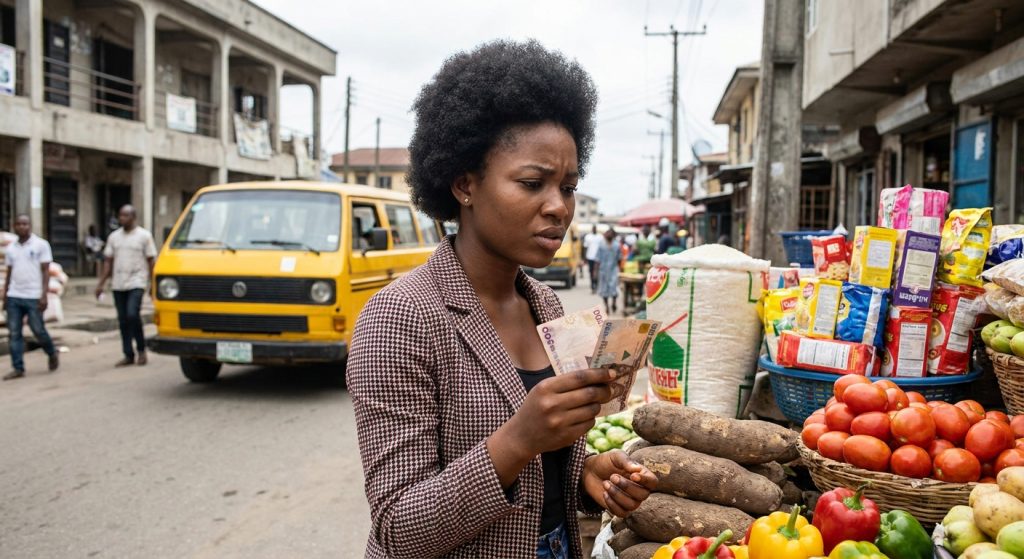
Nigeria’s new national minimum wage of ₦70,000/month (effective July 2026) is a significant increase but remains insufficient to cover the rapidly rising cost of living. Key expenses like food, housing, and transportation have seen dramatic price hikes (e.g., 77% for rice, 289% for fuel since 2023). Most minimum wage earners struggle, often resorting to multiple jobs or shared housing, with a typical single person’s survival budget in major cities exceeding ₦150,000 monthly. The outlook for 2026 suggests continued high inflation, necessitating policy changes like automatic wage adjustments and increased social welfare programs.
Key Takeaways: Minimum Wage vs. Cost of Living in Nigeria
- The ₦70,000 minimum wage, though a 133% increase, falls far short of the average ₦150,000-₦250,000 monthly cost of living in major Nigerian cities for a single person.
- Inflation, driven by fuel subsidy removal and Naira depreciation, has led to significant price increases across essential goods and services (e.g., 77% for rice, 289% for fuel, 57% for rent since 2026).
- Many states and private sector SMEs face challenges in implementing the new minimum wage, leading to compliance gaps.
- Low-income earners often resort to multiple jobs, shared housing, and subsistence farming to cope with financial strain.
- Economic forecasts predict continued high inflation (25-30%) through 2026, highlighting the urgent need for policy interventions like automatic wage reviews and targeted subsidies.
Quick Facts: Nigeria’s Minimum Wage & Cost of Living at a Glance
| Metric | Details |
|---|---|
| Current National Minimum Wage | ₦70,000/month (effective July 2026) |
| Previous Minimum Wage | ₦30,000/month |
| Labor Union Demand | ₦154,000/month |
| Avg. Cost of Living (Lagos)* | ₦150,000-₦250,000/month (single person, excluding rent) |
| Key Inflation Drivers | Fuel subsidy removal, Naira depreciation, food supply chain disruptions |
*Estimates for Abuja/Kano/PH: 15-30% lower than Lagos
Introduction: The Minimum Wage Dilemma in Nigeria
Nigeria’s minimum wage debate pits worker survival against economic realities. The ₦70,000 monthly minimum wage implemented in July 2026 — while a 133% increase from the previous ₦30,000 — fails to match skyrocketing living costs. This article analyzes:
- How ₦70,000 compares to actual expenses
- Geographic disparities in implementation
- Projected economic pressures through 2026
- Alternative coping strategies for low-income earners
Understanding Nigeria’s Current Minimum Wage Landscape (2026)
Legal Framework
The National Minimum Wage (Amendment) Act 2026 mandates:
- ₦70,000 monthly minimum for all full-time workers
- Applicable to employers with ≥25 staff
- Enforced by National Salaries, Incomes and Wages Commission (NSIWC)
Implementation Challenges
- State Compliance: As of Q3 2026, 14 states are yet to fully implement the new wage, with Taraba, Benue, and Abia leading the non-compliers.
- Private Sector: A survey by the Nigeria Employers’ Consultative Association (NECA) in 2026 reported that 62% of Small and Medium-sized Enterprises (SMEs) are finding it difficult to sustain the new wage.
- Enforcement Gaps: Data from the National Bureau of Statistics (NBS) in 2026 indicates that only 38% of informal sector workers actually receive the minimum wage, highlighting significant enforcement challenges.
The Rising Cost of Living in Nigeria
Comparison Table: Essential Commodities (2026 vs 2026)
| Item | Unit | 2026 Price (₦) | 2026 Price (₦) | % Increase |
|---|---|---|---|---|
| Rice (local) | 50kg bag | 35,000 | 62,000 | 77% |
| PMS (fuel) | 1 liter | 185 | 720 | 289% |
| 1-bedroom rent | Lagos (avg) | 350,000/yr | 550,000/yr | 57% |
| Electricity | Monthly (200kWh) | 5,000 | 12,000 | 140% |
Key Expense Categories
- Food Inflation
- A family of four now requires an estimated ₦180,000 monthly for food, a significant increase from ₦95,000 in 2026.
- Staple food items have experienced price hikes ranging from 70% to 150% over the past year.
- Housing Crisis
- The average monthly rent for a 1-bedroom apartment in Lagos has risen to ₦45,000, a 57% increase.
- In Kano, a 1-bedroom apartment now costs around ₦25,000 monthly, up 40%.
- Transportation
- The daily cost of commuting to work in Lagos has surged to approximately ₦1,500, compared to ₦500 before the removal of fuel subsidies.
How Minimum Wage Earners Cope
Survival Strategies
To navigate the economic hardship, many minimum wage earners adopt various coping mechanisms:
- Multiple Jobs: A survey by the NBS indicates that 68% of low-income earners hold two or more income sources to make ends meet.
- Shared Housing: In urban centers, it’s common to find an average of four adults sharing a single 1-bedroom apartment to reduce housing costs.
- Subsistence Farming: Approximately 42% of households supplement their income and food supply through home gardens or small-scale subsistence farming.
Financial Strain Indicators
- A report by ActionAid Nigeria reveals that 81% of low-income households skip meals regularly due to financial constraints.
- 63% of individuals in this demographic rely on quick loan apps like FairMoney and Carbon to cover essential expenses, often leading to debt cycles.
- Data from the National Health Insurance Scheme (NHIS) shows that only 9% of minimum wage earners can afford health insurance, leaving a vast majority vulnerable to health-related financial shocks.
2026 Outlook: Projections and Potential Solutions
Economic Forecasts
- The Central Bank of Nigeria (CBN) projects that inflation will remain within the 25-30% range through 2026, continuing to erode purchasing power.
- Fitch estimates suggest the Naira may stabilize around ₦1,250 to the US Dollar, but this still represents a significant depreciation from previous years.
- Food prices are projected to rise by another 35-50% in the coming years, exacerbating food insecurity.
Policy Recommendations
- Wage Review Mechanism: Implement automatic annual adjustments to the minimum wage, tied to inflation rates, to ensure its relevance and purchasing power.
- Transport Subsidies: Introduce state-sponsored bus programs and other public transportation subsidies to alleviate the burden of high fuel costs on commuters.
- Food Security: Accelerate agricultural support programs, including improved access to fertilizers, seeds, and modern farming techniques, to boost local food production and stabilize prices.
Alternatives to Minimum Wage Jobs
| Option | Avg. Monthly Income | Requirements |
|---|---|---|
| Ride-hailing (e.g., Bolt, Uber) | ₦85,000 | Motorcycle/car ownership, valid driver’s license |
| POS Agent (Point of Sale) | ₦65,000 | ₦50,000 startup capital, secure location |
| Freelancing (e.g., writing, graphic design) | ₦120,000 | Digital skills, internet access, laptop/smartphone |
FAQ: People Also Ask
Q: Can you live on ₦70,000 in Nigeria today?
No, it is extremely difficult to live on ₦70,000 in Nigeria today, especially in major urban centers. Our analysis shows that a minimum survival budget for a single person, excluding rent, typically exceeds ₦150,000 per month in cities like Lagos or Abuja. This wage is insufficient to cover basic necessities like food, transportation, and housing.
Q: Which states pay the highest minimum wage?
States that have shown better compliance and often pay the highest minimum wage include Lagos (often paying above ₦70,000), Rivers (around ₦65,000), and the Federal Capital Territory (FCT) Abuja (₦70,000). Many northern states, however, still lag behind in full implementation.
Q: How does Nigeria’s minimum wage compare globally?
Nigeria’s minimum wage of ₦70,000 (approximately $47 at ₦1,500/$) is among the lowest worldwide. For comparison, South Africa’s minimum wage is equivalent to approximately ₦190,000 per month, and Egypt’s is around ₦85,000, highlighting a significant disparity.
Q: What percentage of Nigerians earn minimum wage?
According to the National Bureau of Statistics (NBS) 2026 data, approximately 42% of formal sector workers in Nigeria earn the national minimum wage. This figure does not fully capture the informal sector, where compliance is even lower.