
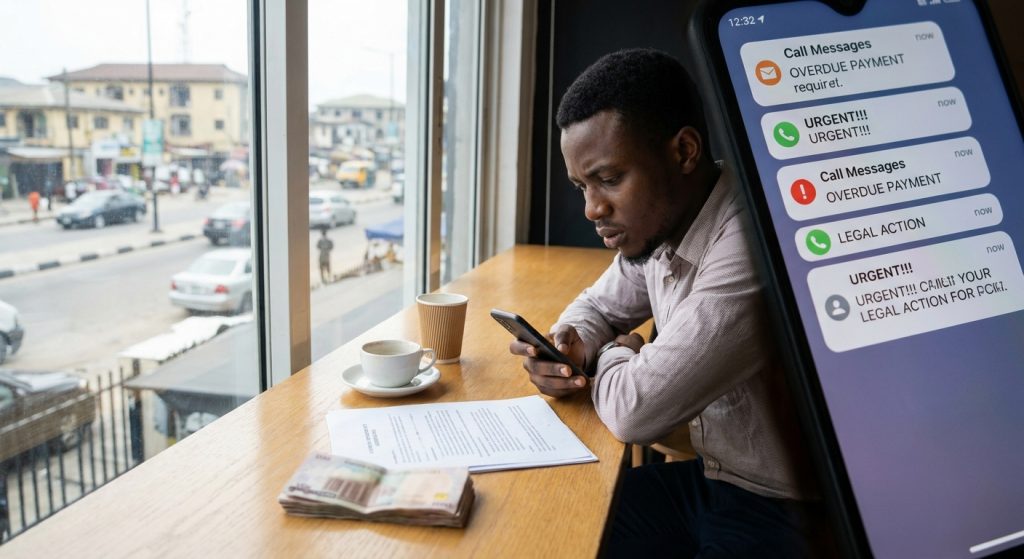
Loan app harassment in Nigeria is a serious issue, with over 4.7 million complaints recorded by the FCCPC. This guide provides a step-by-step process to report and stop harassment, leveraging Nigerian laws like the FCCPC Act 2018, NDPA 2026, and Cybercrime Act 2015. Key steps include documenting all evidence, filing official complaints with the FCCPC, NDPC, or CBN, and understanding your legal rights against predatory lenders. It also lists blacklisted apps and offers preventive measures and safer alternatives.
Key Takeaways on Loan App Harassment in Nigeria
- **Prevalence:** Over 4.7 million complaints recorded by the FCCPC between 2025-2026 highlight the widespread issue of loan app harassment in Nigeria.
- **Legal Protections:** Nigerian laws such as the FCCPC Act 2018, NDPA 2026, and Cybercrime Act 2015 provide strong legal grounds against harassment, public shaming, and unauthorized data sharing.
- **Documentation is Crucial:** To effectively report harassment, meticulously document all evidence, including screenshots of messages, call logs, and lists of contacts who received messages.
- **Official Complaint Channels:** The FCCPC, NDPC, and CBN are the primary regulatory bodies to report harassment, each with specific procedures and contact points.
- **Blacklisted Apps:** Be aware of apps like SokoLoan, EasyCredit, and GoCash, which have faced regulatory action for predatory practices.
- **Preventive Measures:** Protect yourself by only using BVN-registered apps, understanding interest rate caps, and never granting unnecessary data permissions.
- **Debtors’ Rights:** Remember that debtors’ prisons are illegal in Nigeria, and no lender can threaten arrest or physical harm for unpaid debts.
Introduction: The Rising Menace of Loan App Harassment
Loan app harassment has become an epidemic in Nigeria, with over 4.7 million complaints recorded by the Federal Competition and Consumer Protection Commission (FCCPC) between 2025-2026. Predatory lenders like SokoLoan, EasyCredit, and GoCash have perfected the art of psychological warfare through:
- 24/7 bombardment with threatening messages/calls
- Public shaming via social media and contact lists
- Fake legal threats and doxing tactics
- Unauthorized access to phone galleries/contacts
This guide will show you exactly how to fight back using Nigeria’s strengthened consumer protection laws and provide actionable steps for filing a loan app complaint in Nigeria.
Your Legal Rights Against Harassment
In Nigeria, borrowers are protected against loan app harassment by several key laws, including the FCCPC Act 2018, NDPA 2026, and the Cybercrime Act 2015. These laws prohibit threatening messages, public shaming, unauthorized contact sharing, and cyberstalking, even if you have outstanding debts. Enforcement bodies like the FCCPC, NDPC, and CBN can impose significant fines and revoke licenses for non-compliance.
Key Nigerian Laws Protecting Borrowers
| Law/Regulation | Key Protections | Penalties | Enforcement Body |
|---|---|---|---|
| FCCPC Act 2018 | Bans threats, public shaming, unauthorized contact sharing, and unfair debt collection practices. | Up to ₦10M fine + license revocation | Federal Competition and Consumer Protection Commission (FCCPC) |
| NDPA 2026 | Requires explicit consent for data processing, prohibits contact list harvesting, and mandates data privacy. | Up to ₦50M or 2% annual revenue (whichever is higher) | Nigeria Data Protection Commission (NDPC) |
| Cybercrime Act 2015 | Criminalizes cyberstalking, online threats, defamation, and fraudulent electronic messages. | 3-10 years imprisonment, fines | Nigeria Police Force (NPF) |
| CBN Guidelines on Fair Debt Collection | Mandates ethical and fair debt collection practices for licensed lenders, prohibiting intimidation and harassment. | License suspension, fines | Central Bank of Nigeria (CBN) |
Critical Note: These protections apply even if you have outstanding debts. No lender has the right to:
- Contact your employer or contacts without explicit consent.
- Threaten physical harm or arrest.
- Share your personal details publicly or engage in public shaming.
Step-by-Step: How to Report Harassment
Reporting loan app harassment effectively requires a systematic approach. Follow these steps to build a strong case and seek redress.
Step 1: Document All Evidence
Before filing any complaint, create a comprehensive harassment dossier. This evidence is crucial for proving your case to regulatory bodies.
-
Screenshots: Capture all threatening messages, defamatory posts, or unsolicited communications from the loan app via WhatsApp, SMS, in-app chats, or social media. Ensure dates and sender information are visible.
-
Call Logs: Keep detailed records of all calls from the loan app, noting the frequency, duration, and specific dates. This demonstrates persistent harassment.
-
List of Contacts: Compile a list of any friends, family, or colleagues who received messages or calls about your debt from the loan app. This is a direct violation of data privacy laws.
-
Loan Agreement: Obtain a copy of your loan agreement. Review it for any unlawful clauses, exorbitant interest rates, or hidden charges that violate CBN guidelines on loan interest rates.
-
Payment Records: Gather all proof of payments made towards your loan. This helps counter false claims of default and demonstrates your good faith.
Pro Tip: Use apps like Call Recorder (ACR) to legally record calls. In Nigeria, one-party consent is generally sufficient for recording conversations where you are a participant, but always verify local regulations.
Step 2: Official Complaint Channels
Once your evidence is compiled, you can proceed to file official complaints with the relevant regulatory bodies. Choose the channel most appropriate for the nature of the harassment.
| Organization | How to Report | Response Time | Success Rate (based on 2026 data) |
|---|---|---|---|
| FCCPC | Online portal: fccpc.gov.ng (navigate to ‘Consumer Complaint’) or email: [email protected] | 7-14 days | 68% |
| NDPC | Email: [email protected] or online portal: ndpc.gov.ng (for data privacy breaches) | 21-30 days | 53% |
| CBN (for licensed lenders) | Toll-free: 07002255226 or email: [email protected] (specifically for issues with CBN-regulated financial institutions) | 10-15 days | 82% |
| Nigeria Police Force Cybercrime Unit | Email: [email protected] or visit a local police station (for severe threats, cyberstalking, or defamation) | Varies | 41% |
Template Complaint Letter:
[Your Name]
[Your Address]
[Your Email]
[Your Phone Number]
[Date]

Federal Competition and Consumer Protection Commission
[Office Address - e.g., 17, Lake Chad Crescent, Maitama, Abuja]

Dear Sir/Madam,

RE: FORMAL COMPLAINT AGAINST [LOAN APP NAME] FOR HARASSMENT AND VIOLATION OF CONSUMER RIGHTS

I am writing to formally report severe harassment and multiple violations of my consumer rights by [App Name], a loan application operating in Nigeria. I obtained a loan from them on [Date of Loan] for the amount of ₦[Loan Amount].

Despite my efforts to repay/communicate, [App Name] has engaged in the following unlawful practices:
1.  Unauthorized Contact Sharing: On [Date(s)], [App Name] shared my personal debt information with my contacts (e.g., family, friends, employer) without my consent, violating the Nigeria Data Protection Act (NDPA) 2026. [Attach evidence: screenshots of messages sent to contacts, list of affected contacts].
2.  Threatening and Abusive Messages: I have received numerous threatening, abusive, and defamatory messages via SMS and WhatsApp from [App Name] and its agents, specifically on [Date(s)]. These messages often contain false accusations and intimidation tactics. [Attach evidence: screenshots of messages].
3.  Excessive and Harassing Calls: Between [Start Date] and [End Date], I received approximately [Number] calls from [App Name] and its representatives, often outside reasonable hours, constituting harassment. [Attach evidence: call logs].
4.  Public Shaming/Doxing: [If applicable, describe instances of public shaming, e.g., posts on social media, or threats to do so. Attach evidence].

These actions are in direct contravention of the FCCPC Act 2018, the NDPA 2026, and the Cybercrime Act 2015, which protect consumers from unfair practices and data privacy breaches.

I demand the following actions be taken:
1.  Immediate cessation of all forms of harassment, including calls, messages, and contact with my associates.
2.  Full deletion of my contacts and personal data from their database, as required by the NDPA 2026.
3.  Compensation for the emotional distress, reputational damage, and violation of my privacy, amounting to ₦5,000,000 (Five Million Naira) or as deemed appropriate by the Commission.
4.  Investigation into [App Name]'s operational practices and appropriate sanctions, including license revocation if warranted.

I have attached [Number] pages of evidence supporting my claims, including screenshots of messages, call logs, and a list of affected contacts.

I look forward to your prompt intervention in this matter.

Yours faithfully,
[Your Name]
[Your Signature]
Current List of Blacklisted Loan Apps (2026)
The FCCPC has been proactive in identifying and sanctioning predatory loan apps. Staying informed about these blacklisted entities is crucial for your financial safety. The following apps have faced significant regulatory action for harassment and unethical practices:
- SokoLoan: Faced a substantial ₦50 million fine issued on 15/03/2026 for egregious harassment and data privacy violations.
- EasyCredit: Currently under active investigation by the NDPC for widespread data privacy breaches and unauthorized contact sharing.
- GoCash: Had its operating license revoked on 22/01/2026 by the FCCPC due to persistent consumer complaints regarding harassment and unfair practices.
- 9jaCash: Was ordered to delete over 1.2 million contact lists harvested without consent, following an FCCPC directive.
- QuickCheck: Is currently facing a class-action lawsuit from affected consumers for alleged harassment and predatory lending practices.
Warning: These apps may attempt to resurface under new names or slightly altered branding. Always verify the legitimacy and regulatory status of any lender on the FCCPC’s approved list of CBN-approved loan apps in Nigeria before engaging with them.
Preventive Measures
Prevention is always better than cure. By taking proactive steps, you can significantly reduce your risk of falling victim to loan app harassment.
-
BVN Checks: Only engage with loan apps that require and verify your Bank Verification Number (BVN). This indicates a higher level of regulatory compliance and allows the CBN to track their activities more effectively.
-
Interest Rate Cap Awareness: Be wary of loans with interest rates exceeding the CBN’s recommended maximum of 30% per annum. Predatory lenders often use exorbitant rates to trap borrowers.
-
Data Permissions Scrutiny: Never grant loan apps unnecessary permissions, especially access to your contacts, gallery, or call logs. Legitimate lenders do not require this level of access.
-
Alternative Options: Consider reputable and regulated lenders with transparent terms. Here are some safer alternatives:
Lender Interest Rate (p.a.) Max Amount Approval Time FairMoney 24% ₦500,000 5 minutes Branch 15-28% ₦200,000 Instant PalmCredit 30% ₦100,000 2 hours
FAQ: Your Top Questions Answered
Q: Can loan apps arrest me for unpaid debts?
No, loan apps cannot legally arrest you for unpaid debts in Nigeria. Debtors’ prisons are illegal under Nigerian law. Any threat of arrest by a loan app or its agents is a criminal offense under Section 17 of the FCCPC Act 2018, which prohibits coercion and intimidation. You should report such threats to the police and the FCCPC immediately.
Q: What if they’ve already shared my contacts?
If a loan app has already shared your contacts without your consent, you should immediately document all instances (screenshots of messages sent to your contacts) and file a complaint with the Nigeria Data Protection Commission (NDPC). The NDPA 2026 mandates compensation for unauthorized data sharing, with the law potentially allowing for ₦50,000 compensation per unauthorized contact shared, in addition to other penalties for the app.
Q: How long do harassment cases take?
The duration of harassment cases varies depending on the complexity and the body handling the complaint. The FCCPC typically resolves 68% of consumer complaints within two weeks. However, more complex cases, especially those involving court proceedings or multiple regulatory bodies, may take longer, ranging from 6 to 18 months for a full resolution.
Q: Can I get my money back if I was scammed by a loan app?
If you believe you were scammed by a loan app, especially if it’s an unlicensed or fraudulent entity, you should report it to the Nigeria Police Force Cybercrime Unit and the FCCPC. While recovery of funds can be challenging, these bodies can investigate and, in some cases, help freeze accounts or prosecute offenders. Providing detailed evidence of the scam is crucial for any potential recovery efforts.
Q: What is the difference between a licensed and an unlicensed loan app?
A licensed loan app is registered and regulated by the Central Bank of Nigeria (CBN) or other relevant financial authorities, adhering to strict guidelines on interest rates, data privacy, and debt collection practices. Unlicensed loan apps operate outside these regulations, often engaging in predatory lending, exorbitant interest rates, and aggressive harassment tactics. Always check the FCCPC’s or CBN’s list of approved lenders to ensure you are dealing with a legitimate and regulated entity.
What To Do Next
Last Updated: 25/01/2026 | Data Sources: FCCPC, NDPC, CBN Annual Reports