
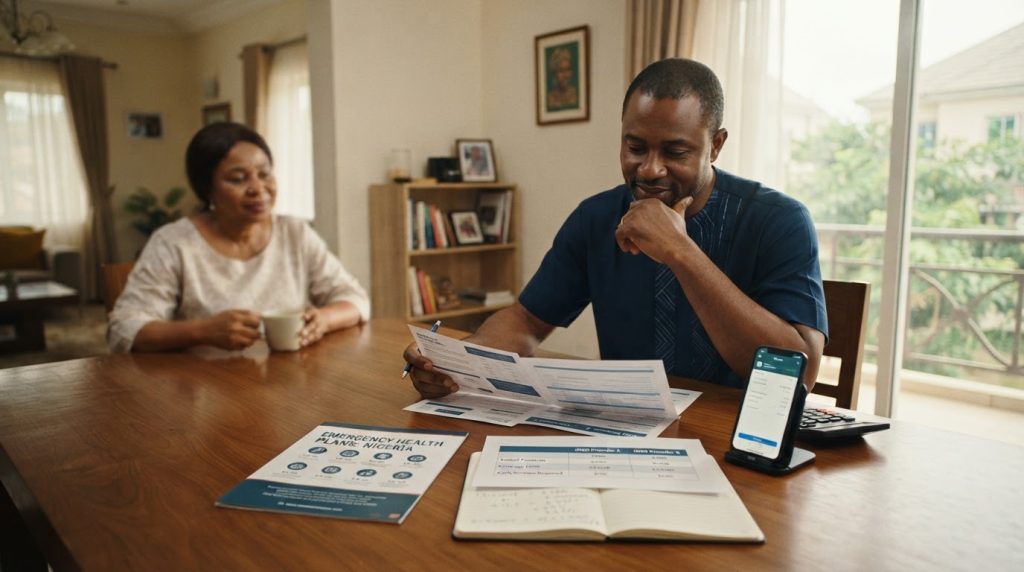
Quick Summary
This guide explains the key costs, trade-offs, and practical steps Nigerian readers should know.
Diaspora Healthcare Nigeria: How to Fund Your Parents’ Care from Abroad with HMO Plans and an Emergency Fund
It is 11pm in Manchester and your 68-year-old mother in Enugu has just been rushed to hospital. The bills unit wants ₦850,000 before treatment can begin. Your UK bank will not process the transfer until morning, and the unofficial agent you used last time charged a fortune. This is the exact situation thousands of Nigerians abroad find themselves in every year — and it is largely avoidable.
If you send money home regularly to support your parents, you already know that healthcare is the expense that can wipe out a month of remittances in one emergency. A better approach exists: a combination of diaspora health insurance (HMO plans) and a structured healthcare emergency fund kept in Nigeria. This guide shows you both options, the real costs in 2026, the documents you need, and the specific platforms that work from the US, UK and EU.
Why the old “emergency remittance” approach is so expensive
When a parent falls ill in Nigeria, the default response is to wire money immediately. That works, but it is the most expensive way to handle the problem.
First, there is the transfer cost. Sending an emergency payment through traditional remittance channels typically costs $25–$45 per transfer, and that is before exchange rate margins. Second, there is the amount itself. A single emergency episode — hospital admission, surgery, blood tests, and drugs — can cost ₦500,000 to ₦2,000,000 or more, depending on the condition and the hospital. Third, there is timing. Nigerian private hospitals often demand payment before treatment, and a transfer that lands in 24 hours can still be too slow.
The structural problem is that barely anyone in Nigeria has health insurance. Industry estimates suggest fewer than 5% of Nigerians have health cover, and over 70% pay for healthcare out of pocket. That means almost every visit to a doctor is a cash event, and almost every admission is a cash emergency.
The solution is to change two things: who pays for routine and unexpected care (an HMO plan) and how you keep money available for the gaps (an emergency fund). Let us look at both.
Option 1: Buy a diaspora HMO plan for your parents
A Health Maintenance Organisation (HMO) plan is annual health insurance. You pay a premium once a year, and the HMO covers a defined list of services — consultations, admissions, surgery, drugs, diagnostics — across its network of hospitals. The sector is regulated by the National Health Insurance Authority (NHIA), which sets standards for what plans must cover and how claims are handled.
Since 2025, the diaspora-specific market has expanded significantly. The key difference from regular Nigerian HMO plans is that you can buy and renew the plan from abroad, pay in Naira, and cover parents who live in Nigeria. Some plans also allow your parents to call a dedicated line when they are ill, and the HMO settles the hospital directly — meaning your parents do not need to raise cash at the point of treatment.
What diaspora HMO plans cost in 2026
| Provider | Diaspora plan | 2026 price | Network size |
|---|---|---|---|
| Novo Health Africa | Loaf Plan | From ₦31,500 per person per year | Varies by region |
| Reliance HMO | Diaspora package | From ₦42,500/year or ₦3,500/month | Nationwide |
| Ultimate Health HMO | GIFSHIP Diaspora | ₦45,000 per person per year | 10,000+ hospitals nationwide |
| AXA Mansard | Diaspora package | From ₦48,000/year or ₦24,000/6 months | 1,000+ hospitals |
| Clearline HMO | Diaspora package | From ₦50,000/year | 1,400+ hospitals |
| Hygeia HMO | Diaspora package | From ₦55,590/year | Nationwide |
| Mediplan Healthcare | Basic and Plus diaspora packages | Varies by package | 600+ hospitals |
> Note on prices: The figures above are the quoted starting premiums published by the providers. Negotiated employer rates and family discounts can be lower, and add-ons (dental, optical, overseas treatment) raise the price. Always confirm the exact 2026 rate on the HMO’s website or by WhatsApp before paying, because premiums can be revised at renewal.
The diaspora-specific platforms worth knowing
Ultimate Health HMO — GIFSHIP Diaspora One of the most direct diaspora products available. Ultimate Health’s GIFSHIP (Global Insurance for Family Health) plan costs ₦45,000 per person per year, gives access to 10,000+ partner hospitals nationwide, and — crucially — accepts Naira payment from diaspora buyers. That means you can pay from a Nigerian account you still operate, a Naira virtual card, or via a fintech app. Source: Ultimate Health HMO
NEM Health — HomeReach and Golden Care NEM Health sells plans specifically for diaspora purchasers covering family members still in Nigeria. Their HomeReach plans provide access to 2,000+ hospitals and 2,500+ pharmacies, while the Golden Care plan is aimed at people aged 60 and above and includes chronic care management — important because many standard HMO plans cap new enrolments at age 60 or 65. Source: NEM Health blog
Diaspora Health Cover — Tulip, Hazel and Ivy plans Diaspora Health Cover is a digital platform built on NEM Health’s network. It offers three tiers: Tulip (basic), Hazel (broader coverage) and Ivy (comprehensive), all purchasable from abroad through their website, with 2,000+ accredited hospitals nationwide. You manage the plan, receive e-cards for your parents, and renew online. Source: Diaspora Health Cover
What HMO plans cover — and what they do not
It is important to be honest about limits. A typical Nigerian HMO plan covers:
- General consultations and outpatient care
- Basic laboratory tests and radiology
- Hospital admission (within a room category cap)
- Common surgeries and maternity care
- Prescription drugs from approved pharmacies
Typical exclusions:
- Pre-existing conditions during a waiting period (often 3–6 months; some plans exclude them entirely)
- Chronic conditions like dialysis or cancer treatment, unless you buy a higher tier
- Overseas treatment
- Dental and optical, unless added
The practical implication: an HMO plan reduces the shock of a ₦1.5 million hospital bill but does not eliminate it. That is precisely why you still need an emergency fund.
Option 2: Pay hospital bills directly from abroad through healthcare payment platforms
If insurance is not an option right now — perhaps your father is over the age limit or has a pre-existing condition — there are platforms that let you pay Nigerian hospitals and pharmacies directly from overseas, often at a discount.
Ensuram is one such platform. It allows Nigerians abroad to pay hospital bills, buy medications, and purchase insurance for family members in Nigeria directly, from 180+ countries, with discounts of up to 20% on healthcare services. Their published sample rates are significantly lower than walk-in pricing at private hospitals:
| Service | Ensuram discounted rate | Typical walk-in rate |
|---|---|---|
| Hospital consultation | ₦6,400 – ₦12,000 | ₦8,000 – ₦15,000 |
| Blood test panel | ₦9,600 – ₦20,000 | ₦12,000 – ₦25,000 |
| Health insurance plan | From ₦40,000+ | From ₦50,000+ |
The model is simple: you create an account, select the service or hospital, pay with a foreign card or Naira wallet, and Ensuram settles the provider. For a parent who needs a one-off procedure, this can be cheaper than an HMO plan you never use.
VigorCare (by Vigor Medical Services Ltd) takes a different angle: it is a healthcare coordination service for diaspora sponsors. You pay for your parent’s care, and VigorCare coordinates the appointment, treatment, and follow-up through 50+ partner clinics in Lagos, Abuja and Port Harcourt. Its defining feature is that every service is logged in a verifiable electronic medical record, so you are not just sending money and hoping the treatment happened — you can see what was done. This was reported in Vanguard in August 2026 as a direct response to the problem of “medical remittances” that cannot be tracked. Source: Vanguard
The honest pros and cons of direct payment platforms:
| Pros | Cons |
|---|---|
| No waiting periods or age limits | No annual cap — a big surgery costs you in full |
| You see exactly what you paid for (especially with VigorCare’s records) | You carry 100% of the risk of a major emergency |
| Discounts of up to 20% reduce the bill | You still need to move money quickly |
| Works for uninsured parents | Less useful for routine care — you pay every single time |
Option 3: Build a healthcare-specific emergency fund in Nigeria
Think of an emergency fund as your own private insurance policy for the costs an HMO does not cover. Instead of scrambling at 11pm, you have money already sitting in Nigeria, earning interest, ready in 24–48 hours.
How much should you target?
A useful benchmark is 3–6 months of expected hospital costs. Based on current private hospital rates in Nigeria, where a single admission typically costs ₦500,000 to ₦2,000,000+, that means a fund of roughly:
- ₦1.5 million to ₦3 million for basic private hospital coverage
- ₦3 million to ₦12 million if your parents have chronic conditions (diabetes, hypertension, kidney disease) or will need surgery
You do not need to build this overnight. Even ₦500,000 parked and labelled “Mama’s health” changes the outcome of an emergency.
The three-tier model for keeping the fund safe and available
A healthcare emergency fund in Nigeria should be split into three tiers, balancing access speed, returns, and inflation protection.
| Tier | Share of fund | Where to keep it | Typical return (2026) | Access speed |
|---|---|---|---|---|
| Tier 1 — Instant access | 25–30% | Regular bank account (savings or current) | 2–4% p.a. | Instant, transfers 24/7 |
| Tier 2 — Growth | 50–60% | Fintech savings products (e.g. PiggyVest SafeLock, Cowrywise Flex) | Roughly 8–13% p.a. in recent years | 24–72 hours |
| Tier 3 — Inflation hedge | 15–25% | Dollar-denominated savings (Dollar cards, domiciliary account) | Interest varies; protects against Naira inflation | 1–3 days |
Tier 1 — the bank leg. This is the money for the first 24 hours: admission deposits, emergency scans, the drugs the hospital insists on before anything else. Keep it in the bank where you already pay your parents’ rent or school fees. Deposits in licensed Nigerian banks are covered by the NDIC up to ₦5 million per depositor per bank, so a typical family fund is fully protected.
Tier 2 — the fintech savings leg. This is where the bulk of the fund works harder. PiggyVest SafeLock and Cowrywise Flex are the two most established options, both of which let you lock money for 10 days to 12+ months and withdraw early at a small penalty. They have delivered double-digit Naira returns in recent years as the Central Bank of Nigeria kept rates high. Because these platforms hold funds with regulated deposit money banks and investments, the underlying Naira value is protected — but note that returns move with monetary policy, so check the rate inside the app before you lock any money.
Tier 3 — the dollar leg. A portion of the fund should sit in foreign currency. If the Naira weakens further, this leg protects your purchasing power when you need to pay for imported drugs, overseas referrals, or private hospitals that price in dollars. You can hold this in a domiciliary account, a Dollar card, or a foreign account you already have in the US, UK or EU, and convert only when needed.
The combined playbook: HMO + emergency fund
These two tools are not competitors; they do different jobs.
| Scenario | What happens with HMO alone | What happens with HMO + fund |
|---|---|---|
| Mother needs malaria treatment | Covered by HMO — small copay only | Covered — fund untouched |
| Father needs ₦2.5m heart surgery | HMO caps surgery at ₦500k–₦1m; you scramble for the rest | HMO pays its share; fund covers the gap in 48 hours |
| Parent over age limit, no insurance possible | No cover at all — full bill on you | Fund pays 100%, you rebuild it gradually |
| Hospital demands ₦300k admission deposit at midnight | HMO needed pre-authorisation; hospital won’t wait | Tier 1 bank money moves immediately |
A conservative approach for most families: buy a mid-tier HMO plan (₦45,000–₦55,000 per parent per year) and build a separate emergency fund of ₦1.5 million or more. That combination covers routine illness cheaply, keeps you prepared for a major event, and costs less than one crisis-driven emergency remittance cycle.
Documents you need (BVN and NIN)
Before you can buy a plan or open a fund, Nigerian KYC (Know Your Customer) rules apply. For most providers you will need:
- Your BVN (Bank Verification Number) — required for any account, Naira wallet or insurance payment in Nigeria. If you have been abroad for years and lost your BVN, you can re-link it through your Nigerian bank’s mobile app or at a branch when you next visit.
- Your NIN (National Identification Number) — now required for SIM registration, bank accounts and many insurance purchases. Your parents will need their own NIN too, because the HMO must verify the person being insured.
- Your international passport or residence permit — for diaspora platforms verifying that the premium payer is outside Nigeria.
- Your parents’ valid ID — National ID card, voter’s card or international passport, depending on the HMO.
Each platform’s onboarding differs slightly, but the pattern is standard: upload the documents, take a selfie for verification, and pay. Buyers in the US, UK and EU typically complete this in under 30 minutes.
Step-by-step: What to do this week
- List your parents’ ages and health conditions. This determines which HMO plans they can actually join. If either is over 60, prioritise plans like NEM Health’s Golden Care that accept older enrollees. Check NEM Health’s plan list
- Compare three diaspora HMO quotes. Get a written quote from at least three providers — for example, Ultimate Health’s GIFSHIP at ₦45,000, Reliance at ₦42,500, and AXA Mansard at ₦48,000 — and ask specifically about waiting periods for pre-existing conditions.
- Buy the plan online. Use your Naira account or fintech wallet to pay. With Ultimate Health, payment is accepted directly from diaspora buyers in Naira. Start here or use Diaspora Health Cover to compare tiers and manage the plan digitally.
- Open or top up the emergency fund. Decide on a target (start with ₦500,000 if that is all you can do). Put 25–30% in a bank account your parents do not touch, 50–60% in a SafeLock/Flex product, and 15–25% in dollars.
- Set up automatic monthly savings. Automate a transfer into the fund on the same day your salary lands. ₦50,000 a month becomes ₦600,000 in a year.
- Save the platforms on your phone. Install Ensuram for direct bill payments and discounted services, and store the HMO’s 24-hour helpline in your parents’ phones. Save Ensuram
- Test the system. Call the HMO helpline with your mother, confirm her member ID works, and check that your Tier 1 bank account can send money instantly to the hospital’s account. Do this before you need it.
Risks and honest warnings
- Waiting periods are real. Most HMOs impose 3–6 months before covering pre-existing conditions. If your father has hypertension, buy the plan now, not after a stroke.
- Age limits can exclude your parents. Some HMOs refuse new enrollees above 65. Check this before paying, and if they are excluded, rely on Ensuram, VigorCare and the emergency fund instead.
- Network gaps exist. A plan with 10,000+ hospitals still has hospitals that are not in-network. When your parent is admitted somewhere outside the network, the HMO may pay only a percentage or nothing.
- Hospital price inflation. Private hospital rates in Nigeria rise faster than general inflation. Revisit the fund target every year and raise it alongside the HMO premium.
- No double coverage with foreign insurance. Your UK or US health insurance generally does not cover treatment in Nigeria. Do not assume it does — check the policy documents or your employer’s plan.
- Fintech returns are not fixed. The 8–13% savings returns are not guaranteed; they track CBN policy rates. Never treat expected interest as a reason to reduce the fund target.
Frequently Asked Questions
Can I buy health insurance for my parents in Nigeria from abroad? Yes. Multiple HMOs now sell diaspora plans online — Ultimate Health’s GIFSHIP (₦45,000/person/year, accepting Naira payments from abroad), NEM Health’s HomeReach and Golden Care, and the Diaspora Health Cover platform (Tulip, Hazel and Ivy tiers) are some of the most established. See Ultimate Health’s diaspora page and Diaspora Health Cover
How much does diaspora health insurance cost in Nigeria in 2026? Basic plans start at roughly ₦31,500 per person per year (Novo Health Africa), with most mid-tier plans at ₦42,500–₦55,590 (Reliance, Ultimate Health, AXA Mansard, Clearline, Hygeia). Verify current rates directly with each provider before buying, since premiums can change at renewal.
Which HMO is best for diaspora families? There is no single “best” — it depends on your parents’ age, their conditions, and the hospitals they can reach. For older parents, NEM Health’s Golden Care (60+) is one of the few with chronic care management. For network size, Ultimate Health claims 10,000+ hospitals and Clearline 1,400+. Compare two or three quotes before choosing. Compare NEM Health’s family plans
How do I send money to Nigeria for the emergency fund? Use a fintech platform with low fees and competitive exchange rates: Chipper Cash (free transfers from US/UK to Nigeria, instant Naira credit), LemFi (zero-fee transfers, good rates), Sendwave (flat fee, fast), or Wise (mid-market rate, small fee). Avoid bank wire transfers — they take 3–5 days and charge ₦50+ in hidden fees. Once the Naira lands in your Nigerian account, move it into the savings instruments immediately.
What if my parents are over 70 and no HMO will accept them? Then the emergency fund becomes your only safety net. Target at least ₦3 million for a parent over 70, because a single hospitalisation for a stroke or fracture can cost ₦2–5 million. Pair this with Ensuram for discounted outpatient care and VigorCare for telemedicine and medication delivery. Also register them with a trusted private hospital that offers a payment plan — some will accept a deposit and allow you to pay the balance over 30 days.
Can I use a US/UK credit card to pay the HMO premium? Some platforms accept international cards (Visa, Mastercard) but often charge a 2–3% foreign transaction fee. The cheapest route is to fund a Naira wallet (e.g., on Chipper or Paga) and pay from there. If you must use a card, check with your bank to see if they waive international fees for Nigerian merchants.
Should I buy health insurance for my parents or just save the money? Both — but insurance first. A ₦45,000 premium covers up to ₦15 million in hospital bills. To self-insure that amount, you would need to save ₦15 million, which is impossible for most diaspora earners. Insurance is leverage: you pay a small fee to transfer catastrophic risk to the HMO. The emergency fund then covers the deductibles, co-pays, and network gaps that the insurance does not.
What to do next (this week)
- Open a dedicated emergency savings account in your parents’ name (or a joint account you control). Use a bank with good digital access — GTBank, Access Bank, or Stanbic IBTC — and enable instant transfer to any Nigerian bank. Do not mix this account with daily spending.
- Buy the HMO plan today. Do not wait until your parents are sick. Visit Ultimate Health’s diaspora page or Diaspora Health Cover, select the plan that matches their age and conditions, and pay. Most plans activate within 24–48 hours.
- Set up a monthly auto-transfer from your foreign account to your Nigerian emergency fund account. Even ₦30,000/month adds up. Use LemFi or Chipper Cash to automate the transfer on the same day each month.
- Save the HMO helpline and Ensuram app on your parents’ phones. Call the helpline together to confirm their member ID works. Test that your Tier 1 bank account can send money instantly to a hospital account.
- Review the fund target every January. As hospital costs rise, increase the target by at least 10% each year. If your parents develop a new condition, adjust the HMO plan at renewal.
The bottom line
Creating an emergency fund for your parents in Nigeria is not optional — it is the single most important financial move you can make as a diaspora child. Without it, a single health crisis can wipe out years of remittances and leave you scrambling for loans. With it, you buy peace of mind: the HMO covers the big bills, the fund covers the gaps, and your parents get care without begging or borrowing.
Start today. Pick one HMO, buy one plan, open one account, and automate one transfer. That is all it takes to build a safety net that works even when you are 6,000 miles away.
Last updated: September 2026. Premiums and provider details may change. Always verify directly with the HMO or platform before purchasing.